Monday, May 26, 2025

[DMANET] PhD position in Classic and Quantum-Inspired Algorithms at Hamburg University of Technology

PHD POSITION IN CLASSIC AND QUANTUM-INSPIRED ALGORITHMS AT HAMBURG
UNIVERSITY OF TECHNOLOGY (TUHH)

The Institute of Algorithms and Complexity at TUHH: Hamburg University
of Technology (www.algo.tuhh.de) in Hamburg, Germany offers an exciting
opportunity to work as a PhD student at the forefront of
algorithms/optimization and quantum computing.

The successful candidate will research algorithms --- both classic and
quantum-inspired --- for discrete/combinatorial optimization problems,
mathematical programming, algorithmic game theory, or related field. We
provide close supervision and support by a panel of established
professors and scientists. Transferable skills and career development
are an integral part of the PhD program. The working language of the
institute is English.

The position is part of the Hamburg Quantum Computing Project
(https://www.physik.uni-hamburg.de/en/iqp/hqc/about-hqc.html), which is
co-financed by the European Union. Hamburg offers a vibrant and diverse
environment in quantum computing, both on the physics side as well as
the software/algorithms side. Indeed, Hamburg is considered the Quantum
Innovation Capital (https://www.hqic.de/de/), with an entire academic
and industrial ecosystem on quantum computing. Thus, there are many
opportunities for academic and industrial transfer at the forefront of
the quantum computing revolution.

This is a full-time position (100%) which comes with an employment
contract for 3 years and social security. The salary of the position is
determined according to level TV-L E-13 of the German public sector. The
exact amount of salary depends on experience, family circumstances, tax
classification and other factors. Travel funding is available, for
attending conferences and workshops, and visiting other researchers.

The successful candidate will join the TUHH Institute for Algorithms and
Complexity (www.algo.tuhh.de), whose research covers a broad spectrum of
algorithmic research; this includes algorithmic game theory,
combinatorial optimization, approximation and parameterized algorithms,
and applications in operations research and discrete mathematics. The
Institute for Algorithms and Complexity at TU Hamburg currently hosts
several international researchers, so English is used on a daily basis
as a working language.

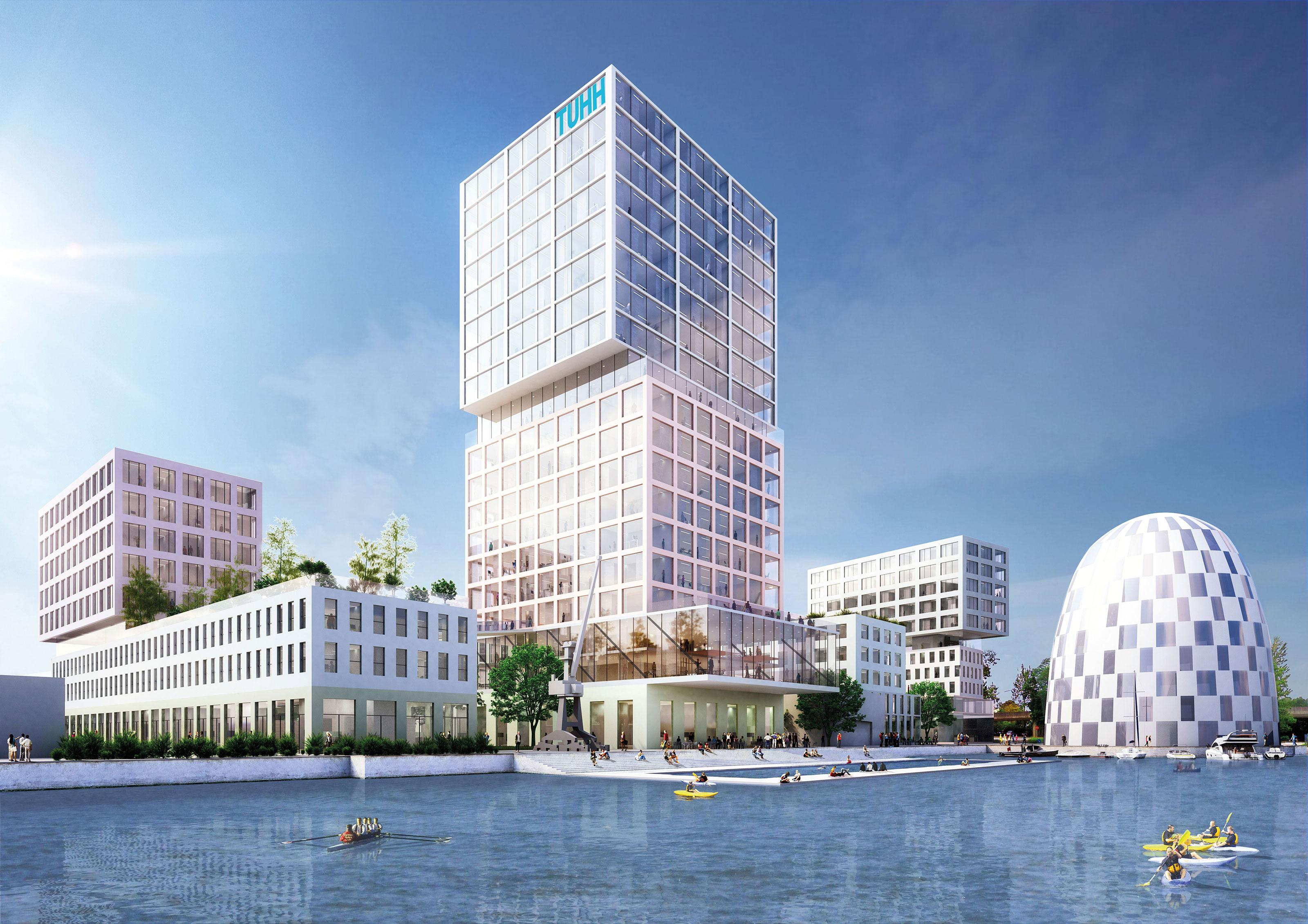
The institute is located in the newly built Hamburg Innovation Port
(www.hamburg-innovation-port.com/wp-content/uploads/2018/09/01-HIPtuhhlogowasser_web.jpg),
which is located right at the Harburg harbour with great views of the
harbour and Hamburg's famous opera house (Elbphilharmonie). Several
other computer science institutes of the TU Hamburg are located in the
area, as well as DASHH - Data Science in Hamburg, the Helmholtz Graduate
School for the Structure of Matter, and the German Air and Space
Research Center (DLR). They are all located in the Free and Hanseatic
City of Hamburg, which is Germany's second largest city, home to a
population of about 1.8 million people. The city is famous for its wide
offers of entertainment, culture and attractions, with several
universities and much research in algorithms.

Hamburg University of Technology (TUHH) is one of the leading technical
universities in Germany, with almost 10,000 students in various
engineering subjects. It is part of Germany's national Strategy of
Excellence. Its goal is to develop Technology for Humanity. For its
staff, it offers several attractive benefits, including a sports centre
on campus, family-friendly working hours, healthy campus initiatives,
and German classes for internationals.

An excellent Masters degree --- either already obtained or to be
completed soon --- in (Applied) Mathematics, Computer Science,
Operations Research, Engineering or related field is required. Affinity
with optimization, algorithms, or discrete mathematics is preferred. In
particular, background in algorithms and complexity, or mathematical
optimization is appreciated. Programming experience is considered a plus.

Interested individuals should submit their applications by 8 June 2025.
For a full job description and details on how to apply see
https://www.tuhh.de/algo/jobs/phd-positions.

Hamburg University of Technology regards diversity as an integral part
of academic excellence and is committed to employment equity and
accessibility for all employees. As such, we encourage applications from
women, persons with disabilities, members of diverse gender identities,
and others who may contribute to the further diversification of ideas.
In Hamburg, you will have the opportunity to work across disciplines and
collaborate with an international community of scholars and a diverse
student body.

**********************************************************
*
* Contributions to be spread via DMANET are submitted to
*
* DMANET@zpr.uni-koeln.de
*
* Replies to a message carried on DMANET should NOT be
* addressed to DMANET but to the original sender. The
* original sender, however, is invited to prepare an
* update of the replies received and to communicate it
* via DMANET.
*
* DISCRETE MATHEMATICS AND ALGORITHMS NETWORK (DMANET)
* http://www.zaik.uni-koeln.de/AFS/publications/dmanet/
*
**********************************************************

Sunday, May 25, 2025

[DMANET] GWP 2025: Call for Participation

GWP 2025 - Graph Width Parameters: from Structure to Algorithms
Satellite Workshop of ICALP 2025
https://homepages.ecs.vuw.ac.nz/~bretteni/GWP2025
Monday 7 July 2025

Registration: https://conferences.au.dk/icalp2025/registration

GWP 2025 is a one-day workshop on graph width parameters and algorithms.

Invited Speakers:
Lars Jaffke, NHH Norwegian School of Economics, Norway.
William Lochet, LIRMM, France.
Marcin Pilipczuk, University of Warsaw, Poland.
Igor Razgon, Durham University, United Kingdom.
Uéverton Souza, Universidade Federal Fluminense, Brazil.
Meirav Zehavi, Ben-Gurion University of the Negev, Israel

For the final session of the workshop, we invite short presentations that highlight an open problem or potential area for future research. If you wish to have a 15-minute slot in our workshop, please send an email with a title and short description to andrea.munaro@unipr.it by Monday 30 June 2025. Note that the review of contributions may close earlier if the session is filled.

Organisers:
Flavia Bonomo (University of Buenos Aires)
Nick Brettell (Victoria University of Wellington)
Andrea Munaro (University of Parma)
Daniel Paulusma (Durham University)


**********************************************************
*
* Contributions to be spread via DMANET are submitted to
*
* DMANET@zpr.uni-koeln.de
*
* Replies to a message carried on DMANET should NOT be
* addressed to DMANET but to the original sender. The
* original sender, however, is invited to prepare an
* update of the replies received and to communicate it
* via DMANET.
*
* DISCRETE MATHEMATICS AND ALGORITHMS NETWORK (DMANET)
* http://www.zaik.uni-koeln.de/AFS/publications/dmanet/
*
**********************************************************

[DMANET] two postdoc offers in computational biology and physics-informed AI in Montpellier, France

Dear All,

Our team based in Montpellier, France, is currently recruiting two
postdoctoral researchers to contribute to innovative research projects
in computational biology and physics-informed artificial intelligence,
with applications in health and biomedical sciences.

https://systems-biology-lphi.cnrs.fr/postdoc-offers/

We would be grateful if you could kindly help disseminate this
announcement widely.

Kind regards,

Ovidiu Radulescu


--
Prof. Ovidiu Radulescu
University of Montpellier
Laboratory of Pathogens and Host Immunity
Leader, Computational Systems Biology team
------------------------------------------------------------------------
LPHI - UMR 5294 CNRS/UM/INSERM Phone: +33-(0)4-6714-9221
Pl. E. Bataillon - Bat. 24 Fax: +33-(0)4-6714-4286
Université de Montpellier email:ovidiu.radulescu@umontpellier.fr
CP 107
34095 Montpellier Cedex 5
FRANCE

**********************************************************
*
* Contributions to be spread via DMANET are submitted to
*
* DMANET@zpr.uni-koeln.de
*
* Replies to a message carried on DMANET should NOT be
* addressed to DMANET but to the original sender. The
* original sender, however, is invited to prepare an
* update of the replies received and to communicate it
* via DMANET.
*
* DISCRETE MATHEMATICS AND ALGORITHMS NETWORK (DMANET)
* http://www.zaik.uni-koeln.de/AFS/publications/dmanet/
*
**********************************************************

[DMANET] GACLM 2025 (Co-Sponsored by IEEE): Generative AI and Computational Language Modelling Conference, 18-21 August, 2025 | Valencia, Spain

[Apologies if you got multiple copies of this invitation]

The 2nd International Generative AI and Computational Language Modelling
Conference (GACLM 2025)


https://gaclm.org/2025/


18-21 August, 2025 | Valencia, Spain


Hybrid Event

Technically Co-Sponsored by IEEE Spain Section

*GACLM 2025 CFP:*

With the emergence of Generative AI (GenAI), the world is experiencing a
new era of generative models producing various types of data, including
textual and visual data. This is accompanied by the unprecedented
advancement of Computational Language Modeling (CLM) techniques that are
supporting a wide range of downstream applications. Both Generative AI and
Computational Language Modeling are leading the paradigm shift we are
witnessing in Artificial Intelligence.

The International Generative AI and Computational Language Modeling
Conference (GACLM 2025) addresses the architectures, applications,
challenges, approaches, and future directions of this new era of Artificial
Intelligence systems based on GenAI and CLM. We invite the submission of
original papers on all topics related to GACLM, with special interest in,
but not limited to, the following:

- Human-Centered Generative AI
- Natural Language Processing (NLP)
- Large Language Models (LLMs)
- Text generation, summarization, and question answering
- Sentiment analysis, misinformation detection, and emotion detection
- Machine translation and multilingual models
- Language comprehension, grammar and style checking, and complex
reasoning
- Document processing and information retrieval
- Computer-Assisted Language Learning
- Adversarial machine learning and applications
- Generative adversarial networks (GANs)
- GenAI and diffusion models
- Federated and distributed learning for GenAI
- Fine-tuning and retrieval-augmented generation (RAG)
- Synthetic data generation and data augmentation
- Explainable AI (XAI) and trustworthy AI systems
- GenAI in healthcare, education, robotics, and smart cities
- GenAI for cybersecurity and Internet of Things (IoT) systems
- GenAI for sustainability and human good
- Computer vision, creative applications, and video generation
- GenAI ethics and governance

*Submissions Guidelines and Proceedings*

Manuscripts should be prepared in 10-point font using the IEEE 8.5" x 11"
two-column format. All papers should be in PDF format, and submitted
electronically at Paper Submission Link. A full paper can be up to 8 pages
(including all figures, tables and references). Submitted papers must
present original unpublished research that is not currently under review
for any other conference or journal. Papers not following these guidelines
may be rejected without review. Also submissions received after the due
date, exceeding length limit, or not appropriately structured may also not
be considered. Authors may contact the Program Chair for further
information or clarification. All submissions are peer-reviewed by at least
three reviewers. Accepted papers will appear in the GACLM Proceeding, and
be published by the IEEE Computer Society Conference Publishing Services
and be submitted to IEEE Xplore for inclusion.

Submitted papers must include original work, and must not be under
consideration for another conference or journal. Submission of regular
papers must follow the IEEE paper format. And include up to 7 keywords.
Authors of accepted papers are expected to present their work at the
conference. Submitted papers that are deemed of good quality but that could
not be accepted as regular papers will be accepted as short papers. Length
of short papers can be up to 6 pages.

*Important Dates:*

- *Paper submission deadline: June 15th 2025 (Extended)*
- Notification of acceptance: July 15th, 2025
- Camera-ready Submission: July 31th, 2025

*Contact:*

Please send any inquiry on GACLM to: info@gaclm.org

**********************************************************
*
* Contributions to be spread via DMANET are submitted to
*
* DMANET@zpr.uni-koeln.de
*
* Replies to a message carried on DMANET should NOT be
* addressed to DMANET but to the original sender. The
* original sender, however, is invited to prepare an
* update of the replies received and to communicate it
* via DMANET.
*
* DISCRETE MATHEMATICS AND ALGORITHMS NETWORK (DMANET)
* http://www.zaik.uni-koeln.de/AFS/publications/dmanet/
*
**********************************************************

Saturday, May 24, 2025

[DMANET] 45th JFRO - Coloring

Dear all,

We are pleased to announce that the 45th Ile-de-France Operation Research Day
(JFRO) will take place on Wednesday, June 4, 2025, and will focus on the theme:

GRAPH COLORING

The event will be held at Université Paris Dauphine, room B. Pl. du Maréchal de Lattre de Tassigny, 75016 Paris.

The day will begin with a tutorial by Pierre Charbit from IRIF. Following that, scientific presentations will be given by:
Pierre Aboulker, ENS
      Thomas Bellitto, LIP6
      Ararat Harutyunyan, LAMSADE
      Michael Lampis, LAMSADE


A detailed program will soon be available on the JFRO website: https://roadef.org/jfro/.
Participation is free and open to all. However, registration is required: please complete the online form using the link above.

We particularly encourage PhD students to participate.

For any questions regarding the event, feel free to contact us at: jfro@framalistes.org.

Best regards,

The JFRO Organizing Committee
Nawal Benabbou (LIP6)
Diego Delle Donne (ESSEC Business School)
Emiliano Lancini (LAMSADE)
Alessandro Maddaloni (SAMOVAR)

**********************************************************
*
* Contributions to be spread via DMANET are submitted to
*
* DMANET@zpr.uni-koeln.de
*
* Replies to a message carried on DMANET should NOT be
* addressed to DMANET but to the original sender. The
* original sender, however, is invited to prepare an
* update of the replies received and to communicate it
* via DMANET.
*
* DISCRETE MATHEMATICS AND ALGORITHMS NETWORK (DMANET)
* http://www.zaik.uni-koeln.de/AFS/publications/dmanet/
*
**********************************************************

[DMANET] DeepLearn 2025: early registration June 17

******************************************************

12th INTERNATIONAL SCHOOL ON DEEP LEARNING
(with a special focus on Large Language Models, Foundation Models and Generative AI)

DeepLearn 2025

Porto – Maia, Portugal

July 21-25, 2025

https://deeplearn.irdta.eu/2025/

******************************************************

Co-organized by:

University of Maia

Institute for Research Development, Training and Advice – IRDTA
Brussels/London

******************************************************

Early registration: June 17, 2025

******************************************************

SCOPE:

DeepLearn 2025 will be a research training event with a global scope aiming at updating participants on the most recent advances in the critical and fast developing area of deep learning. Previous events were held in Bilbao, Genova, Warsaw, Las Palmas de Gran Canaria, Guimarães, Las Palmas de Gran Canaria, Luleå, Bournemouth, Bari, Las Palmas de Gran Canaria and Porto.

Deep learning is a branch of artificial intelligence covering a spectrum of current frontier research and industrial innovation that provides more efficient algorithms to deal with large-scale data in a huge variety of environments: computer vision, neurosciences, speech recognition, language processing, human-computer interaction, drug discovery, biomedicine and health informatics, medical image analysis, recommender systems, advertising, fraud detection, robotics, games, business and finance, biotechnology, physics experiments, biometrics, communications, climate sciences, geographic information systems, signal processing, genomics, materials design, video technology, social systems, earth and sustainability, etc. etc.

The field is also raising a number of relevant questions about robustness of the algorithms, explainability, transparency, interpretability, as well as important ethical concerns at the frontier of current knowledge that deserve careful multidisciplinary discussion.

Most deep learning subareas will be displayed, and main challenges identified through 18 four-hour and a half courses, 2 keynote lectures, 1 round table and a hackathon competition among participants. Renowned academics and industry pioneers will lecture and share their views with the audience. The organizers are convinced that outstanding speakers will attract the brightest and most motivated students. Face to face interaction and networking will be main ingredients of the event. It will be also possible to fully participate in vivo remotely.

DeepLearn 2025 will place special emphasis on large language models, foundation models and generative artificial intelligence.

ADDRESSED TO:

Graduate students, postgraduate students and industry practitioners will be typical profiles of participants. However, there are no formal pre-requisites for attendance in terms of academic degrees, so people less or more advanced in their career will be welcome as well.

Since there will be a variety of levels, specific knowledge background may be assumed for some of the courses.

Overall, DeepLearn 2025 is addressed to students, researchers and practitioners who want to keep themselves updated about recent developments and future trends. All will surely find it fruitful to listen to and discuss with major researchers, industry leaders and innovators.

VENUE:

DeepLearn 2025 will take place in Porto, the second largest city in Portugal, recognized by UNESCO in 1996 as a World Heritage Site. The venue will be:

University of Maia
Avenida Carlos de Oliveira Campos - Castêlo da Maia
4475-690 Maia
Porto, Portugal

https://www.umaia.pt/en

STRUCTURE:

3 courses will run in parallel during the whole event. Participants will be able to freely choose the courses they wish to attend as well as to move from one to another.

All lectures will be videorecorded. Participants will be able to watch them again for 45 days after the event.

An open session will give participants the opportunity to present their own work in progress in 5 minutes. Also companies will be able to present their technical developments for 10 minutes.

The school will include a hackathon, where participants will be able to work in teams to tackle several machine learning challenges.

Full live online participation will be possible. The organizers highlight, however, the importance of face to face interaction and networking in this kind of research training event.

KEYNOTE SPEAKERS:

Yonina Eldar (Weizmann institute of Science), Model Based Deep Learning: Applications to Imaging and Communications

Manuela Veloso (JPMorganChase), The Journey of Humans and AI: Insights from AI in Robotics and AI in Finance

PROFESSORS AND COURSES:

Pierre Baldi (University of California Irvine), [intermediate/advanced] From Deep Learning and Transformers to AI Risks and Safety

Sean Benson (Amsterdam University Medical Center), [intermediate] Digital Twins and Generative AI for Personalised Medicine

Xavier Bresson (National University of Singapore), [intermediate/advanced] Graph Transformers, Graph Generative Models and Large Language Models

Nello Cristianini (University of Bath), [introductory] Machina Sapiens - Towards More General Forms of AI

Mark Derdzinski (Dexcom), [introductory] From Prototype to Production: Evaluation Strategies for Agentic Applications

Samira Ebrahimi Kahou (University of Calgary), [intermediate/advanced] Explainability in Machine Learning

Elena Giusarma (Michigan Technological University), [introductory/intermediate] Machine Learning at the Frontier of Astrophysics: Simulating the Universe

Shih-Chieh Hsu (University of Washington), [intermediate/advanced] Real-Time Artificial Intelligence for Science and Engineering

Xia "Ben" Hu (Rice University), [introductory/advanced] Efficient LLM Serving: Algorithms and Systems

Lu Jiang (ByteDance & Carnegie Mellon University), [introductory/intermediate] Transformers for Image and Video Generation: Fundamentals, Design, and Innovations

Jayashree Kalpathy-Cramer (University of Colorado), [introductory/intermediate] Multimodal AI for Healthcare

Yingbin Liang (Ohio State University), [intermediate/advanced] Theory on Training Dynamics of Transformers

Chen Change Loy (Nanyang Technological University), [intermediate/advanced] Harnessing Prior for Content Enhancement and Creation

Fenglong Ma (Pennsylvania State University) & Cao (Danica) Xiao (GE HealthCare), [introductory/intermediate] Transforming Healthcare and Drug Development through Multimodal AI with LLMs and Generative AI Technologies

Evan Shelhamer (DeepMind), [intermediate] Test-Time Adaptation for Updating on New and Different Data

Atlas Wang (University of Texas Austin), [intermediate] Low Rank Strikes Back in the Era of Large Language Models

Xiang Wang (University of Science and Technology of China), [advanced] Large Language Models for User Behavior Modeling: Cross-Modal Interpretation, Preference Optimization, and Agentic Simulation

Rex Ying (Yale University), [intermediate/advanced] Multimodal Foundation Models for Graph-Structured Data: Framework and Scientific Applications

OPEN SESSION:

An open session will collect 5-minute voluntary oral presentations of work in progress by participants.

They should submit a half-page abstract containing the title, authors, and summary of the research to david@irdta.eu by July 13, 2025.

INDUSTRIAL SESSION:

A session will be devoted to 10-minute demonstrations of practical applications of deep learning in industry.

Companies interested in contributing are welcome to submit a 1-page abstract containing the program of the demonstration and the logistics needed. People in charge of the demonstration must register for the event.

Expressions of interest have to be submitted to david@irdta.eu by July 13, 2025.

HACKATHON:

A hackathon will take place, where participants can work in teams to tackle several machine learning challenges. They will be coordinated by Professor Sergei V. Gleyzer (University of Alabama). The challenges will be released 2 weeks before the beginning of the school. A jury will judge the submissions and the winners of each challenge will be announced by August 25, 2025. The winning teams will receive a modest monetary prize and the runners-up will get a certificate.

SPONSORS:

Companies/institutions/organizations willing to be sponsors of the event can download the sponsorship leaflet from

https://deeplearn.irdta.eu/2025/sponsors/

ORGANIZING COMMITTEE:

Samuel Anjos (Maia, social networks)
Sergei V. Gleyzer (Tuscaloosa, hackathon chair)
José Paulo Marques dos Santos (Maia, local chair)
Carlos Martín-Vide (Tarragona, program chair)
Santiago Montes (Tarragona, webpage)
Sara Morales (Brussels)
José Luís Reis (Maia)
Luís Paulo Reis (Porto)
David Silva (London, organization chair)

REGISTRATION:

It has to be done at

https://deeplearn.irdta.eu/2025/registration/

The selection of 6 courses requested in the registration template is only tentative and non-binding. For logistical reasons, it will be helpful to have an estimation of the respective demand for each course.

Since the capacity of the venue is limited, registration requests will be processed on a first come first served basis. The registration period will be closed and the on-line registration tool disabled when the capacity of the venue will have got exhausted. It is highly recommended to register prior to the event.

FEES:

Fees comprise access to all program activities and lunches.

There are several early registration deadlines. Fees depend on the registration deadline.

The fees for on site and for online participation are the same.

ACCOMMODATION:

Accommodation suggestions are available at

https://deeplearn.irdta.eu/2025/accommodation/

CERTIFICATE:

A certificate of successful participation in the event will be delivered indicating the number of hours of academic activities. This should be sufficient for those participants who plan to request ECTS recognition from their home university.

QUESTIONS AND FURTHER INFORMATION:

david@irdta.eu

ACKNOWLEDGMENTS:

Universidade da Maia

Universidade do Porto

Universitat Rovira i Virgili

Institute for Research Development, Training and Advice – IRDTA, Brussels/London
**********************************************************
*
* Contributions to be spread via DMANET are submitted to
*
* DMANET@zpr.uni-koeln.de
*
* Replies to a message carried on DMANET should NOT be
* addressed to DMANET but to the original sender. The
* original sender, however, is invited to prepare an
* update of the replies received and to communicate it
* via DMANET.
*
* DISCRETE MATHEMATICS AND ALGORITHMS NETWORK (DMANET)
* http://www.zaik.uni-koeln.de/AFS/publications/dmanet/
*
**********************************************************

Friday, May 23, 2025

[DMANET] IEEE IPCCC 2025 CALL FOR PAPERS

*CALL FOR PAPERS*
------------------------------

44th IEEE International Performance, Computing and Communications
Conference (IPCCC)
https://ipccc.org
November 21st - 23rd, 2025
Austin, Texas, USA
Hotel Viata, 320 S. Capital of Texas Hwy, West Lake Hills, Texas 78746
------------------------------

The International Performance, Computing, and Communications Conference is
a premier conference presenting research in the performance of computer and
communication systems. For over four decades, IPCCC has been a research
forum for academic, industrial, and government researchers. We encourage
submission of high-quality papers reporting original work in both
theoretical and experimental research areas. IPCCC will again be
utilizing *IEEE
Open Preview* to allow the conference proceedings to be available in the *IEEE
Xplore® Digital Library* and conference mobile app (if applicable), free of
charge to all IEEE Xplore® customers, prior to the conference start date.
This usage of IEEE Open Preview will be contingent on receiving the final
manuscripts on time to enable this option.
SUBMISSION GUIDELINES

All papers should be submitted at https://edas.info/N33767. The following
types of papers are accepted:

- *Regular Paper:* 8 pages without extra charge, and up to 2 extra pages
at $100 per extra page.
- *Short Paper:* 6 pages without extra charge, and up to 1 extra page at
$100 per extra page.
- *Poster Abstract Paper:* 2 pages. No extra pages are available.
Posters are encouraged from students to present their work in progress as a
poster at the conference.
- *All papers are required to be presented in-person at the
conference,* however
under extenuating circumstances, IPCCC will also allow some papers to be
presented virtually. Please refer to www.ipccc.org for guidelines.
------------------------------
HOT TOPICS FOR IPCCC 2025Topics of interest include, but are not limited
to:

- Cloud Computing and Data Centers
- Serverless Computing & Microservices
- Edge & Fog Computing
- Pervasive/Mobile Computing
- High Performance Computing
- Workload Characterization
- Systems and Networking for AI
- 5G/6G/NextG Networks
- Wireless Communication and Networks
- Mobility Management and Modeling
- Smart and Mobile Applications
- Localization, Positioning, and Tracking
- Smart Sensing
- Software Defined Networking
- Internet and Network Management
- Network Design and Protocols
- Information Centric Networking
- Performance Evaluation and Modeling
- Network Measurement
- Sustainable Systems and Networking
- Emerging Computing and Networks
- Metaverse
- Augmented/Virtual/Mixed Reality
- Digital Twins
- Mobile AI and LLM
- Quantum Computing and Networking
- Internet of Things
- Cyber Physical Systems
- Parallel and Distributed Systems
- Embedded Systems
- Computer and Storage Systems
- Smart Grid
- Crowdsourcing Systems
- Intelligent Mission Critical Operations
- Smart Health Systems, Wearable, and Implantable Systems
- Social Network Analysis
- Security and Privacy
- Network Information Assurance and Security
- Blockchain, Distributed Ledger,Decentralized Trust
- Fundamental Theory and Algorithms
- Machine Learning and AI for Systems and Networking
------------------------------
CONFERENCE ID:IEEE : 66453
------------------------------
LOCATION:Austin, Texas, USA
------------------------------
IMPORTANT DATES
Paper Abstract Due: July 1st, 2025
All Paper/Poster Submissions Due: July 7th, 2025
Acceptance Notification: August 20th, 2025
Camera Ready "Final Manuscript" Due: September 15th, 2025
Virtual Conference Day: November 15th, 2025
In-person Conference Date: November 21st-23rd, 2025


**********************************************************
*
* Contributions to be spread via DMANET are submitted to
*
* DMANET@zpr.uni-koeln.de
*
* Replies to a message carried on DMANET should NOT be
* addressed to DMANET but to the original sender. The
* original sender, however, is invited to prepare an
* update of the replies received and to communicate it
* via DMANET.
*
* DISCRETE MATHEMATICS AND ALGORITHMS NETWORK (DMANET)
* http://www.zaik.uni-koeln.de/AFS/publications/dmanet/
*
**********************************************************

[DMANET] Workshop on Online Learning and Economics @EC 2025 - Call for Posters

—————————————————————————

—————————————————————————

Call for Posters: Workshop on Online Learning and Economics (OLE 2025) @EC
2025

—————————————————————————

—————————————————————————

We invite submissions to the first Workshop on Online Learning and
Economics (OLE 2025), which will be co-located with ACM EC 2025 in
Stanford, CA, USA, on July 10th, 2025.

Important Dates (All times are 11:59 PM AoE)

* Submission Deadline: June 6, 2025

* Notification of Acceptance: June 9, 2025

* Workshop Date: July 10, 2025

—————————————————————————

OLE 2025 aims to provide a venue for researchers to explore and discuss
recent trends in topics at the intersection of online learning and
economics. We welcome submissions that explore this space along various
directions, including (but not limited to):

-

Learning in repeated auctions
-

Learning for pricing and bilateral trade
-

Learning in mechanism/contract/information design
-

Learning in markets
-

No-regret learning and convergence to equilibria


For more information, we refer to the EC <https://ec25.sigecom.org/> and
the workshop <https://sites.google.com/view/ole-2025/home-page> websites:

-

https://ec25.sigecom.org/
-

https://sites.google.com/view/ole-2025/home-page

—————————————————————————

Submission Guidelines

* Submissions should be made via https://ole2025.hotcrp.com/

* The preferred format is a 2-page abstract. Longer submissions are
welcome, but only the first two pages are guaranteed to be reviewed.

* Submissions will be evaluated based on relevance to the workshop,
academic quality, and potential impact.

This is a non-archival workshop. We encourage the submission of work that
has been recently published, is under review, or is in progress. We also
encourage submissions of papers accepted at EC 25. Submissions need not be
anonymized, and authors are encouraged to point to extended versions of
their submissions available on public repositories.

—————————————————————————

Presentation Format

Authors of accepted submissions will be invited to present their work
during a poster session at the workshop.

—————————————————————————
**********************************************************
*
* Contributions to be spread via DMANET are submitted to
*
* DMANET@zpr.uni-koeln.de
*
* Replies to a message carried on DMANET should NOT be
* addressed to DMANET but to the original sender. The
* original sender, however, is invited to prepare an
* update of the replies received and to communicate it
* via DMANET.
*
* DISCRETE MATHEMATICS AND ALGORITHMS NETWORK (DMANET)
* http://www.zaik.uni-koeln.de/AFS/publications/dmanet/
*
**********************************************************

[DMANET] Workshop: Mechanisation and Mathematical Research

Dear all,

We are organising a workshop "Mechanisation and Mathematical Research" at the Lorentz Center in Leiden, from 15 to 19 September 2025.

In this event, we want to reflect on how developments in formalized mathematics and AI for theorem proving may change the practice of mathematical research. We have an exciting group of experts from computer science, mathematics, history, and philosophy lined up. Confirmed participants:

Jarod Alper (U Washington), Jeremy Avigad (Carnegie Mellon), Michael Barany (Edinburgh), Kevin Buzzard (Imperial College), Antoine Chambert-Loir (Paris Cité), Thierry Coquand (Gothenburg), Silvia De Toffoli (Pavia), Walter Dean (Warwick), Simon DeDeo (Carnegie Mellon), Stephanie Dick (Simon Fraser), Robbert Dijkgraaf (U Amsterdam), Catarina Dutilh Novaes (VU Amsterdam), Timothy Gowers (Collège de France), Massimiliano Gubinelli (Oxford), Thomas Hubert (Google DeepMind), Albert Jiang (Mistral AI), Bryna Kra (Northwestern), Wenda Li (Edinburgh), Heather Macbeth (Imperial College), Jim Portegies (TU/Eindhoven), Talia Ringer (U Illinois), Ronald van Luijk (Leiden), Jan van Neerven (TU Delft).

There is still room for 25-30 additional participants, and we invite everyone how is interested in reflecting on the mathematical practice to apply to participate. Junior mathematicians in particular are strongly encouraged to apply (and we have some limited financial support for junior participants). Deadline is June 9.

For more information and to apply: https://www.lorentzcenter.nl/mechanization-and-mathematical-research.html

Feel free to forward this message to potentially interested participants.

The organisers,
Johan Commelin, Mateja Jamnik, Rodrigo Ochigame, Lenny Taelman, Akshay Venkatesh

PS. Apologies for the somewhat off-topic announcement, and for multiple postings...

**********************************************************
*
* Contributions to be spread via DMANET are submitted to
*
* DMANET@zpr.uni-koeln.de
*
* Replies to a message carried on DMANET should NOT be
* addressed to DMANET but to the original sender. The
* original sender, however, is invited to prepare an
* update of the replies received and to communicate it
* via DMANET.
*
* DISCRETE MATHEMATICS AND ALGORITHMS NETWORK (DMANET)
* http://www.zaik.uni-koeln.de/AFS/publications/dmanet/
*
**********************************************************

[DMANET] CFP: 9th Cyber Security in Networking Conference (CSNet 2025)- Abu Dhabi, UAE, October 20 - 22, 2025

[Apologies if you got multiple copies of this Call For Papers]

*********************************************************************

CALL FOR PAPERS

CSNet 2025

9th Cyber Security in Networking Conference


October 20 - 22, 2025 // Abu Dhabi, UAE

https://csnet-conference.org/2025/


*********************************************************************


Authors of the best papers will be invited to submit an extended version in
Annals of Telecommunications, a Springer Journal

Full and short paper submissions deadline: June 15, 2025

CSNet 2025 is technically sponsored by IEEE and IEEE ComSoc

All accepted and presented papers will be submitted for publication to IEEE
Xplore


👉 Submission link: https://edas.info/N33530

On behalf of the CSNet 2025 Committee, we are pleased to welcome you all to
its 8th edition from October 20 to 22, hosted in the wonderful city of Abu
Dhabi, UAE.

Since the first successful edition in Rio de Janeiro, Brazil (2017), and
subsequent editions in Paris (2018), Quito (2019), Lausanne (2020), Abu
Dhabi (2021), Rio de Janeiro (2022), Montreal (2023) and Paris (2024), the
CSNet conference has aimed to bring future visions for creating even
greater value to all corners of the cybersecurity research society.

This year, CSNet 2025 will center around the "GenAI and Cybersecurity"
theme, encompassing both AI for Cybersecurity and Cybersecurity for AI. The
theme highlights the challenges and opportunities of AI in reinforcing
security and privacy within traditional cybersecurity domains such as cloud
computing and cryptography. The integration of GenAI into cybersecurity
represents a pivotal advancement with the potential to revolutionize how we
protect and secure digital infrastructure.


AI has shown remarkable capabilities in automating and enhancing various
aspects of cybersecurity. From predictive analytics that anticipate cyber
threats to intelligent systems that detect and mitigate attacks in real
time, AI-driven solutions are becoming indispensable. These technologies
improve the efficiency and effectiveness of security measures and adapt to
the evolving threat landscape, providing robust defense mechanisms against
increasingly sophisticated cyberattacks.

Like any other tool or system, AI introduces its own security threats,
which require the development of new security mechanisms to address them.
For instance, prompt injection attacks raise important challenges for Large
Language Models (LLMs), which are increasingly integrated into various
applications in daily life.

Combining researchers and industry professionals at CSNet 2025 allows to
forge new pathways and develop comprehensive solutions addressing topics
related to AI and cybersecurity.

CSNet 2025 seeks contributions in full papers, short papers, posters,
demos, work-in-progress papers, and tutorials. We are particularly
interested in innovative solutions and breakthrough ideas that can shape
the future landscape of cybersecurity.

Authors are welcome to submit original papers that have not been published
or simultaneously submitted to another venue with topics that include but
are not limited to:

AI-Driven Security and Threat Management

-

AI for cybersecurity: challenges, opportunities, and threats.
-

AI-based security monitoring, anomaly detection, intrusion prevention,
and response.
-

Adversarial machine learning, secure AI model training, and adversarial
mitigation.
-

AI for cyber resilience, incident response, and threat hunting.
-

AI-powered threat modeling, risk assessment, and automation.
-

Large Language Model (LLM)-based anomaly and malware detection.
-

AI for blockchain, IoT, and fog/edge computing security.
-

Reinforcement learning and federated learning in security.
-

Security for AI Systems (GenAI, Agentic, etc.)

Privacy and Ethical AI

-

Privacy risks, preservation techniques, and AI for surveillance.
-

Ethical and regulatory considerations in AI-based security.
-

Secure federated learning and data protection.

Emerging Technologies and Infrastructure Security

-

Cybersecurity for smart cities, grids, IoT, and cyber-physical systems.
-

Blockchain, decentralized security, and secure cloud computing.
-

Network infrastructure security, resilient systems, and secure protocols.
-

DoS attacks, wireless security, and cryptographic key management.

Networking in the GenAI Era

-

GenAI for Network Traffic Analysis and Threat Detection
-

AI-Augmented Network Protocol Security
-

Edge and Fog Computing Security with Lightweight AI
-

Adversarial Attacks and Defenses for Networked AI Systems
-

Privacy-Preserving AI Techniques for Network Data
-

AI-Driven Network Forensics and Incident Response


Submitted papers should address novel challenges or industrial and standard
aspects of key technologies for sustainable and intelligent AI
cybersecurity solutions.

************************************************************************

Submission Guidelines:

Submitted papers must represent original material that is not currently
under review in any other conference or journal and has not been previously
published.

All submissions should be written in English with a maximum of eight (8)
printed pages (in Two-Column IEEE Conference Format), including text,
figures, and references for full papers, and with a maximum of four (4)
printed pages for short papers.


Papers should be submitted through EDAS at https://edas.info/N33530

Best papers will be considered for fast-track publication in the Annals of
Telecommunications (Springer, ISI-indexed)

***************************************************************************

Important Dates:

-

Full and short paper submissions deadline: June 15, 2025
-

Notifications of acceptance: July 15, 2025
-

Camera-ready submissions: July 25, 2025

***************************************************************************

TPC Chairs:

-

Martin Andreoni, TII/Khalifa University, UAE
-

Nour El Madhoun, Isep, France


-

Richard Ikuesan, Zayed University, Abu Dhabi, UAE

General Chairs:

-

Ahmad Samer Wazan, Zayed University
-

Maryline Laurent, Telecom Suparis

Details: https://csnet-conference.org/2025

Looking forward to your submissions!

**********************************************************
*
* Contributions to be spread via DMANET are submitted to
*
* DMANET@zpr.uni-koeln.de
*
* Replies to a message carried on DMANET should NOT be
* addressed to DMANET but to the original sender. The
* original sender, however, is invited to prepare an
* update of the replies received and to communicate it
* via DMANET.
*
* DISCRETE MATHEMATICS AND ALGORITHMS NETWORK (DMANET)
* http://www.zaik.uni-koeln.de/AFS/publications/dmanet/
*
**********************************************************

[DMANET] 12 PhD positions in Mathematics at Wrocław Tech

The Faculty of Pure and Applied Mathematics at Wrocław University of
Science and Technology is one of Poland's leading centres for mathematical
research. We cover a broad spectrum of topics—from foundational
mathematics, via stochastics, to cutting-edge applications in science,
technology, and industry. We invite ambitious candidates to join our
Doctoral School in Mathematics and carry out high-level research under the
guidance of internationally recognized experts.

Number of Positions:
12 PhD positions available in the 2025/2026 cycle

Key Benefits:
Tuition-free programme for all PhD students
Monthly net scholarship:
— 3,905 PLN during the first two years
— 4,872 PLN after the midterm evaluation
More details: https://szd.pwr.edu.pl/en/for-candidates/scholarships

How to Apply:
Review the admission procedure:
https://szd.pwr.edu.pl/en/for-candidates/admission-procedure

Select a supervisor from the list of faculty members:
https://raporty.szd.pwr.edu.pl/baza-promotorow/?scientific_discipline=9&per_page=100

Application deadline: 3 June 2025

Need Assistance?
If you have additional questions or need guidance, feel free to contact us
at k96jobs@pwr.edu.pl. In that case, please include:
Your CV
A summary of your scientific activity
A brief description of your research interests

We look forward to welcoming you to our vibrant research community in
Wrocław!

With regards,
Krzysztof Bogdan

**********************************************************
*
* Contributions to be spread via DMANET are submitted to
*
* DMANET@zpr.uni-koeln.de
*
* Replies to a message carried on DMANET should NOT be
* addressed to DMANET but to the original sender. The
* original sender, however, is invited to prepare an
* update of the replies received and to communicate it
* via DMANET.
*
* DISCRETE MATHEMATICS AND ALGORITHMS NETWORK (DMANET)
* http://www.zaik.uni-koeln.de/AFS/publications/dmanet/
*
**********************************************************

Thursday, May 22, 2025

[DMANET] Wissenschaftliche/r Mitarbeiter/in - Mathematische Optimierung in Siegen

Die Universität Siegen ist eine interdisziplinär ausgerichtete und
weltoffene Universität mit aktuell rund 14.000 Studierenden und einem
Fächerspektrum von den Geistes-, Sozial- und Wirtschaftswissenschaften
bis hin zu Natur-, Ingenieur- und Lebenswissenschaften. Mit über 2.000
Beschäftigten zählen wir zu den größten Arbeitgebern der Region und
bieten ein einzigartiges Umfeld für Lehre, Forschung und Weiterbildung.

In der Fakultät IV - Naturwissenschaftlich-Technische Fakultät,
Mathematik, suchen wir eine/n wissenschaftliche/n Mitarbeiter/in zum
01.10.2025 zu folgenden Konditionen:

75% = 29,87 Stunden
Entgeltgruppe 13 TV-L
befristet bis 30.09.2028

Online-Algorithmen finden in Problemen Anwendung, bei denen die
vollständige Eingabe nicht im Voraus bekannt ist. Stattdessen muss der
Algorithmus jeden neuen ankommenden Teil der Eingaben ohne Kenntnisse
über die Zukunft verarbeiten. In der Arbeitsgruppe Mathematische
Optimierung beschäftigen wir uns unter anderem mit der Frage, wie gut
ein Online-Algorithmus im Vergleich zum allwissenden Offline-Algorithmus
sein kann. Unser Ziel ist es, mathematisch fundierte Aussagen über die
Leistungsfähigkeit von Online-Verfahren zu treffen - ein spannendes
Forschungsfeld an der Schnittstelle von Mathematik und Informatik.

Es gibt eine Lehrverpflichtung von 3 Semesterwochenstunden. Weitere
Informationen sind hier zu finden:

https://jobs.uni-siegen.de/job-invite/6619/
**********************************************************
*
* Contributions to be spread via DMANET are submitted to
*
* DMANET@zpr.uni-koeln.de
*
* Replies to a message carried on DMANET should NOT be
* addressed to DMANET but to the original sender. The
* original sender, however, is invited to prepare an
* update of the replies received and to communicate it
* via DMANET.
*
* DISCRETE MATHEMATICS AND ALGORITHMS NETWORK (DMANET)
* http://www.zaik.uni-koeln.de/AFS/publications/dmanet/
*
**********************************************************

[DMANET] Three Postdoc Positions in Computational Social Choice and AI Safety

Dear colleagues,

We have openings for **three postdoc positions** and one **research
assistant position** as part of our research project "[Aggregating
Safety Preferences for AI Systems: A Social Choice
Approach](https://sites.google.com/view/sc4ai/projects/aspai)," funded
by the [Advanced Research + Invention Agency
(ARIA)](https://www.aria.org.uk/). Our project aims to develop and
analyze new methods in computational social choice for eliciting and
aggregating safety specifications for safeguarded AI systems.

**Postdoc positions** are available at:

* University of Warwick (Coventry, UK) with [Markus
Brill](https://www.markus-brill.de/)
* Hasso Plattner Institute (Potsdam, Germany) with [Niclas
Boehmer](https://sites.google.com/view/niclas-boehmer/home)
* University of Groningen (the Netherlands) with [Davide
Grossi](https://davidegrossi.me/)


We seek candidates with a strong background in (computational) social
choice, (algorithmic) game theory, and/or AI safety.

The positions are intended to begin in **October 2025** and are offered
for one year (Warwick and Potsdam) or two years (Groningen). The
application deadline is **June 15th, 2025**.

At Warwick, we're also hiring a **research assistant**. This position,
for which a PhD degree is not required, has an earlier application
deadline of June 1st, 2025.

For position details and application instructions, please visit the
project homepage at https://sites.google.com/view/sc4ai/projects/aspai

Please forward this email to potentially interested candidates.
Interested candidates are encouraged to reach out to express their
interest or ask questions.

Best regards,
Markus Brill, Niclas Boehmer, Paul W. Goldberg, Davide Grossi, Jobst
Heitzig, and Wesley H. Holliday


**********************************************************
*
* Contributions to be spread via DMANET are submitted to
*
* DMANET@zpr.uni-koeln.de
*
* Replies to a message carried on DMANET should NOT be
* addressed to DMANET but to the original sender. The
* original sender, however, is invited to prepare an
* update of the replies received and to communicate it
* via DMANET.
*
* DISCRETE MATHEMATICS AND ALGORITHMS NETWORK (DMANET)
* http://www.zaik.uni-koeln.de/AFS/publications/dmanet/
*
**********************************************************

[DMANET] 2nd International Workshop on Highlights in Organizing and Optimizing Proof-logging Systems (WHOOPS '25)

2nd International Workshop on Highlights in Organizing and Optimizing
Proof-logging Systems (WHOOPS '25)

The */2nd International Workshop on Highlights in Organizing and
Optimizing Proof-logging Systems (WHOOPS '25)/* will be held on
*September 13-14, 2025,* at *Institut Pascal
<https://www.institut-pascal.universite-paris-saclay.fr/> in Orsay* on
the outskirts of Paris in coordination with the /EuroProofNet Workshop
on Automated Reasoning and Proof Logging
<https://europroofnet.github.io/wg2-symposium/>/, which is in turn part
of the /Final EuroProofNet Symposium
<https://europroofnet.github.io/Symposium/>/.

Please note that the *deadline for travel funding applications *is
already *this Sunday May 25! *More information about the workshop can be
found at https://jakobnordstrom.se/WHOOPS25/. Please contact Jakob
Nordström <https://jakobnordstrom.se/> if you wish to contribute a
presentation.


Background and Purpose

Since the turn of the millennium there have been dramatic improvements
in algorithms for combinatorial solving and optimization. The flipside
of this is that as the methods get increasingly sophisticated, it
becomes increasingly harder to avoid bugs sneaking in during algorithm
design and implementation, and even the most mature tools currently
available struggle with incorrect results. Software testing, while
important, has not been sufficient to resolve this problem, and formal
verification methods are far from being able to scale to the level of
complexity in modern combinatorial solvers. During the last ten years
the Boolean satisfiability (SAT) solving community has instead
spearheaded the use of /proof logging/, meaning that the SAT solvers
have to output, along the answer to a problem, a machine-verifiable
proof that this answer is correct. Such solvers are also referred to as
/certifying algorithms/.

For a long time, attempts to extend proof logging to stronger paradigms
in combinatorial solving and optimization have met with limited success,
but has changed in the last few years with the introduction of
/pseudo-Boolean (PB) proof logging/. Pseudo-Boolean proofs operate with
0-1 integer linear inequalities using a version of the cutting planes
proof system, but have turned out to be a very convenient format also
for algorithms that reason in terms of very different concepts. The
/VeriPB <https://gitlab.com/MIAOresearch/software/VeriPB>/ tool
developed by the /Mathematical Insights into Algorithms for Optimization
(MIAO) <https://jakobnordstrom.se/miao-group/>/ research group in
Copenhagen/Lund and its collaborators has so far been shown to support
efficient proof logging for paradigms such as SAT-based optimization
(MaxSAT), pseudo-Boolean optimization, subgraph solving, constraint
programming, automated planning, and presolving techniques in 0-1
integer linear programming, as well as for techniques such as symmetry
breaking and dynamic programming.

These developments have been so fast that in 2024 the fairly spontaneous
idea arose to gather researchers in Europe working on pseudo-Boolean
proof logging to an informal gathering, which—reflecting the rather
improvised nature of the event—was named the /1st Workshop on Highlights
in Organizing and Optimizing Proof-logging Systems (WHOOPS '24)/
<https://jakobnordstrom.se/WHOOPS24/>. This year, the second edition of
the workshop will be held on September 13-14 in Orsay outside Paris
under the auspices of EuroProofNet <http://europroofnet.github.io/>.
While we still expect a healthy dose of pseudo-Boolean proof logging, we
are very much hoping to also discuss certifying algorithms for automated
reasoning more broadly, including satisfiability modulo theories (SMT)
solving and first- and higher-order theorem proving.


Registration and Travel Funding

Registration is free but mandatory, and is done by filling in the
registration form <https://forms.gle/QLFzh3Ugv5WgkhZr7>.

As part of the registration, it is also possible to apply for travel
funding <https://forms.gle/QLFzh3Ugv5WgkhZr7> from EuroProofNet
<http://europroofnet.github.io/>. Please note that the *application
deadline for funding requests* is already *May 25, 2025.* See also
information about the formal eligibility rules
<https://europroofnet.github.io/eligibility/>.


Workshop Program

More information about the program will be available closer to the
workshop at https://jakobnordstrom.se/WHOOPS25/. The tentative plans are
as follows:

* Saturday will probably mostly consist of slightly longer,
tutorial-style, talks, explaining how pseudo-Boolean proof logging
can support efficient certified solving for paradigms such as
SAT-based optimization (MaxSAT), pseudo-Boolean optimization,
subgraph solving, constraint programming, automated planning, as
well as for techniques such as symmetry breaking and dynamic
programming.
* On Sunday we will have contributed talks, where we might still have
some presentations of the very latest news in pseudo-Boolean proof
logging, but where we are very much hoping to also discuss
certifying algorithms for automated reasoning more broadly,
including satisfiability modulo theories (SMT) solving and first-
and higher-order theorem proving.

/Please contact Jakob Nordström <https://jakobnordstrom.se/> if you
would be interested in giving a presentation at the WHOOPS '25 workshop
(virtually or on site).

/
Jakob Nordström, Professor
University of Copenhagen and Lund University
Phone: +45 28 78 38 11 / +46 70 742 21 98
https://jakobnordstrom.se/

/

**********************************************************
*
* Contributions to be spread via DMANET are submitted to
*
* DMANET@zpr.uni-koeln.de
*
* Replies to a message carried on DMANET should NOT be
* addressed to DMANET but to the original sender. The
* original sender, however, is invited to prepare an
* update of the replies received and to communicate it
* via DMANET.
*
* DISCRETE MATHEMATICS AND ALGORITHMS NETWORK (DMANET)
* http://www.zaik.uni-koeln.de/AFS/publications/dmanet/
*
**********************************************************

[DMANET] PhD on Planar graphs and polyhedra, University of Torino, Italy

Dear Colleagues,
I would like to draw your attention to the open call for positions in the PhD program in Mathematics at the University of Torino, Italy.
See here<https://www.dottorato.unito.it/do/home.pl/View?doc=Bando_XLI_ciclo.html> for the call and information on how to apply.

Deadline: June 15th.

There are 10 positions with scholarship, with one reserved for candidates with a foreign master degree.
See here<https://www.dottorato.unito.it/do/documenti.pl/ShowFile?_id=strh;field=file;key=buoNnh487IWtnOeSOQoh8DBHAib6NEw6BMDoOqd10s9aPZTNVwd7g;t=5580> for a description of the 10 positions, some of which involve a joint supervision with a foreign partner. See also this link<https://www.mathphd.unito.it/do/home.pl/View?doc=supervisors.html> for a list of research topics with corresponding possible supervisors.

I would like to draw your attention specifically to the possibility of a PhD on Planar Graphs and Polyhedra, co-supervised by me in Torino, and with frequent visits to the University of Warwick, UK, working with Prof. Agelos Georgakopoulos.
There is also the possibility of a PhD supervised by me on topics relating to graph theory, number theory, geometry of numbers, discrete mathematics, probability.

Candidates are very welcome to contact me for further details if they are interested.

The interviews for the selection of candidates will take place in July, and can be carried out online. The outcome of the selection will be published at the beginning of August; admitted candidates have 7 days to accept the position.

Candidates can obtain their Master degree by October 31st, 2025 (and not by the expiry date of the call).

The starting date of the PhD program is November 1st, 2025.

Please forward this email to anyone who might be interested.

Best regards,

Riccardo Maffucci
University of Torino


**********************************************************
*
* Contributions to be spread via DMANET are submitted to
*
* DMANET@zpr.uni-koeln.de
*
* Replies to a message carried on DMANET should NOT be
* addressed to DMANET but to the original sender. The
* original sender, however, is invited to prepare an
* update of the replies received and to communicate it
* via DMANET.
*
* DISCRETE MATHEMATICS AND ALGORITHMS NETWORK (DMANET)
* http://www.zaik.uni-koeln.de/AFS/publications/dmanet/
*
**********************************************************

[DMANET] [CFP] ALGOCLOUD 2025 - Deadline: 1 July 2025 - 10th International Symposium on Algorithmic Aspects of Cloud Computing

=======================================================================================
ALGOCLOUD 2025 - 10th International Symposium on Algorithmic Aspects of Cloud Computing

September 15-16, 2025, Warsaw, Poland - part of ALGO 2025

https://algo-conference.org/2025/algocloud

Submission deadline: 1st July 2025
========================================================================================

SCOPE
---------------
The International Symposium on Algorithmic Aspects of Cloud Computing (ALGOCLOUD) is an annual event aiming to tackle the diverse new topics in the emerging area of algorithmic aspects of computing and data management in modern cloud-based systems interpreted broadly so as to include edge- and fog-based systems, cloudlets, cloud micro-services, virtualization environments, decentralized systems, as well as dynamic networks.

ALGOCLOUD aims at bringing together researchers, students, and practitioners to present research activities and results on topics related to algorithmic, design, and development aspects of modern cloud-based systems. The 10th edition of this symposium (ALGOCLOUD 2025) is co-located with ALGO 2025, a leading international event of researchers working on algorithms and their engineering.

IMPORTANT DATES
---------------
Paper submission deadline: 1 July 2025
Notification to authors: 1 August 2025
Conference: 15-16 September 2025

CALL FOR PAPERS
---------------
ALGOCLOUD invites submissions covering theoretical, design, and implementation aspects of modern cloud-based systems. It specifically encourages novel algorithms related to cloud and edge computing, cloud architectures, and the cloud-edge continuum. Experimental work evaluating contemporary cloud-edge approaches and relevant applications is of particular interest. Additionally, ALGOCLOUD welcomes demonstration manuscripts showcasing successful system developments, as well as articles discussing experiences, use cases, and high-quality survey papers. Contributions may encompass a broad spectrum of algorithms, practices, and techniques for modelling, building, and evaluating operations and services across various systems, including virtualized infrastructures, cloud computing platforms, edge computing platforms, fog computing platforms, data centers, cloud storage options, cloud data management, non-traditional key-value stores on the cloud, HPC architectures, decentralized systems, and dynamic networks.

All papers must be original and not simultaneously submitted to another journal or conference. The following paper categories are welcome:

Regular papers: Authors are invited to submit high-quality manuscripts reporting original unpublished research in the topics related to the symposium. A regular paper submission should clearly motivate the importance of the problem being addressed, discuss prior work and its relationship to the paper, explicitly and precisely state the paper's key contributions, and outline the key technical ideas and methods used to achieve the main results. A regular paper submission should not exceed 12 pages, including title page and abstract but excluding references and an optional appendix. Authors should include all necessary details in their submission so that the Technical Program Committee (TPC) can judge correctness, importance and originality of their work. Any material (e.g., proofs or experimental results) omitted (from the main part of 12 pages)due to space limitations can be put into the optional appendix, which will be read at the TPC's discretion. Regular papers will be allotted up to 20 pages in the proceedings.

Short papers: A short paper submission may present work-in-progress on a specific topic, or work appeared elsewhere but is worth publicizing it in the symposium, or a demonstration of a system or library, or an experience/use-case paper, or a vision paper. Authors should clearly motivate the importance of their contribution, discuss prior work and its relationship to the paper, and in general provide sufficient details in their submission so that the TPC can judge the quality and importance of their work. A short paper submission should be at least 2 and at most 8 pages. Short papers will be allotted up to 8 pages in the proceedings.

Survey papers: A survey paper submission concerns the write-up of a high-quality survey paper on an emerging hot topic. Authors are asked to submit a proposal between 5 and 10 pages, that clearly motivates the importance of the topic, and contains the structure of the survey paper along with the most important references that will be critically reviewed and presented. If the proposal is accepted, then authors will be given sufficient time to prepare the full version of their survey paper that needs to pass a quality control check by the TPC, in order to be finally accepted and appear in the proceedings. Survey papers will be allotted up to 40 pages in the proceedings.

Topics of interest include, but are not limited to:

Algorithms for Decentralized Systems
Algorithms for Dynamic Networks
Cloud-Edge Continuum
IoT and Cloud Computing
Fog and Edge Computing
Mobile Edge Computing
Stream processing for Cloud-Edge continuum
In-network stream processing
Serverless Computing
Open datasets of Cloud-Edge workloads
Infrastructure optimizations for Cloud-Edge applications
Fault tolerance, reliability and resilience for Cloud-Edge Computing
AI & Machine Learning for Cloud-Edge
Federated Learning in Cloud-Edge Architectures
Resource Management and Scheduling
Resource Management in Mobile Edge Computing
Scheduling, orchestration and resource provisioning in Cloud-Edge Computing
Data Center and Infrastructure Management
Distributed Caching and Load Balancing
Distributed Storage management
Privacy, Security and Anonymization
Game-theoretic Approaches for Cloud-Edge Computing
Economic Models and Pricing
Cloud-Edge deployment tools and their analysis
Performance modelling and evaluation of Cloud-Edge applications


PROCEEDINGS
---------------
The conference proceedings will be published in the Springer-Nature Lecture Notes in Computer Science series.

PAPER SUBMISSION
---------------
All papers should be submitted electronically via the EasyChair submission system at:
Submissions website:https://easychair.org/conferences/?conf=algocloud2025


Submissions must be in the form of a single pdf file prepared using the LNCS latex templates and style files (available, together with Springer's authors' guidelines, fromhttps://www.springer.com/gp/computer-science/lncs/conference-proceedings-guidelines). Springer's proceedings LaTeX templates are also available on Overleaf (https://www.overleaf.com/latex/templates/springer-lecture-notes-in-computer-science/kzwwpvhwnvfj#.WsdHOy5uZpg).

By submitting a paper the authors acknowledge that in case of acceptance at least one of the authors must register at ALGO/ALGOCLOUD 2025 and present the paper (this holds for all types of papers, including accepted survey proposals).

Springer encourages authors to include their ORCIDs in their papers. In addition, the corresponding author of each paper, acting on behalf of all of the authors of that paper, must complete and sign a Consent-to-Publish form. The corresponding author signing the copyright form should match the corresponding author marked on the paper. Once the files have been sent to Springer, changes relating to the authorship of the papers cannot be made. Accepted papers will be included in the post-proceedings published by Springer in its Lecture Notes in Computer Science series.

AWARDS
---------------
Awards will be given to the best regular paper and the best student regular paper. A regular paper is eligible for the best student paper award if at least one of the authors is a full-time student (Bachelor, Master, or Ph.D.) at the time of submission and the student(s) must have made a major contribution to the paper. The TPC can decide to decline or to split the awards. Awards are sponsored by Springer.


COMMITTEES
---------------
Program Committee Chairs

Domenico Garlisi, University of Palermo, Italy
Dimitris Chatzopoulos, University College Dublin, Ireland

Program Committee

Ioannis Chatzigiannakis, Sapienza University of Rome, Italy
Santaromita Giuseppe, IMDEA, Spain
John Byabazaire, University College Dublin
Tiziana Cattai, University of Rome "La Sapienza", Italy
Dimitrios Amaxilatis, Spark Works Ltd, Ireland
Giuseppe Piro, Politecnico di Bari, Bari, Italy
Antonio Skarmeta Gomez, Universidad de Murcia, Spain
Symeon Papavassiliou, National Technical University of Athens, Greece
Christos Kotselidis, University of Manchester, UK
Aris Leivadeas, ETS, Canada
Giacomo Vertical, Politecnico di Milano, Milano, Italy
Ngo Trung Kien, Posts and Telecommunications Institute of Technology, Viet Nam
Francesco Gringoli, University of Brescia, Italy
Katerina Doka, National Technical University of Athens, Greece
Raffaele Gravina, University of Calabria, Italy
Spyros Lalis, University of Thessaly, Greece
Christoforos Ntantogian, Ionian University, Greece
Ioannis Karydis, Ionian University, Greece
Krzysztof Grochla, Institute of Theoretical and Applied Informatics, Poland

Steering Committee

Spyros Sioutas, University of Patras, Greece
Peter Triantafillou, University of Warwick, UK
Christos Zaroliagis, University of Patras, Greece (Chair)

_____________________________
Dr. Domenico Garlisi
Assistant Professor
University of Palermo

**********************************************************
*
* Contributions to be spread via DMANET are submitted to
*
* DMANET@zpr.uni-koeln.de
*
* Replies to a message carried on DMANET should NOT be
* addressed to DMANET but to the original sender. The
* original sender, however, is invited to prepare an
* update of the replies received and to communicate it
* via DMANET.
*
* DISCRETE MATHEMATICS AND ALGORITHMS NETWORK (DMANET)
* http://www.zaik.uni-koeln.de/AFS/publications/dmanet/
*
**********************************************************

[DMANET] [ICLP 2025 - Announcement of Accepted Workshops ] 41st International Conference on Logic Programming (ICLP’25), University of Calabria, Rende, Italy | September 12-19, 2025

*[apologize for multiple postings]*

ICLP 2025, the 41st International Conference on Logic Programming, will be
held at the University of Calabria, Rende, Italy, from September 12 to
September 19, 2025.

This year, we are pleased to announce that eight workshops will be
co-located with ICLP 2025. The topics span a broad range of areas related
to logic programming (e.g., theory, implementation, environments, language
issues, alternative paradigms, applications), including cross-disciplinary
areas.

Below is the list of the accepted workshops, along with short descriptions
and links to their respective websites. For comprehensive details,
including submission procedures and important dates, please refer to the
individual workshop websites. The calls for paper submission are open.


-

32nd RCRA Workshop on Experimental Evaluation of Algorithms for Solving
Problems with Combinatorial Explosion (RCRA 2025). Website:
https://rcra2025.wordpress.com
-

18th Workshop on Answer Set Programming and Other Computing Paradigms
(ASPOCP 2025). Website: https://sites.google.com/view/aspocp-2025/
-

12th Workshop on Probabilistic Logic Programming (PLP 2025). Website:
https://stoics.org.uk/~plp2025/
-

9th Workshop on Advances in Argumentation in Artificial Intelligence
(AI³ 2025). Website: https://tinyurl.com/ai3w25
-

Third Prolog Education Workshop (PEG 2025). Website:
https://prolog-lang.org/Education/PrologEducationWS2025.html
-

Second Annual Workshop on Prolog Improvement Proposals (PIPs). Website:
https://prolog-lang.org/ImplementersForum/PIPWorkshop2025.html
-

Workshop on Logic Programming and Legal Reasoning (LPLR 2025). Website:
https://lplr2025.legaltech.wales/
-

1st Workshop on Cognitive Architectures for Robotics: LLMs and Logic in
Action (CARLA). Website: https://carla-ws.github.io/web/


------------------------------

32nd RCRA Workshop on Experimental Evaluation of Algorithms for Solving
Problems with Combinatorial Explosion (RCRA 2025)

The scope of the workshop is fostering the cross-fertilization of ideas
stemming from different areas, proposing benchmarks for new challenging
problems, comparing models and algorithms from an experimental viewpoint,
and, in general, comparing different approaches regarding efficiency,
problem modelling, and ease of development.
Website: https://rcra2025.wordpress.com

------------------------------

18th Workshop on Answer Set Programming and Other Computing Paradigms
(ASPOCP 2025)

Workshop on combining Answer Set Programming with Other Computing
Paradigms, such as constraint satisfaction, quantified Boolean formulas
(QBF), Constraint Logic Programming (CLP), first-order logic (FOL).
Website: https://sites.google.com/view/aspocp-2025/

------------------------------

12th Workshop on Probabilistic Logic Programming (PLP 2025)

The PLP workshop encompasses all aspects of combining logic, algorithms,
programming, and probability. Due to logic programming's strong theoretical
underpinnings, PLP is one of the more disciplined areas of probabilistic
programming. It builds upon and benefits from the large body of existing
work in logic programming, both in semantics and implementation, but also
presents new challenges to the field.
Website: https://stoics.org.uk/~plp2025/

------------------------------

9th Workshop on Advances in Argumentation in Artificial Intelligence (AI³
2025)

Argumentation is the study of the processes and activities involving the
production and exchange of arguments, where arguments are attempts to
persuade someone or something by giving reasons for accepting a particular
conclusion as evident.
The goal of the workshop is to stimulate discussions and promote scientific
collaboration among researchers not only directly involved in
argumentation, but also from research fields indirectly related to
argumentation.
Website: https://tinyurl.com/ai3w25

------------------------------

Third Prolog Education Workshop (PEG 2025)

The PEG workshop series is one of the initiatives of the Prolog Education
Group 2.0 (PEG 2.0), which aims to promote the use of Prolog-like computing
to make logical reasoning and trustworthy coding skills more universally
available.
PEG 2.0 builds upon a nearly 50-year history of developing educational
materials for using logic programming languages such as Prolog and ASP to
introduce children in primary and secondary schools to both logic and
computing. It also includes the insights and innovations developed for
teaching Prolog at university level in both Computing and non-Computing
courses.
Website: https://prolog-lang.org/Education/PrologEducationWS2025.html

------------------------------

Second Annual Workshop on Prolog Improvement Proposals (PIPs)

The PIP workshop series offers Prolog implementers and users an opportunity
to present short descriptions of features desired or not supported in all
systems that they believe would benefit other systems and are thus
candidates for PIPs. It is also a chance to become familiar and comment on
the process of PIP creation and the current PIPs.
Website: https://prolog-lang.org/ImplementersForum/PIPWorkshop2025.html

------------------------------

Workshop on Logic Programming and Legal Reasoning (LPLR 2025)

Representation of legal rules and reasoning over them is a critical
application area since laws and regulations are used in almost all human
activities. Furthermore, corpora pertaining to laws and regulations are
typically complex and enormous in size, and experts are usually needed in
order to apply legal reasoning in everyday life. Thus, automating reasoning
over legal documents by means of applying logic programming can speed up a
process that is laborious and time consuming.
The aim of the workshop is to give the opportunity to legal experts and
computer scientists to present recent research results and discuss related
ideas on this particularly active area of research.
Website: https://lplr2025.legaltech.wales/

------------------------------

1st Workshop on Cognitive Architectures for Robotics: LLMs and Logic in
Action (CARLA)
CARLA aims to advance the field of intelligent robotics through the
integration of large language models (LLMs), symbolic reasoning, and logic
solvers. Addressing the demands of real-world adaptability, safety, and
complex decision-making, the workshop explores the complementary roles of
LLMs and symbolic systems. By combining the dynamic adaptability of LLMs
with the precise inferential capabilities of symbolic solvers, CARLA seeks
to promote the development of intelligent, reliable, and explainable
robotic systems capable of effective human interaction.
Website: https://carla-ws.github.io/web/


Best regards,
ICLP 2025 Chairs

--
------------------------------------------------------------------------------------------------------------------
Il banner è generato automaticamente dal servizio di posta elettronica
dell'Università della Calabria
<https://www.unical.it/5x1000>


**********************************************************
*
* Contributions to be spread via DMANET are submitted to
*
* DMANET@zpr.uni-koeln.de
*
* Replies to a message carried on DMANET should NOT be
* addressed to DMANET but to the original sender. The
* original sender, however, is invited to prepare an
* update of the replies received and to communicate it
* via DMANET.
*
* DISCRETE MATHEMATICS AND ALGORITHMS NETWORK (DMANET)
* http://www.zaik.uni-koeln.de/AFS/publications/dmanet/
*
**********************************************************

[DMANET] IJPR is the flagship journal of our profession! You can meet Editors of IJPR at IFAC MIM 2025 in Norway!

Dear Colleagues:


The flagship journal of our profession -*The International Journal of
Production Research* (IJPR) - is published since 1961 with more than
3800 submissions and 380 papers published in 24 issues an year:


1. I invite to follow us on Linkedin: *
*

*https://www.linkedin.com/company/99934208/admin/dashboard/*

if you are a follower of this page, you will able to connect the site
and see all news when you wish to do it


2. You can also register at

*https://www.tandfonline.com/action/doUpdateAlertSettings?journalCode=tprs20&action=addJournal&referrer=%2Fjournals%2Ftprs20*

to receive by email the content of each new issue and follow the most
recent publications in IJPR  (two issues are published per month)

You can also acess the page https://www.tandfonline.com/journals/tprs20

then Follow this journal -> New content alerts


3. I invite you to attend the conference IFAC MIM 2025 in Norway

*https://conferences.ifac-control.org/mim2025/*


This is the most important and largest conference of the Production
Research community.

We will organize a Board meeting at the IFAC MIM 2025 and it will be
possible to discuss with the Editors and members of the Board the
journal policy.


Sincerely yours,

Alexandre

--
____________________________________________________________________________

Alexandre Dolgui, Dr.habil., Ph.D., IISE Fellow,
Professor and Head

Automation, Production and Computer Sciences Dept.
IMT Atlantique, LS2N-CNRS
La Chantrerie, 4, rue Alfred Kastler - B.P. 20722
F-44307 NANTES Cedex 3, France
E-mails:alexandre.dolgui@imt-atlantique.fr
URL:https://www.imt-atlantique.fr/en/person/alexandre-dolgui

Editor-in-Chief
International Journal of Production Research
https://www.tandfonline.com/toc/tprs20/current
http://linkedin.com/company/international-journal-of-production-research

Highly Cited Researcher in the field of Engineering by Clarivate 2021 to 2024

Next conference: IFAC MIM'2025:https://conferences.ifac-control.org/mim2025/
_____________________________________________________________________________

**********************************************************
*
* Contributions to be spread via DMANET are submitted to
*
* DMANET@zpr.uni-koeln.de
*
* Replies to a message carried on DMANET should NOT be
* addressed to DMANET but to the original sender. The
* original sender, however, is invited to prepare an
* update of the replies received and to communicate it
* via DMANET.
*
* DISCRETE MATHEMATICS AND ALGORITHMS NETWORK (DMANET)
* http://www.zaik.uni-koeln.de/AFS/publications/dmanet/
*
**********************************************************

Wednesday, May 21, 2025

[DMANET] [Deadline Extended] CFP: LCN Special Track on Large Language Models and Networking (LLMNet)

** Apologies if you receive multiple copies of this message **

CFP: LCN Special Track on Large Language Models and Networking (LLMNet)

===================================================================================
SUBMISSION DEADLINE (EXTENDED): June 15, 2025 (AoE)
===================================================================================
CALL FOR PAPERS
The 1st LCN Special Track on on Large Language Models and Networking (LLMNet 2025)
in conjunction with the
50th Annual IEEE Conference on Local Computer Networks (IEEE LCN 2025)
====================================================================================

Sydney, Australia, 14 – 16 October 2025
Website - https://llmnet.nss-research.io


## Scope and Topics

Large Language Models (LLMs) and Generative AI (GenAI) have rapidly advanced in language modelling and related tasks, with their applications now expanding into various other domains. In networking, LLMs and their variants have the potential to address key challenges such as traffic management and classification, configuration management, network migration, and scheduling. However, their full potential in networking remains largely underexplored. This special track aims to foster research in this emerging area and bring together the international networking research community working on LLM-driven solutions.

## Topics

The topics of interest include, but are not limited to:

* LLM Applications in Network Operations
* LLMs for traffic prediction and management
* LLM-driven anomaly and fault detection in networks
* LLMs for Network Security and Privacy
* LLMs for detecting malware in network traffic
* LLMs in Networked System Optimization
* LLM-guided routing and congestion control
* Machine-to-machine LLM
* Network configuration and optimization through Large GenAI models
* Benchmarking reasoning and planning capabilities for Networks
* Network configuration and optimization through Large GenAI models
* Large GenAI models for resource allocation and quality of service optimization
* Large GenAI models for network fault diagnosis and troubleshooting
* LLMs for network performance prediction
* LLMs for network protocol design
* Scheduling and load balancing with LLMs
* QoS/QoE prediction and optimization using LLMs
* Natural Language Interfaces for Network Management
* Using LLMs to generate network configurations from natural language
* Troubleshooting and diagnostics through conversational interfaces
* LLMs in Mobile and Wireless Networking
* Adaptive LLMs for edge and mobile scenarios
* LLMs for device mobility prediction and handover optimization
* Federated learning with LLMs in wireless networks
* LLMs and Network Data Analytics
* Summarization of network incidents and logs via LLMs
* Automated documentation and change logs using LLMs
* Efficient fine-tuning and inference of LLMs in network environments
* Deployment of LLMs at the edge, in routers, or programmable switches
* LLMs for Emerging Network Architectures
* Use of LLMs in Software-Defined Networking (SDN) and Network Function Virtualization (NFV)
* LLMs for programmable networks and intent-based networking
* LLM Applications in 6G, IoT, and space-terrestrial integrated networks
* Datasets and benchmarks for evaluating LLMs in networking
* Explainability and interpretability of LLMs in networking tasks
* Human-in-the-loop evaluation frameworks
* Multi-modal models for networking (e.g., combining text, telemetry, and packet traces)
* Ethical considerations, fairness, and bias in LLM-driven network operations
* LLMs for cybersecurity education and training in networked environments

## Submission guidelines
* via EDAS: https://lcn2025-llmn.edas.info/
* Paper submissions may be up to six (6) pages (excl. references)
* in two-column IEEE style
* Detailed instructions can be found on the LCN webpage.

## Important dates
* Paper Registration (Extended): Jun 15, 2025
* Paper Submission Deadline (Extended): Jun 15, 2025
* Paper Acceptance Notification: July 1, 2025
* Camera-ready Papers Due: August 1, 2025

## Special Track Organizers
* Suranga Seneviratne - The University of Sydney
* Madhusanka Liyanage - University College Dublin


## Technical Program Chair
* Chamara Kattadige – RMIT University
* Engin Zeydan – Centre Tecnològic de Telecomunicacions de Catalunya
* Minzhao Lyu – The University of New South Wales
* Muhammad Ikram – Macquarie University
* Shen Wang – University College of Dublin
* Surangika Ranathunga – Massey University
* Thilina Weerasinghe – University of Ruhuna
* Gustavo Batista – The University of New South Wales
* Michell Boerger – Fraunhofer Institute for Open Communication Systems
* Ying Li – North China University of Technology
* Hooman Alavizadeh – La Trobe University
* Thien Huynh-The - Ho Chi Minh City University of Technology and Education
* Samuel Marchal - VTT Technical Research Centre of Finland
* Viet Quoc Pham - Trinity College Dublin
* Long Cheng - North China Electric Power University

We look forward to your submissions!


**********************************************************
*
* Contributions to be spread via DMANET are submitted to
*
* DMANET@zpr.uni-koeln.de
*
* Replies to a message carried on DMANET should NOT be
* addressed to DMANET but to the original sender. The
* original sender, however, is invited to prepare an
* update of the replies received and to communicate it
* via DMANET.
*
* DISCRETE MATHEMATICS AND ALGORITHMS NETWORK (DMANET)
* http://www.zaik.uni-koeln.de/AFS/publications/dmanet/
*
**********************************************************

[DMANET] PhD in algorithmic graph theory at Chalmers

The Department of Computer Science and Engineering at Chalmers University of Technology welcomes applications for a full-time PhD position with a focus on graph algorithms and parameterized complexity. The student will be supervised by Esther Galby. The starting date is negotiable, with a preferred date of September 1, 2025.
The main goal is to investigate the complexity of graph modification problems. The ideal candidate has a solid background in graph theory and some basic knowledge of parameterized algorithms and complexity.
More information regarding the position and application procedure can be found at https://www.chalmers.se/en/about-chalmers/work-with-us/vacancies/?rmpage=job&rmjob=13908&rmlang=UK
Questions about the position are welcome and should be sent to galby@chalmers.se<mailto:galby@chalmers.se>

Application deadline: 2 June, 2025


**********************************************************
*
* Contributions to be spread via DMANET are submitted to
*
* DMANET@zpr.uni-koeln.de
*
* Replies to a message carried on DMANET should NOT be
* addressed to DMANET but to the original sender. The
* original sender, however, is invited to prepare an
* update of the replies received and to communicate it
* via DMANET.
*
* DISCRETE MATHEMATICS AND ALGORITHMS NETWORK (DMANET)
* http://www.zaik.uni-koeln.de/AFS/publications/dmanet/
*
**********************************************************