Tuesday, March 26, 2024

[DMANET] NCMA 2024 - First Call for Papers

**FIRST CALL FOR PAPERS**

14th International Workshop on Non-Classical Models of Automata and Applications (NCMA 2024)

August 12-13, 2024, Göttingen, Germany

Website: https://ncma2024.uni-goettingen.de/
NCMA workshop series website: https://www.cs.uni-potsdam.de/NCMA/

NCMA 2024 is the 14th edition in a series of events established in 2009. The workshop welcomes research papers that contain original contributions on classical and non-classical models of automata and applications and related subjects. Many models of automata and grammar-like structures are the natural objects of theoretical computer science. They are studied from different points of view in various areas, both as theoretical concepts and as formal models for applications. As such, the aim of the workshops on Non-Classical Models of Automata and Applications is to provide a forum for researchers who work on different aspects of classical and non-classical models of automata and grammars to exchange and develop novel ideas.

In order to emphasize the workshop character of NCMA 2024, we also invite short contributions that report on recent results (unpublished, or published in other venues) or ongoing work in addition to full papers. However, in contrast to the accepted regular (full) papers that will be published in the official proceedings (EPTCS), the accepted short papers will appear in a separate technical report.

Alongside the regular programme of contributed (full or short) talks, the workshop will also host two invited talks (see below).

**Venue**

The 14th edition of NCMA will be held at the historic University of Göttingen in Germany, August 12–13, 2024, collocated with the 28th International Conference on Developments in Language Theory (DLT 2024, https://dlt2024.uni-goettingen.de/ ).

It is hosted by the TCS research group of Florin Manea. For more information, see https://ncma2024.uni-goettingen.de/

**Important Dates**

Full papers:
Deadline for submission: 17 May 2024 (23:59 AOE)
Notification: 30 June 2024
Final Version: 12 July 2024

Short papers:
Deadline for submission: 7 July 2024 (23:59 AOE)
Notification: 19 July 2024
Final version: 26 July 2024.

NCMA 2024: 12-13 August 2024

**Invited Speakers**

Martin Kutrib (Gießen, Germany, unifying speaker with DLT 2024)
Robert Mercas (Loughborough, UK)

**Program Committee**

Marcella Anselmo (Salerno, Italy)
Péter Battyányi (Debrecen, Hungary)
Martin Berglund (Umeå, Sweden)
Erzsébet Csuhaj-Varjú (Budapest, Hungary)
Joel Day (Loughborough, UK)
Pamela Fleischmann (Kiel, Germany)
Tore Koß (Göttingen, Germany, chair)
Zbyněk Křivka (Brno, Czech Republic)
Andreas Malcher (Gießen, Germany)
Florin Manea (Göttingen, Germany, chair)
Victor Mitrana (Madrid, Spain)
Giovanni Pighizzini (Milano, Italy, chair)
Dana Pardubska (Bratislava, Slovak Republic)
Luca Prigioniero (Loughborough, UK)
Stefan Siemer (Göttingen, Germany)
Bianca Truthe (Gießen, Germany)
Brink Van Der Merwe (Stellenbosch, South Africa)
Petra Wolf (Bordeaux, France)


**Publication**

The Proceedings of NCMA 2024 will be published in the EPTCS series. A journal special issue (in the Journal of Automata, Languages and Combinatorics, https://jalc.de/) is planned.

**Submission Guidelines**

Authors are invited to submit papers presenting original and unpublished research. The proceedings of NCMA 2024 will be published in the EPTCS series.

Please submit your paper here:
https://easychair.org/conferences/?conf=ncma2024 .

Submitted full papers should not exceed 16 pages excluding bibliography, the title page (containing only the title, authors, affiliations, abstract), and a potential appendix (see below), and must follow the EPTCS LaTeX-style (available via https://info.eptcs.org/ ).

Proofs omitted from the main part of the paper due to space constraints should be put into an appendix, to be read by the program committee members at their discretion.

Further questions about submissions should be emailed to ncma2024@easychair.org.

Submitted short papers should not exceed 8 pages, following the same instructions as above.

Typical topics for the NCMA worskhops include (but are not limited) to :

formal models inspired by linguistics, bio-computing, text processing, document engineering, self-assembly, etc.,
bio-inspired models of automata and generative devices,
cellular automata,
forgetting automata and restarting automata,
automata with additional resources,
regulated rewriting/automata,
networks of automata or generative devices,
models of cooperation and communication,
quantum automata.
automata in the framework of membrane computing

Other related topics, in particular, contributions dealing with questions on classical automata and generative devices are also welcome.

**Sponsors**

The German Research Foundation (DFG).

==
Prof. Dr. Florin Manea,
Institute of Computer Science
Georg-August-Universität Göttingen

**********************************************************
*
* Contributions to be spread via DMANET are submitted to
*
* DMANET@zpr.uni-koeln.de
*
* Replies to a message carried on DMANET should NOT be
* addressed to DMANET but to the original sender. The
* original sender, however, is invited to prepare an
* update of the replies received and to communicate it
* via DMANET.
*
* DISCRETE MATHEMATICS AND ALGORITHMS NETWORK (DMANET)
* http://www.zaik.uni-koeln.de/AFS/publications/dmanet/
*
**********************************************************

Monday, March 25, 2024

[DMANET] Assistant Professor in Connected and Autonomous Vehicles at Coventry University (UK)

[Apologies if you receive multiple copies of this message]

Dear Colleagues,

The Centre for Future Transport and Cities
<https://www.coventry.ac.uk/research/areas-of-research/centre-for-future-transport-and-cities/>
at Coventry University is looking for an enthusiastic and ambitious
researcher with expertise in developing AI/ML models to enhance the
connectivity and security of wireless networked systems, with a focus on
Connected and Autonomous Vehicles (CAVs) and Unmanned Aerial Vehicles
(UAVs).

Position: Assisted Professor in Connected and Autonomous Vehicles
Department: Centre for Future Transport and Cities of Coventry University
Location: Coventry, United Kingdom
Closing date: *16 April 2024 *
Salary range: *£44,263.00 - £63,029.00 per annum*
Mode: *Permanent, Full Time*

*Job details can be found here
<https://www.coventry.ac.uk/globalassets/media/global/job-descriptions/new-folder-1/1499-jd.pdf>
*

*Apply for this job here
<https://cugcareers.coventry.ac.uk/job/Coventry-Assistant-Professor-in-Connected-and-Autonomous-Vehicles-Cove-CV1-5FB/790908802/>
*

For anyone wishing to find out more information about the Research Centre
and the job please contact Professor Soufiene Djahel at
ae3095@coventry.ac.uk

Best regards

**********************************************************
*
* Contributions to be spread via DMANET are submitted to
*
* DMANET@zpr.uni-koeln.de
*
* Replies to a message carried on DMANET should NOT be
* addressed to DMANET but to the original sender. The
* original sender, however, is invited to prepare an
* update of the replies received and to communicate it
* via DMANET.
*
* DISCRETE MATHEMATICS AND ALGORITHMS NETWORK (DMANET)
* http://www.zaik.uni-koeln.de/AFS/publications/dmanet/
*
**********************************************************

[DMANET] Last Call: Theorietag 2024: Workshop on Algorithms, Complexity and Logic

Dear colleagues,

we cordially invite you to the

86th Workshop on Algorithms, Complexity, and Logic (Theory Day)

on April 18 and 19, 2024, at Heinrich-Heine-Universität Düsseldorf
(HHU), organized by the working group Computational Complexity and
Cryptology.

The Theory Days enable an intensive dialogue between young researchers
and experienced researchers in the field of Theoretical Computer
Science. The talks will cover a broad spectrum between results of not
yet completed projects, which will be presented to a broader audience
for the first time, and completed research work, which will later also
be presented at conferences.

The workshop covers the topics of the specialist groups "Algorithms"
(Algo), "Complexity" (KP), and "Logic in Computer Science" (LogInf) in
their breadth.
The relevant topics include, in addition to algorithmic and
complexity-theoretical issues, in particular algorithm theory, algorithm
engineering, applied algorithms, parallel/distributed algorithms,
complexity classes, hierarchies, lower and upper complexity bounds for
special problems, structural issues, equivalence investigations, one-way
and trapdoor functions, cryptography, interactive proof systems,
complexity of logical decision problems, logical-descriptive complexity
classes, parameterized complexity, Kolmogorov complexity, nonuniform
computational models (special automata, circuits, branching programs,
formulas, etc.).

We would be pleased if you could contribute to the program of the
workshop with a talk. If applicable, please let us know and send the
title of your talk, the list of all co-authors (and who will give the
talk), and a one-page abstract as a LaTeX2e file by e-mail to
theorietag2024@uni-duesseldorf.de by March 31, 2024. As usual for the
Theory Days, there will be no proceedings.

Even when you won't give a talk but wish to participate in the 86th
Theory Day, please register by e-mail to
theorietag2024@uni-duesseldorf.de by March 31, 2024, and let us also
know whether you intend to join us for the Workshop Dinner at Scotti's.

The program and a collection of abstracts will be announced soon.
Further information (about the venue and travel etc.) can be found on
the website: https://ccc.cs.hhu.de/theorietag-2024/

Further details will follow shortly on the above website.

Participation in and registration for the 86th Theory Day is free. We
look forward to a lively participation in the workshop!

Jörg Rothe <rothe@hhu.de>
Paul Nüsken <paul.nuesken@hhu.de>
**********************************************************
*
* Contributions to be spread via DMANET are submitted to
*
* DMANET@zpr.uni-koeln.de
*
* Replies to a message carried on DMANET should NOT be
* addressed to DMANET but to the original sender. The
* original sender, however, is invited to prepare an
* update of the replies received and to communicate it
* via DMANET.
*
* DISCRETE MATHEMATICS AND ALGORITHMS NETWORK (DMANET)
* http://www.zaik.uni-koeln.de/AFS/publications/dmanet/
*
**********************************************************

[DMANET] INFORMS Annual Meeting 2024 - Call for Session Chairs in Telecommunications and Network Analytics Cluster

Dear Colleagues,


The INFORMS Telecommunication and Network Analytics Society (TNA) is inviting session chairs for the 2024 INFORMS Annual Meeting in Seattle. We cordially welcome individuals from both academia (students and faculty members) and industry.

Possible session types are Regular-talk, Flash-talk and Panel Discussion. Chairs are responsible for organizing 4-5 presentations of 15 minutes in a 75-minute session (regular), or 8-12 presentations of 5 minutes (flash). Each presentation will be in-person only - speakers can only present once.

Topics of interest include but are not limited to telecommunications modeling, network optimization, network science, machine learning on graphs, network economics, network design, network survivability & reliability, sensor networks, wireless & broadband networks, semantic networks, vehicle & mobile computing, information security & privacy, quality of service, social networks, internet, and multimedia.


If you are interested in organizing a session, please contact us via jinzhu.yu@uta.edu<mailto:jinzhu.yu@uta.edu> or alessandro.hill@gmail.com<mailto:alessandro.hill@gmail.com> by April 15. Please provide the following information: session chair name(s), email, affiliation, session type, tentative session title, and a short session description. We will review your request and provide instructions on how to invite presentations for your session.

Important Dates:

- April 15: Deadline Session Chair application

- May 1: Deadline for Session Chairs to submit Presenters

- May 15: Deadline for Presenters to submit Abstracts

- Aug 1: Deadline for Presenters to register for INFORMS

- October 20-23: INFORMS Annual Meeting<https://meetings.informs.org/wordpress/seattle2024> (https://meetings.informs.org/wordpress/seattle2024/)


Thank you for your consideration! If you have any questions regarding the session organization, please feel free to contact us.

Best regards,
Jinzhu Yu and Alessandro Hill

Cluster Chairs

Telecommunication and Network Analytics Cluster at INFORMS Annual Meeting 2024


**********************************************************
*
* Contributions to be spread via DMANET are submitted to
*
* DMANET@zpr.uni-koeln.de
*
* Replies to a message carried on DMANET should NOT be
* addressed to DMANET but to the original sender. The
* original sender, however, is invited to prepare an
* update of the replies received and to communicate it
* via DMANET.
*
* DISCRETE MATHEMATICS AND ALGORITHMS NETWORK (DMANET)
* http://www.zaik.uni-koeln.de/AFS/publications/dmanet/
*
**********************************************************

[DMANET] HALG 2024 reminder for short talks + list of speakers

9th IGAFIT Highlights of Algorithms conference (HALG 2024)
Warsaw, June 3-June 5, 2024
https://highlightsofalgorithms.org/

The Highlights of Algorithms conference is a forum for presenting the highlights of recent developments in algorithms and for discussing potential further advances in this area. The conference will provide a broad picture of the latest research in algorithms through a series of invited talks, as well as the possibility for all researchers and students to present their recent results through a series of short talks and poster presentations. Attending the Highlights of Algorithms conference will also be an opportunity for networking and meeting leading researchers in algorithms.
-------------------------------------------------------------------

Call For Submissions of Contributed Presentations


The IGAFIT HALG 2024 conference seeks submissions for contributed presentations. Each presentation is expected to consist of a short talk followed by a question and answer session. There will be no conference proceedings, hence presenting work already published or accepted at a different venue or journal (or to be submitted there) is welcome.

Please submit the paper by registering in the link: https://systemcoffee.pl/?lang=en&go2rej=1&kid=1536
Please choose: Participant category = "participant with abstract". No payment should be made at this time.
After registration, you can login through the link: https://systemcoffee.pl/?lang=en&go2logPanel=1&kid=1536

The abstract should include (when relevant) information where the results have been published/accepted (e.g., conference), and where they are publicly available (e.g., ArXiv). All submissions will be reviewed by the program committee, giving priority to work accepted or published in 2023 or later.

Submissions deadline: March 29th, 2024, 23:00 GMT.
Acceptance/rejection notifications for contributed presentations: April 30th, 2024.

-------------------------------------------------------------------
Invited Speakers

Survey Speakers (partial): Shiri Chechik, Paul Duetting, Bernhard Haeupler, Sam Hopkins, Ronitt Rubinfeld

Invited Talks:

Soheil Behnezhad (Northeastern University): Dynamic Algorithms for Maximum Matching Size
Naama Ben-David (Technion): The FIDS Theorems: Tensions between Multinode and Multicore Performance in Transactional Systems
Christian Coester (University of Oxford): The Randomized k-Server Conjecture is False!
Andrés Cristi (University of Chile). A Constant Factor Prophet Inequality for Online Combinatorial Auctions
Gary Hoppenworth (University of Michigan): Folklore Sampling is Optimal for Exact Hopsets: Confirming the $\sqrt{n}$ Barrier
Shang-En Huang (Boston College): Byzantine Agreement with Optimal Resilience via Statistical Fraud Detection
Sanjeev Khanna (University of Pennsylvania): A Faster Combinatorial Algorithm for Maximum Bipartite Matching
Tomasz Kociumaka (Max Planck Institute for Informatics): Weighted Edit Distance Computation: Strings, Trees and Dyck
Tuukka Korhonen (University of Bergen): Dynamic treewidth
Annamária Kovács (Goethe University Frankfurt): A Proof of the Nisan-Ronen Conjecture
William Kuszmaul (Harvard University): Tiny Pointers
Kasper Green Larsen (Aarhus University): Bagging is an Optimal PAC Learner
Jason Li (CMU): Deterministic Near-Linear Time Minimum Cut in Weighted Graphs
Chris Schwiegelshohn (Aarhus University): Deterministic Clustering in High Dimensional Spaces: Sketches and Approximation
Cameron Seth (University of Waterloo): Testing Graph Properties with the Container Method
David Wajc (Technion): Dynamic Matching with Better-than-2 Approximation in Polylogarithmic Update Time

**********************************************************
*
* Contributions to be spread via DMANET are submitted to
*
* DMANET@zpr.uni-koeln.de
*
* Replies to a message carried on DMANET should NOT be
* addressed to DMANET but to the original sender. The
* original sender, however, is invited to prepare an
* update of the replies received and to communicate it
* via DMANET.
*
* DISCRETE MATHEMATICS AND ALGORITHMS NETWORK (DMANET)
* http://www.zaik.uni-koeln.de/AFS/publications/dmanet/
*
**********************************************************

[DMANET] 2nd CFP: DCFS 2024 (Santa Clara, June 25-27, deadlines updated)

                           CALL FOR PAPERS
                              DCFS 2024
International Conference on Descriptional Complexity of Formal Systems
                        Santa Clara University
                          June 25 - 27, 2024

               https://sites.google.com/scu.edu/dcfs24
                          dcfs2024@gmail.com

               Paper submission deadline: April 12, 2024
                  Author notification: April 26, 2024
                Camera-ready deadline: May 10, 2024


The 26th edition of DCFS is organized by the Department of Mathematics
and Computer Science of Santa Clara University, USA and by the IFIP
Working Group 1.02 "Descriptional Complexity".

TOPICS

Original research papers concerning the descriptional complexity of
formal systems and structures (and its applications) are sought. Topics
include, but are not limited to:

  Automata, grammars, languages and other formal systems; various modes
of  operations and complexity measures.

  Succinctness of description of objects, state-explosion-like phenomena.

  Circuit complexity of Boolean functions and related measures.

  Size complexity of formal systems.

  Structural complexity of formal systems.

  Trade-offs between computational models and mode of operation.

  Applications of formal systems -- for instance in software and
hardware testing, in dialogue systems,  in systems modeling or in
modeling natural languages -- and their complexity constraints.

  Co-operating formal systems.

  Size or structural complexity of formal systems for modeling natural
languages.

  Complexity aspects related to the combinatorics of words.

  Descriptional complexity in resource-bounded or structure-bounded
environments.

  Structural complexity as related to descriptional complexity.

  Frontiers between decidability and undecidability.

  Universality and reversibility.

  Nature-motivated (bio-inspired) architectures and unconventional
models of computing.

  Blum Static (Kolmogorov/Chaitin) complexity, algorithmic information.


INVITED SPEAKERS

    1. Michaël Cadilhac (DePaul University, USA)

    2. Ian McQuillan (University of Saskatchewan, Canada)

    3. Bala Ravikumar (Sonoma State University, USA)

PROGRAM COMMITTEE

    Henning Bordihn (University of Potsdam, Germany), co-chair

    Pascal Caron (University of Rouen, France)

    Szilárd Fazekas (Akita University, Japan)

    Yo-Sub Han (Yonsei University, Republic of Korea)

    Galina Jirásková (Slovak Academy of Sciences, Slovakia)

    Stavros Konstantinidis (Saint Mary's University, Canada)

    Martin Kutrib (University of Giessen, Germany)

    Ian McQuillan (University of Saskatchewan, Canada)

    Timothy Ng (University of Chicago, USA)

    Alexander Okhotin (St. Petersburg State University, Russia)

    Giovanni Pighizzini (University of Milan, Italy)

    Chris Pollett (San Jose State University, USA)

    Luca Prigioniero (Loughborough University, UK)

    Bala Ravikumar (Sonoma State University, USA)

    Rogérior Reis (University of Porto, Portugal)

    Kai Salomaa (Queen's University, Canada)

    Shinnosuke Seki (The University of Electro-Communications, Japan)

    Howard Straubing (Boston College, USA)

    Nicholas Tran (Santa Clara University, USA), co-chair

    György Vaszil (University of Debrecen, Hungary)

    Hsu-Chun Yen (National Taiwan University, Taiwan)


PAPER SUBMISSION

Submissions to DCFS must not exceed 12 pages in Springer-Verlag's
Lecture Notes style including bibliography. If the authors believe that
more details are essential to substantiate the main claims, they may
include a clearly marked appendix that will be read at the discretion of
the program committee. Simultaneous submissions of papers to any other
conference with published proceedings or submitting previously published
papers is not allowed.  Papers should be submitted electronically as a
PDF document to

https://www.easychair.org/conferences/?conf=dcfs24.

After logging in to your EasyChair account, select the "New Submission"
menu item on the top of the page.  If you do not have an EasyChair
account, follow the instructions on the login page. The proceedings will
be published by Springer-Verlag in the series Lecture Notes in Computer
Science. In addition, a special issue of Journal of Automata, Languages,
and Combinatorics will be devoted to revised and extended versions of
selected papers of the conference.

**********************************************************
*
* Contributions to be spread via DMANET are submitted to
*
* DMANET@zpr.uni-koeln.de
*
* Replies to a message carried on DMANET should NOT be
* addressed to DMANET but to the original sender. The
* original sender, however, is invited to prepare an
* update of the replies received and to communicate it
* via DMANET.
*
* DISCRETE MATHEMATICS AND ALGORITHMS NETWORK (DMANET)
* http://www.zaik.uni-koeln.de/AFS/publications/dmanet/
*
**********************************************************

[DMANET] CALL FOR PAPERS - WiMob 2024

[Apologies if you receive multiple copies of this message]
==========================================================
CALL FOR PAPERS
******************************************************************
The 20th International Conference on Wireless and Mobile
Computing, Networking and Communications (WiMob 2024), October 9-11, 2024
in Paris, France.

http://wimob.org/wimob2024/

******************************************************************
!**** IEEE Communications Society sponsorship ****!
!**** The papers will be included in the conference proceedings, published
by IEEE CS Press (IEEE Xplore) and indexed by Scopus and Ei Compendex.****!


The WiMob conference is an international forum for the exchange of
experience and knowledge among researchers and developers concerned with
wireless and mobile technology. For seventeen years, the International
WiMob conference has provided unique opportunities for researchers to
interact, share new results, show live demonstrations, and discuss emerging
directions in - Wireless Communication, - Wireless Networking, Mobility and
Nomadicity, - Ubiquitous Computing, Services and Applications, - Green and
sustainable communications and network computing and - Security on Wireless
and mobile Networks.

WiMob 2024 is soliciting high quality technical papers addressing research
challenges in the areas of wireless communications, wireless networking,
mobility, nomadicity, ubiquitous computing, services and
applications. Papers should present original work validated via analysis,
simulation or experimentation. Practical experiences and Testbed trials
also are welcome.

WiMob 2024 will host FIVE parallel symposia:

1. Wireless Communications (WC)
2. Wireless Networking, Mobility and Nomadicity (WNMN)
3. Ubiquitous Computing, Services and Applications (UCSA)
4. Green and Sustainable Communications and Network computing (GSCN)
5. Security on Wireless and Mobile Networks (SWMN)

For the detailed topics, you can refer to WiMob 2024 web site.

Important Dates

- Submissions Date: May 15, 2024
- Notifications Date: July 30, 2024
- Camera ready Date: September 9, 2024
- Registrations for Authors: September 9, 2024


INSTRUCTIONS FOR PAPER SUBMISSION

Authors are required to submit fully formatted, original papers (PDF), with
graphs, images, and other special areas arranged as intended for the final
publication.
Papers should be written in English conforming to the IEEE standard
conference format (two-column, 10 pt font, etc., including figures, tables,
and references). The review submissions are limited to six pages, with two
additional pages for final papers (additional charges may apply for
additional pages).
Conference content will be submitted for inclusion into IEEE Xplore as well
as other Abstracting and Indexing (A&I) databases.
Each accepted paper must be presented at the conference by one of the
co-authors or a third party, otherwise it will not be indexed and archived
through IEEE Xplore.
Only timely submissions through EDAS will be accepted. To submit your
paper, please, click here:
https://edas.info/newPaper.php?c=30581

For more details, please visit the WiMob 2024 official website (
http://wimob.org/wimob2024) and Facebook page for WiMob 2024:
https://www.facebook.com/profile.php?id=100088392632437

ACCEPTED PAPERS
Accepted papers will be submitted for inclusion into IEEE Xplore subject to
meeting IEEE Xplore's scope and quality requirements.

**********************************************************
*
* Contributions to be spread via DMANET are submitted to
*
* DMANET@zpr.uni-koeln.de
*
* Replies to a message carried on DMANET should NOT be
* addressed to DMANET but to the original sender. The
* original sender, however, is invited to prepare an
* update of the replies received and to communicate it
* via DMANET.
*
* DISCRETE MATHEMATICS AND ALGORITHMS NETWORK (DMANET)
* http://www.zaik.uni-koeln.de/AFS/publications/dmanet/
*
**********************************************************

[DMANET] 30th British Combinatorial Conference

30th British Combinatorial Conference
1–5 July 2024, Queen Mary University of London, UK

https://www.qmul.ac.uk/maths/news-and-events/30th-british-combinatorial-conference/

The British Combinatorial Conference is the foremost UK conference on combinatorics and its applications. In 2024 it will include nine plenary talks accompanying articles published in a volume of Surveys in Combinatorics, six mini-symposia covering the breadth of combinatorics, and contributed talks.

Deadline for submission of contributed talks: 5 May 2024
Early registration deadline: 13 May 2024

Plenary speakers:

Federico Ardila, SFSU (Clay Lecturer)
Paul Balister, Oxford
Matthew Jenssen, KCL
Shoham Letzter, UCL
Richard Montgomery, Warwick
Sarah Peluse, Michigan
Lisa Sauermann, Bonn (Richard Rado Lecturer)
Martin Skutella, TU Berlin
Maya Stein, Universidad de Chile

Mini-Symposia:

Probabilistic Combinatorics, organised by Gal Kronenberg (Oxford) and Asaf Shapira (Tel Aviv)
Extremal Combinatorics, organised by Eoin Long (Birmingham) and Candida Bowtell (Warwick)
Combinatorial Optimisation, organised by László Végh (LSE)
Combinatorial Geometry and Matroids, organised by Felipe Rincón (QMUL)
Designs and Algebraic Combinatorics, organised by Sophie Huczynska (St Andrews)
Additive Combinatorics, organised by Thomas Bloom (Oxford)

**********************************************************
*
* Contributions to be spread via DMANET are submitted to
*
* DMANET@zpr.uni-koeln.de
*
* Replies to a message carried on DMANET should NOT be
* addressed to DMANET but to the original sender. The
* original sender, however, is invited to prepare an
* update of the replies received and to communicate it
* via DMANET.
*
* DISCRETE MATHEMATICS AND ALGORITHMS NETWORK (DMANET)
* http://www.zaik.uni-koeln.de/AFS/publications/dmanet/
*
**********************************************************

[DMANET] A 2-year postdoc position in Structural and Algorithmic Graph Theory (Koper, Slovenia)

Dear colleagues,

The Departments of Mathematics of the Faculty of Mathematics, Natural
Sciences and Information Technologies (FAMNIT) of the University of
Primorska,
https://www.famnit.upr.si/,
and Andrej Marusic Institute (IAM) of the University of Primorska,
https://www.iam.upr.si/,
are seeking a top early-career researcher for a postdoctoral position in
the area of structural and algorithmic graph theory, in connection with
a research grant of Prof. Martin Milanic,
https://osebje.famnit.upr.si/~martin.milanic/,
"Beyond Sparsity: Graph Classes and Width Parameters" funded by the
Slovenian Research and Innovation Agency,
https://p1-0285.iam.upr.si/en/research-projects/n1-0370

The Graph Sparsity Theory of Nešetřil and Ossona de Mendez is a highly
active and rapidly developing topic in combinatorics and graph theory,
with applications in many areas including algorithmic graph theory,
complexity theory, and property testing. A recent focus of structural
and algorithmic graph theory has been to extend the graph sparsity
theory to dense graph classes. The proposed project aims at introducing
novel ways and methods of addressing this goal. This will be done along
the following two interconnected research lines:
– first, by advancing the recently emerging and fast developing theory
of graph width and depth parameters through a general framework based on
graph measures and an in-depth analysis of known and novel graph parameters;
– second, by developing a biparametric theory of hereditary graph
classes in which some parameter is bounded by a function of another one,
with the goal of identifying nontrivial structural and algorithmic
implications.
Our approach is expected to lead to an improved understanding of the
boundaries of tractability for maximum independent set and several other
practically relevant graph optimization problems.

The successful candidate will be part of the Departments of Mathematics
at UP FAMNIT and UP IAM and will work under the guidance of Prof. Martin
Milanic, PhD.

TERMS AND CONDITIONS:

- The position is for two years.
- Applicants must possess (or expect to obtain shortly) a PhD in
Mathematics, Computer Science, or a related area, and show evidence of
excellence in discrete mathematics or theoretical computer science.
Candidates who completed their PhD recently or will do so by next
September are encouraged to apply.
- Relevant expertise in structural and algorithmic graph theory is
required, including a solid knowledge of various aspects of graph
theory, algorithms, and computational complexity theory.
- The position will require teaching at most two courses per year in
Mathematics or Computer Science programs at UP FAMNIT (depending on the
candidate's background and expertise).
- The postdoctoral researcher will have access to a certain amount of
funding for travel, conferences, and visitors.
- The compensation is set according to the academic title by Slovenian
law governing higher education and is expected to be about 1680 EUR /
month after tax, which can increase to about 1780 EUR / month after the
first 6 months (if the tax residency status is obtained).

DEADLINE AND APPLICATION PROCESS:

Applications will be assessed on a rolling basis until the position is
filled, beginning April 15, 2024.

The starting date is flexible, but preferably not later than October 2024.
To apply, please send the following documents in electronic form to
razpisi@famnit.upr.si with the subject line "University of Primorska
Postdoc 2024" in the Subject field:
- Curriculum Vitae,
- Publication List,
- Research Statement,
- Copies of at most three recent papers or preprints,
- Names and e-mail addresses of two or three persons who can be
contacted for reference (and who have agreed to be contacted).

Informal inquiries may be directed by email to martin.milanic@upr.si.

Kind regards,
Martin Milanic

**********************************************************
*
* Contributions to be spread via DMANET are submitted to
*
* DMANET@zpr.uni-koeln.de
*
* Replies to a message carried on DMANET should NOT be
* addressed to DMANET but to the original sender. The
* original sender, however, is invited to prepare an
* update of the replies received and to communicate it
* via DMANET.
*
* DISCRETE MATHEMATICS AND ALGORITHMS NETWORK (DMANET)
* http://www.zaik.uni-koeln.de/AFS/publications/dmanet/
*
**********************************************************

[DMANET] Deadline Approaching (April 2nd): Two Professorships (open rank) interfacing classical Network Science and Graph Machine Learning at Goethe University Frankfurt

The recently founded Center for Critical Computational Studies (C3S) at
Goethe University Frankfurt am Main, Germany, seeks to fill the
positions of at least twelve professorships. The first round of
recruitment includes

Two professorships at the interface between classical network science
and graph machine learning.

The calls are open discipline and open rank (W1 to W2 Tenure Track; W2
to W3 Tenure Track; W3). Ideal candidates for these professorships will
possess a robust cross-disciplinary profile or interest, demonstrating
not only expertise within their specific domains but also a genuine
openness to collaborative, cross-disciplinary work. While the primary
focus is on researchers with a strong background in network science,
computer science or mathematics, proven by a matching PhD and
high-ranking publications in the research areas described above, other
degrees in suitable application areas are also welcome.
Envisioned research fields include but are not limited to:

- Mathematics of graph machine learning.
- Robustness and guaranteed performance, in particular dealing with
noise, data bias and application specific challenges (e.g., in
social/socio-ecological settings).
- Sustainability, in particular scalability, data and resource efficiency.
- Non-static graphs: dynamic, temporal, streaming settings.
- Random graphs and random processes.
- Dealing with higher-order structures such as motifs, graphlets, and
simplicial complexes.

In an explorative workshop from 25 to 27 June in Frankfurt am Main, we
will invite candidates to showcase their expertise and
cross-disciplinary interests in a dynamic, engaging, and collaborative
environment. Neither your application for the workshop nor the workshop
as such are part of the formal hiring process. The workshop will pave
the way for this hiring process, which will be conducted by
extraordinary selection committees ("Findungskommissionen" in German)
pursuant to the Rules of Recruitment ("Berufungssatzung" in German) of
Goethe University.

For more information see

https://www.c3s-frankfurt.de/workshop

We invite applications for the workshop until 02 April 2024 and will
cover travel and accommodation for invitees.


--
Prof. Dr. Ulrich Meyer
Algorithm Engineering Group
Institute of Computer Science
Goethe University Frankfurt am Main
Robert-Mayer-Straße 11-15
60325 Frankfurt am Main, Germany

Tel: +49-69-798-28433
Fax: +49-69-798-28357
Email: umeyer@cs.uni-frankfurt.de
Web: http://www.uli-meyer.de
**********************************************************
*
* Contributions to be spread via DMANET are submitted to
*
* DMANET@zpr.uni-koeln.de
*
* Replies to a message carried on DMANET should NOT be
* addressed to DMANET but to the original sender. The
* original sender, however, is invited to prepare an
* update of the replies received and to communicate it
* via DMANET.
*
* DISCRETE MATHEMATICS AND ALGORITHMS NETWORK (DMANET)
* http://www.zaik.uni-koeln.de/AFS/publications/dmanet/
*
**********************************************************

Sunday, March 24, 2024

[DMANET] Final Call for Papers - Special Session on Artificial Intelligence in Inventory Research @ 22nd International Symposium on Inventories

Final Call for Papers - Special Session on Artificial Intelligence in Inventory Research @ 22nd International Symposium on Inventories

We are excited to announce the call for papers for the special session on 'Artificial Intelligence in Inventory Research' as part of the 22nd International Symposium on Inventories organized by the International Society for Inventory Research (ISIR), to be held at the Radisson Blu Béke Hotel in Budapest, Hungary, from August 19 to 23, 2024.

This special session, organized by Francesco Stranieri (Polytechnic of Turin), Fabio Stella (University of Milano-Bicocca), and Chaaben Kouki (ESSCA School of Management), aims to explore the transformative role of Artificial Intelligence (AI) in inventory research. It will highlight the convergence of operations research, management science, and AI, focusing on innovative algorithms tailored for complex inventory scenarios. The session will also address the broader implications, including technical advancements and ethical considerations, in applying AI to inventory management.

Main Topics:
- Reinforcement learning
- Deep learning and machine learning applications
- Mathematical methods in decision-making
- Sustainable AI models for inventory management
- Advanced prediction methods and reproducibility
- Open access and fairness in AI applications

Submission Details:
- Abstracts should be submitted via the ISIR conference website: https://2024.isirsymposium.hu/call-for-papers.html.
- Please indicate your intention to participate in the 'Artificial Intelligence in Inventory Research' session when submitting.
- Abstract Submission Deadline: March 31, 2024.

Contact Information:
- Francesco Stranieri, Polytechnic of Turin, Email: francesco.stranieri@polito.it
- Fabio Stella, University of Milano-Bicocca, Email: fabio.stella@unimib.it
- Chaaben Kouki, ESSCA School of Management, Email: chaaben.kouki@essca.fr

For more details about the Symposium, please visit: https://2024.isirsymposium.hu/.

We are looking forward to your contributions and hope to see you in Budapest!

Sincerely,

Francesco Stranieri, Fabio Stella, and Chaaben Kouki


Francesco Stranieri
PhD Student | Italian National PhD Program in Artificial Intelligence

Università degli Studi di Milano-Bicocca
Piazza dell'Ateneo Nuovo 1, 20126 Milano

francesco.stranieri@unimib.it | frenkowski.it
unimib.it

**********************************************************
*
* Contributions to be spread via DMANET are submitted to
*
* DMANET@zpr.uni-koeln.de
*
* Replies to a message carried on DMANET should NOT be
* addressed to DMANET but to the original sender. The
* original sender, however, is invited to prepare an
* update of the replies received and to communicate it
* via DMANET.
*
* DISCRETE MATHEMATICS AND ALGORITHMS NETWORK (DMANET)
* http://www.zaik.uni-koeln.de/AFS/publications/dmanet/
*
**********************************************************

[DMANET] CFP-SI-IEEE JOURNAL OF BIOMEDICAL AND HEALTH INFORMATICS (IF:7.7)-Current Trends and Future Directions in Biomedical Data Science

IEEE JOURNAL OF BIOMEDICAL AND HEALTH INFORMATICS
J-BHI Special Issue on
"Current Trends and Future Directions in Biomedical Data Science"
*Deadline for Submission: June 17, 2024*

This special issue is dedicated to Professor Panos M. Pardalos on his 70th
birthday to celebrate his contributions to this field and provide a
platform for researchers to present their latest research findings, ideas,
and future directions in biomedical data science.
The topics of the special issue include, but are not limited to, the
following expected applications:
• Explainable AI (XAI): In healthcare, it is critical to have interpretable
AI models that provide explanations for their predictions. XAI is
particularly important for gaining the trust of healthcare professionals
and ensuring patient safety.
• Multi-Omics Integration: Integrating data from various omics fields,
such as genomics, proteomics, and metabolomics, provides a comprehensive
view of biological systems. Biomedical data scientists are developing
methods to combine and analyze these diverse datasets for a more holistic
understanding of health and disease.
• Microscopic and Biomedical Imaging: The application of data science
techniques to image analysis, segmentation, registration, and fusion in
microscopy and biomedical imaging.
• Next-Generation Sequencing: Using data science techniques to process and
analyze genomic data from nextgeneration sequencing technologies.
• Artificial Intelligence for Biomedical Data: The application of
artificial intelligence techniques, including machine learning and deep
learning, to analyze and interpret biomedical data
. • Biomedical Big Data Analytics: The development of advanced analytics
techniques and tools to process and analyze large-scale biomedical data.
• Optimization and Operation Research for Biomedical Data: Developing
optimization models and algorithms to improve healthcare operations and
decision-making processes.
• Deep Learning for Biomedical Data: Applying deep learning techniques to
biomedical data, including medical imaging and genomic data.
• Additionally, we encourage submissions of surveys and future-oriented
papers in biomedical data science
=====
Guest Editors Hossein Moosaei, Roohallah Alizadehsani, Mario Rosario
Guarracino, Jerry Chun-Wei Lin

For more details, please visit:
https://www.embs.org/jbhi/wp-content/uploads/sites/18/2023/10/JBHI_Biomedical-Data-Science_SI_Moosaei.edited.pdf

**********************************************************
*
* Contributions to be spread via DMANET are submitted to
*
* DMANET@zpr.uni-koeln.de
*
* Replies to a message carried on DMANET should NOT be
* addressed to DMANET but to the original sender. The
* original sender, however, is invited to prepare an
* update of the replies received and to communicate it
* via DMANET.
*
* DISCRETE MATHEMATICS AND ALGORITHMS NETWORK (DMANET)
* http://www.zaik.uni-koeln.de/AFS/publications/dmanet/
*
**********************************************************

Saturday, March 23, 2024

[DMANET] [CFP] IEEE International Conference on Artificial Intelligence of Things (AIoT), 24–26 July 2024, Melbourne, Australia

*************************************************************************************

IEEE International Conference on Artificial Intelligence of Things (AIoT)

24–26 July 2024, Melbourne, Australia

https://www.ieee-aiot.org

*************************************************************************************

*Submission Link: *https://easychair.org/my/conference?conf=aiot2024

*Best Paper Award and Journal Special Issues*

Three accepted papers will be selected for best paper awards. Selected
papers will be recommended to *IEEE Internet of Things Journal (IF: 10.238)
and Digital Communications and Networks (IF: 7.9) *for potential fast-track
publications.

*Important Dates:*

Paper Submission: *25 March 2024*

Notification of Acceptance: 10 June 2024

Final Manuscript (Camera Ready): 3 July 2024

IEEE AIoT 2024 aims at bringing together interested parties (universities,
research centers, industries and stakeholders) from around the world
working in the fields of AI and Internet of Things to exchange opinions,
discuss brand-new ideas, developing innovative and emerging solutions, and
establishing new collaborations.

Artificial Intelligence (AI) and the Internet of Things (IoT) are two of
the most rapidly evolving and interdependent fields of technology. The
convergence of these two fields is leading to the creation of an emerging
interdisciplinary field, dubbed the Artificial Intelligence of Things
(AIoT). The AIoT represents the integration of AI technologies into IoT
systems and devices, enabling them to interact with their environment in
more sophisticated and intelligent ways. By combining IoT with AI, the data
collected by distributed nodes can be utilized by applying AI techniques
such as machine learning and deep learning. As a result, machine learning
capabilities are moved closer to the data source.

The IEEE AIoT Conference aims to explore the integration of artificial
intelligence (AI) technologies into the Internet of Things (IoT) systems
and devices, enabling them to interact with their environment in more
sophisticated and intelligent ways. The conference will focus on the
following areas:

l AIoT Architectures, Frameworks, and Algorithms: Developing
novel AIoT architectures, frameworks, and algorithms for deploying
state-of-the-art machine learning and deep learning algorithms on IoT and
edge devices, realising the so-called Edge AI or Edge Intelligence;

l AIoT Applications: Identifying and exploring new AIoT applications,
including healthcare, smart homes, industrial automation, transportation,
and digital agriculture;

l Standards and Interoperability: Developing standards and protocols
for AIoT systems and ensuring interoperability between different platforms
and devices; and

l Ethics and Security: Addressing ethical and security concerns related
to AIoT, such as privacy, transparency, and accountability.

Authors are cordially invited to submit their original papers within the
eHealth area. The topics include but are not limited to:

1. 1. Edge AI and Distributed Intelligence

2. Machine Learning for IoT Applications

3. Mobile deployment of LLMs

4. Generative AI and LLMs for IoT applications

5. AI-empowered Robotics and Sensing for IoT

6. Smart Cities: AI and IoT Solutions

7. Security and Privacy in AI-driven IoT Systems

8. 5G and its Impact on AI and IoT

9. Blockchain Technology for Securing IoT Devices

10. Human-Machine Interaction in IoT Environments

11. IoT Sensors and Actuators: Innovations and Advances

12. AI-driven Data Analytics and Decision-making

13. Energy-Efficient AI Algorithms for IoT Devices

14. IoT in Healthcare: Applications and Challenges

15. Industrial IoT (IIoT) and AI for Manufacturing

16. Smart Agriculture: AI and IoT in Precision Farming

17. Ethical Considerations in AI-powered IoT Systems

18. IoT Standards and Interoperability

19. Robotic Process Automation (RPA) in IoT

20. AI-driven Automation in Supply Chain Management

21. IoT Analytics and Big Data Processing

22. AI in Edge Devices: Challenges and Solutions

23. Wireless Sensor Networks in AI and IoT

24. IoT for Environmental Monitoring and Sustainability

25. AI and IoT in Transportation and Logistics

26. Cross-domain Integration of AI and IoT Technologies

27. Privacy, Security, and Trustworthiness

28. Standardization and Interoperability

29. Demonstrations, Proof-of-Concepts, and Deployments

*Paper Format and Submission*

Perspective authors are invited to submit their papers using EDAS. A full
paper should not have more than six (6) IEEE style pages including results,
figures and references. One (1) extra page is allowed with an extra charge
of $100. Papers will be reviewed with the standard reviewing procedure
(with at least 3 independent anonymous reviews). All of the accepted papers
will be published on IEEE Xplore®. Articles selected for publication in
journals must meet the conditions against self-plagiarism.

The submitted manuscripts shall be prepared in LaTeX or Word using the
official IEEE templates. Final submission of the manuscript will be in PDF
format, and make sure that the file will print on a printer that uses
letter size (8.5 x 11) paper. The official language of the meeting is
English.

*Organization Committee*

*General Chairs:*

Wei Xiang, La Trobe University, Australia

Carla Fabiana Chiasserini, Politecnico di Torino, Italy

*TPC Chairs:*

Dusit Niyato, Nanyang Technological University, Singapore

Ruidong Li, Kanazawa University, Japan

Prasad Kodaypak, The XMG, USA

*Keynote Chair:*

Song Guo, Hong Kong University of Science and Technology, China

*Tutorial Chair:*

Flora Salim, University of New South Wales, Australia

JaeSeung Song, Sejong University, South Korea

*Workshop Chairs:*

Teng Joon Lim, University of Sydney, Australia

Jia Hu, University of Exter, U. K.

*Industry Forum Chair:*

Henry Leung, University of Calgary

*Poster Chairs:*

Pietro Manzoni, Universidad Politécnica de Valencia, Spain

Xiang Sun, University of Mexico, USA

*Publicity Chairs:*

Zhengxin Yu, Lancaster University, U. K.

*Publication Chairs:*

Constandinos X. Mavromoustakis, University of Nicosia, Cyprus

Peng Cheng, La Trobe University, Australia

*Registration Chair:*

Wei Wang, San Diego State University

*Web Chair:*

Haihan Nan, Kanazawa University, Japan

*Financial Chair:*

Kang Han, La Trobe University, Australia

*Local Chair:*

Phu Lai, La Trobe University, Australia

**********************************************************
*
* Contributions to be spread via DMANET are submitted to
*
* DMANET@zpr.uni-koeln.de
*
* Replies to a message carried on DMANET should NOT be
* addressed to DMANET but to the original sender. The
* original sender, however, is invited to prepare an
* update of the replies received and to communicate it
* via DMANET.
*
* DISCRETE MATHEMATICS AND ALGORITHMS NETWORK (DMANET)
* http://www.zaik.uni-koeln.de/AFS/publications/dmanet/
*
**********************************************************

[DMANET] Tenure-Track Professor in Discrete Mathematics at the University of Vienna

The Faculty of Mathematics at the University of Vienna seeks to appoint a

Tenure-Track Professor in the field of Discrete Mathematics.

We are looking for an outstanding early career scientist working in discrete mathematics and its interplay with other areas such as algebra, geometry, and theoretical computer science. The Faculty of Mathematics is characterized by the breadth of represented subjects, offering numerous opportunities for collaboration. The Tenure Track professorship will be affiliated with the Faculty's Key Research Area "Arithmetics, Algebra and Discrete Mathematics" (https://mathematik.univie.ac.at/forschung/arithmetik-algebra-und-diskrete-mathematik/). Research fields related to the advertised position include enumerative and algebraic combinatorics, special functions, as well as combinatorial aspects of representation theory and algebraic geometry.

Please see the job opening for a detailed job description online at

https://jobs.univie.ac.at/job/Tenure-Track-Professor-in-the-field-of-Discrete-Mathematics/1041820401/
**********************************************************
*
* Contributions to be spread via DMANET are submitted to
*
* DMANET@zpr.uni-koeln.de
*
* Replies to a message carried on DMANET should NOT be
* addressed to DMANET but to the original sender. The
* original sender, however, is invited to prepare an
* update of the replies received and to communicate it
* via DMANET.
*
* DISCRETE MATHEMATICS AND ALGORITHMS NETWORK (DMANET)
* http://www.zaik.uni-koeln.de/AFS/publications/dmanet/
*
**********************************************************

[DMANET] MCU 2024 : submission deadline extension

[Apologies for multiple postings]

============================================================
MCU 2024 - LAST CALL FOR PAPERS
10th Conference on Machines, Computations and Universality

MCU 2024, June 5 - June 7, 2024, Nice, France

============================================================

NEWS: Co-located workshop - CMC 2024, June 3-5

============================================================

The International conference MCU series traces its roots back to the mid
90's, and has always been concerned with gaining a deeper understanding
of computation and universality through the study of models of general
purpose computation. The MCU conference series was initiated in Paris
(1995). Following editions were held in Metz (1998), Chisinau (2001),
St. Petersburg (2004), Orleans (2007), Zurich (2013), Famagusta (2015),
and Fontainebleau, (2018). The 2020 edition was supposed to be held in
Wien, Austria but was cancelled due to the COVID pandemic.

The 10th edition will take place at the Université Côte d'Azur in Nice, France on an hybrid form (both in person and online). The conference is co-located with CMC 2024 (Conference on Membrane Computing) which will took from June 3rd to June 5th, 2024.


IMPORTANT DATES

* Submission deadline: April 5th, 2024,
* Notification of acceptance: May 7th, 2024,
* Camera ready due: May 13th, 2024.


SCOPE

The scope of the conference topics includes, but is not limited to,
computation in the setting of various discrete models (Turing machines,
register machines, cellular automata, tile assembly systems, rewriting
systems, molecular computing models, neural models...) and analog and
hybrid models (BSS machines, infinite time cellular automata, real
machines, quantum computing...) and the meaning and implantation of
universality in these contexts. Particular emphasis is given towards
search for frontiers between decidability and undecidability in the
various models, search for the simplest universal models, computational
complexity of predicting the evolution of computations in the various
models. Parallel computing models and their connections to
decidability, complexity and universality.


TOPICS ADDRESSED

MCU 2024 conference topics include, but not exclusively:
* Analog computation
* Automata theory
* Cellular automata
* Classical computability and degree structures
* Computability theoretic aspects of programs
* Computable analysis and real computation
* Computable structures and models
* Continuous computing
* Decidability of theories
* DNA computing, self-assembly and tiling
* Dynamical systems and computational models
* Emerging and non-standard models of computation
* Finite model theory
* Generalized recursion theory
* Higher type computability
* Hyper-computational models
* Infinite time Turing machines
* Membrane computing
* Molecular computation
* Morphogenesis and developmental biology
* Multi-agent systems
* Natural computation and Hybrid systems
* Neural nets and connectionist models
* Physics and computability
* Proof theory and computability
* Randomness and Kolmogorov complexity
* Relativistic computation
* Swarm intelligence and self-organisation
* Theory of Petri nets
* Turing, Counter, Register, Signal machines
* Universality of systems

INVITED SPEAKERS

Genova Daniela, University of North Florida, USA
Margenstern Maurice, University of Lorraine, France
Porreca Antonio Enrico, Aix-Marseille University, France
Puzynina Svetlana, St. Petersburg State University, Russia
Schabanel Nicolas, Ecole Normale Supérieure de Lyon, France


PROGRAM COMMITTEE

Battyányi Petér, Univ. of Debrecen, Hungary
Besozzi Daniela, University of Milano-Bicocca, Italy
Bournez Olivier, Ecole Polytechnique, France
Csuhaj-Varjú Erzsébet, ELTE Eötvös Loránd University, Hungary
Durand-Lose Jérôme, University of Orléans, France - Chair
Fernau Henning, University of Trier, Germany
Flocchini Paola, University of Ottawa, Canada
Formenti Enrico, Université Côte d'Azur, France - Chair
Freund Rudolf, University of Wien Austria
Hirvensalo Mika, University of Turku, Finland
Kari Jarkko, University of Turku, Finland
Martin Bruno, Université Côte d'Azur, France
Nagy Benedek, Eastern Mediterranean Univ., Turkey
Ochotin Aleksander, St. Petersburg State Univ., Russia
Patitz Matthew, Univ. of Arkansas, USA
Perdrix Simon, Univ. de Lorraine & CNRS, France
Prodanoff Zornitza, University of North Florida, USA
Rauch Christian, University of Giessen, Germany
Riscos-Núñez Augustín, University of Sevilla, Spain
Vaszil György, University of Debrecen, Hungary
Verlan Sergey, University of Paris Est Créteil, France

AUTHOR GUIDELINES

Authors of accepted papers are expected to present their results at the
conference. Submitted papers must describe work not previously
published, and they must neither be accepted nor under review at a
journal or at another conference with refereed proceedings. Authors are
required to submit their manuscripts electronically in PDF using the
LNCS style. Authors using LaTeX can download the needed macros at
Springer-Verlag site. Papers should not exceed 15 pages; full proofs may
appear in a clearly marked technical appendix which will be read at the
reviewers' discretion.

The submission process is managed by EasyChair:

https://easychair.org/conferences/?conf=mcu2024

The proceedings will be available after the conference as post-proceedings in the LNCS series by Springer Verlag.

As for the previous editions, there will be a best paper and best student (authors are students with possibly one PhD advisor) paper awards.

A selection of papers will be invited to submit extended versions for
publication in a special issue of an international journal.


CONTACT

Jérôme Durand-Lose - jerome.durand-lose@univ-orleans.fr <mailto:jerome.durand-lose@univ-orleans.fr>
Enrico Formenti - enrico.formenti@univ-cotedazur.fr <mailto:enrico.formenti@univ-cotedazur.fr>

WEBSITE
https://webusers.i3s.unice.fr/MCU2024
**********************************************************
*
* Contributions to be spread via DMANET are submitted to
*
* DMANET@zpr.uni-koeln.de
*
* Replies to a message carried on DMANET should NOT be
* addressed to DMANET but to the original sender. The
* original sender, however, is invited to prepare an
* update of the replies received and to communicate it
* via DMANET.
*
* DISCRETE MATHEMATICS AND ALGORITHMS NETWORK (DMANET)
* http://www.zaik.uni-koeln.de/AFS/publications/dmanet/
*
**********************************************************

Friday, March 22, 2024

[DMANET] Postdoc position in Algorithms / Optimization at Hamburg University of Technology

POSTDOC POSITION IN ALGORITHMS/OPTIMIZATION AT HAMBURG UNIVERSITY OF
TECHNOLOGY (TUHH)
--
The Institute of Algorithms and Complexity at TUHH: Hamburg University
of Technology (www.algo.tuhh.de) in Hamburg, Germany offers an exciting
opportunity to work as a postdoctoral researcher at the forefront of
algorithms/optimization.

The position is on algorithms for discrete/combinatorial optimization
problems and operations research with applications in data science. The
position offers the exciting opportunity to become part of DASHH - Data
Science in Hamburg, which belongs to and is funded by the Helmholtz
Foundation, and to work on real-life data sets obtained from world-class
experiments at DESY (a natural research center) and beyond.

The position is offered for a period of 31 months. The salary of the
position is determined according to level TV-L E-14 of the German public
sector. The exact amount of salary depends on experience, family
circumstances, tax classification and other factors. Travel funding is
available, for attending conferences and workshops, and visiting other
researchers.

The successful candidate will join the TUHH Institute for Algorithms and
Complexity (www.algo.tuhh.de <https://www.algo.tuhh.de>), whose research
covers a broad spectrum of algorithmic research; this includes big data
algorithms, foundations of data science, combinatorial optimization,
approximation and parameterized algorithms, and applications in
operations research and discrete mathematics. The Institute for
Algorithms and Complexity at TU Hamburg currently hosts several
international researchers, so English is used on a daily basis as a
working language.

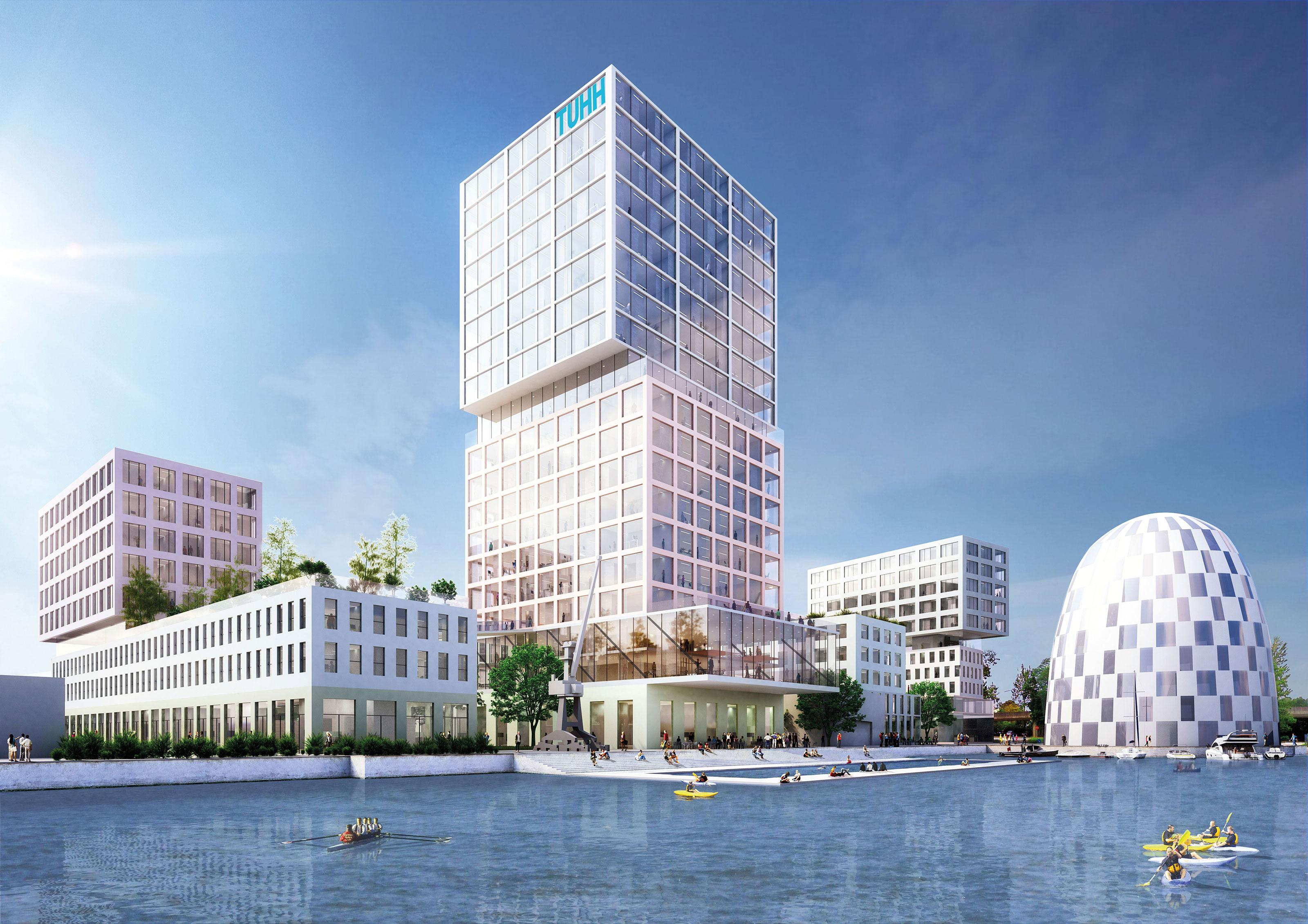
The institute is located in the newly built Hamburg Innovation Port
(www.hamburg-innovation-port.com/wp-content/uploads/2018/09/01-HIPtuhhlogowasser_web.jpg
<https://www.hamburg-innovation-port.com/wp-content/uploads/2018/09/01-HIPtuhhlogowasser_web.jpg>),
which is located right at the Harburg harbour with great views of the
harbour and Hamburg's famous opera house (Elbphilharmonie). Several
other computer science institutes of the TU Hamburg are located in the
area, as well as DASHH - Data Science in Hamburg, the Helmholtz Graduate
School for the Structure of Matter, and the German Air and Space
Research Center (DLR). They are all located in the Free and Hanseatic
City of Hamburg, which is Germany's second largest city, home to a
population of about 1.8 million people. It is a famous city of
entertainment, trade and commerce, with several universities and much
research in algorithms.

TU Hamburg offers several attractive benefits, including subsidized
public transport for the Hamburg metropolitan area, a sports centre on
campus, family-friendly working hours, healthy campus initiatives, and more.

An excellent PhD degree in (Applied) Mathematics, Computer Science,
Operations Research, Engineering or related field is required. Affinity
with optimization, algorithms, or discrete mathematics is preferred. In
particular, background in algorithms and complexity, or mathematical
optimization is appreciated. Programming experience is considered a plus.

Interested individuals should submit their applications by 19 April
2024. For a full job description and details on how to apply see
https://www.tuhh.de/algo/jobs/postdoc/senior-positions. Any questions
regarding the position should be directed to Prof. Matthias Mnich
(algo@tuhh.de).

Hamburg University of Technology regards diversity as an integral part
of academic excellence and is committed to employment equity and
accessibility for all employees. As such, we encourage applications from
women, persons with disabilities, members of diverse gender identities,
and others who may contribute to the further diversification of ideas.
In Hamburg, you will have the opportunity to work across disciplines and
collaborate with an international community of scholars and a diverse
student body.
**********************************************************
*
* Contributions to be spread via DMANET are submitted to
*
* DMANET@zpr.uni-koeln.de
*
* Replies to a message carried on DMANET should NOT be
* addressed to DMANET but to the original sender. The
* original sender, however, is invited to prepare an
* update of the replies received and to communicate it
* via DMANET.
*
* DISCRETE MATHEMATICS AND ALGORITHMS NETWORK (DMANET)
* http://www.zaik.uni-koeln.de/AFS/publications/dmanet/
*
**********************************************************

[DMANET] Call for Papers: RANDOM 2024 and APPROX 2024

-------------------------------------------------------------------------
Call for papers: RANDOM 2024 (http://randomconference.com/)
and
APPROX 2024 (http://approxconference.com/)
-----------------------------------------------------------------------

The 28th International Workshop on Randomization and Computation (RANDOM
2024) and the 27th International Workshop on Approximation Algorithms for
Combinatorial Optimization Problems (APPROX 2024) will be held in person
in London, UK from August 28-30, 2024.

RANDOM 2024 focuses on applications of randomness to computational and
combinatorial problems while APPROX 2024 focuses on algorithmic and
complexity theoretic issues relevant to the development of efficient
approximate solutions to computationally difficult problems.

IMPORTANT DATES

Submissions: May 10, 2024, AoE Time Zone
Notifications: July 1, 2024
Camera ready: July 15, 2024

TOPICS
Papers are solicited in all research areas related to randomization and
approximation, including but not limited to:

RANDOM
design and analysis of randomized algorithms
randomized complexity theory
pseudorandomness and derandomization
random combinatorial structures
random walks/Markov chains
expander graphs and randomness extractors
probabilistic proof systems
random projections and embeddings
error-correcting codes
average-case analysis
smoothed analysis
property testing
sublinear-time and local algorithms
computational learning theory
(pseudo)randomness in cryptography and data privacy
(pseudo)randomness and quantum information

APPROX
approximation algorithms
hardness of approximation
small space, sub-linear time and streaming algorithms
online algorithms
approaches that go beyond worst-case analysis
distributed and parallel approximation
embeddings and metric space methods
mathematical programming methods
spectral methods
combinatorial optimization
algorithmic game theory, mechanism design and economics
computational geometric problems
approximate learning

SUBMISSION SERVERS
RANDOM: To be posted on the web-site
APPROX: https://easychair.org/conferences/?conf=approx2024

Submissions must be received by May 10, 2024, AoE Time Zone to be
considered.

Submission Format: Submissions, in PDF, should start with the title of
the paper, followed by a 1-2 paragraph abstract summarizing the paper's
contributions. This should be followed by a technical exposition on
single-spaced, single-column pages, letter-size paper, using page
numbers, at least 1-inch margins all around, and at least 11-point font.
The first 10 pages should contain a clear presentation of the main
technical and conceptual ideas underlying the results, including the
motivation behind the paper and a clear comparison with related work
(not including the references). The submission should be accessible to a
wide variety of researchers in theoretical computer science and discrete
mathematics. There is no page limit, but any material beyond the first
10 pages will be read at the sole discretion of the program committee.

Work that has been previously published in another conference
proceedings or journal, or which will be published before the end of the
conference, will not be considered for acceptance. Simultaneous
submission of the same (or an overlapping) paper to RANDOM/APPROX and to
another conference with published proceedings is not allowed.

ATTENDANCE POLICY

At least one author of each accepted paper should attend the conference
in person to present the work. An exception to this policy may be
granted in case of unavoidable visa issues, in which case the paper will
still be included in the proceedings, and a recorded talk video will be
made available online, but the paper will not be given a presentation
slot at the in-person event. Therefore, please make sure to make travel
arrangements well in advance to attend the conference, especially if you
need a visa for entering the UK.

PROCEEDINGS
Accepted papers will be published in the online proceedings of the
conference in the Leibniz International Proceedings in Informatics
(LIPIcs) series, based at Schloss Dagstuhl. This guarantees perennial,
free and easy electronic access, while the authors retain the rights
over their work. We also expect that authors of accepted papers make a
full version of their paper available online by the conference date.


RANDOM Program Chair
Noga Ron-Zewi, University of Haifa
nronzewi@ds.haifa.ac.il

APPROX Program Chair
Amit Kumar, IIT Delhi
amit.kumar@cse.iitd.ac.in

Local Organizing Committee (approx-random-local@maths.lse.ac.uk) at the
London School of Economics:

Ahmad Abdi
Tugkan Batu
Neil Olver (Chair)
Gregory Sorkin

RANDOM PROGRAM COMMITTEE
Ioana Bercea, KTH Royal Institute of Technology
Andrej Bogdanov, University of Ottawa
Sarah Cannon, Claremont McKenna College
Lijie Chen, UC Berkeley
Weiming Feng, ETH Zurich
Sumegha Garg, Rutgers University
Zeyu Guo, Ohio State University
Tom Gur, University of Cambridge
William Hoza, University of Chicago
Valentine Kabanets, Simon Fraser University
Reut Levi, Reichman University
Ray Li, Santa Clara University
Inbal Livni-Navon, Stanford University
Dor Minzer, MIT
Ilan Newman, University of Haifa
Pan Peng, University of Science and Technology of China
João Ribeiro, Universidade Nova de Lisboa
Piyush Srivastava, Tata Institute of Fundamental Research
Emanuele Viola, Northeastern University
Erik Waingarten, University of Pennsylvania
Ronald de Wolf, CWI and University of Amsterdam


APPROX PROGRAM COMMITTEE
Susanne Albers, Technical University of Munich
Keerti Choudhury, Indian Institute of Technology Delhi
Debarati Das, Pennsylvania State University
Thomas Erlebach, Durham University
Zhiyi Huang, University of Hong Kong
Sanjeev Khanna, University of Pennsylvania
Euiwoong Lee, University of Michigan
Roie Levin, Rutgers University
Anand Louis, Indian Institute of Science Bangalore
Julián Mestre, University of Sydney
Sahil Singla, Georgia Institute of Technology
Thomas Rothvoss, University of Washington
José Verschae, Pontificia Universidad Católica de Chile
Erik Waingarten, University of Pennsylvania
David Wajc, Technion–Israel Institute of Technology

RANDOM Steering Committee
Oded Goldreich, Weizmann
Raghu Meka, UCLA, Steering Committee Chair
Cris Moore, SFI
Anup Rao, U Washington
Omer Reingold, Stanford
Dana Ron, Tel Aviv University
Ronitt Rubinfeld, MIT
Amit Sahai, UCLA
Ronen Shaltiel, U Haifa, Publicity Chair
Alistair Sinclair, UC Berkeley
Paul Spirakis, U Liverpool and U Patras

APPROX Steering Committee
Jaros&#322;aw Byrka, University of Wroclaw
Samir Khuller, Northwestern University
Nicole Megoe, University of Bremen
Monaldo Mastrolilli, IDSIA
Laura Sanità, Bocconi University
Chaitanya Swamy, University of Waterloo
László A. Végh, LSE, Steering Committee Chair
Virginia Vassilevska Williams, MIT
David P. Williamson, Cornell


**********************************************************
*
* Contributions to be spread via DMANET are submitted to
*
* DMANET@zpr.uni-koeln.de
*
* Replies to a message carried on DMANET should NOT be
* addressed to DMANET but to the original sender. The
* original sender, however, is invited to prepare an
* update of the replies received and to communicate it
* via DMANET.
*
* DISCRETE MATHEMATICS AND ALGORITHMS NETWORK (DMANET)
* http://www.zaik.uni-koeln.de/AFS/publications/dmanet/
*
**********************************************************

[DMANET] Permanent position of Assistant Professor in Operations Research (Ecole des Mines de Saint-Etienne in Gardanne, near Aix-en-Provence)

Dear all,


A permanent position of Assistant Professor in Operations Research is
open at the École des Mines de Saint-Étienne (Gardanne Campus - in the
south of France near Aix-en-Provence, Bouches-du-Rhône) with affiliation
to UMR 6158 LIMOS - ODPS axis.

The job announcement (in French) is available online (I can provide a
translated version)
https://institutminestelecom.recruitee.com/o/maitre-de-conferences-en-recherche-operationnelle-cdi


We encourage high-level candidates in Operations Research, regardless of
nationality, to apply. The selected candidate will enhance the
activities of the Department of Manufacturing Sciences and Logistics
(Département Sciences de la Fabrication et Logistique) and the ODPS axis
of LIMOS by working closely with fellow faculty members to develop
original work combining combinatorial optimization, industrial
engineering, and data science for production and logistics.

Deadline for applications on recruitee: April 10, 2024, 11:59 PM Paris time

Recruitment interview date: May 2024

Desired start date: October 1, 2024

We invite potential candidates to contact me (absi@emse.fr) as soon as
possible for further details. Thank you for sharing within your network!


Best regards,

--
Nabil Absi
Professor and Head of the department
Department of Manufacturing Sciences and Logistics
Ecole des Mines de Saint-Etienne
LIMOS - UMR CNRS 6158
Campus G. Charpak Provence
880 route de Mimet
F-13541 GARDANNE
FRANCE

Tel: +33 (0)4 42 61 66 56
E-mail:absi@emse.fr
URL:http://cmp.mines-stetienne.fr/
https://scholar.google.fr/citations?user=2MERbJgAAAAJ

**********************************************************
*
* Contributions to be spread via DMANET are submitted to
*
* DMANET@zpr.uni-koeln.de
*
* Replies to a message carried on DMANET should NOT be
* addressed to DMANET but to the original sender. The
* original sender, however, is invited to prepare an
* update of the replies received and to communicate it
* via DMANET.
*
* DISCRETE MATHEMATICS AND ALGORITHMS NETWORK (DMANET)
* http://www.zaik.uni-koeln.de/AFS/publications/dmanet/
*
**********************************************************

[DMANET] PhD position and Master internship in Telecom Paris

Dear all,

I have an open position for a master's internship/thesis and a PhD at
Telecom Paris in the RMS team (Networks, Mobility, Services) on the
theme: Reinforcement learning for the scheduling of ultra-reliable and
low latency communications ( URLLC communications in 5G). This involves
designing single-agent or multi-agent reinforcement learning algorithms
to solve the problem of scheduling URLLC communications on the uplink,
between the terminals and the base station. This would extend the work
done in the following publication:

https://arxiv.org/abs/2308.14523

The ideal would be to continue the internship with a doctorate but
independent applications are also welcome.

Please distribute the information among interested students and don't
hesitate to contact me for further information.

Reagrds,

--
Marceau Coupechoux

Telecom Paris (ENST)
Département Informatique et Réseaux
19 place Marguerite Perey
91120 Palaiseau


**********************************************************
*
* Contributions to be spread via DMANET are submitted to
*
* DMANET@zpr.uni-koeln.de
*
* Replies to a message carried on DMANET should NOT be
* addressed to DMANET but to the original sender. The
* original sender, however, is invited to prepare an
* update of the replies received and to communicate it
* via DMANET.
*
* DISCRETE MATHEMATICS AND ALGORITHMS NETWORK (DMANET)
* http://www.zaik.uni-koeln.de/AFS/publications/dmanet/
*
**********************************************************

[DMANET] [CFP] Sensing and Data Platforms: what is ahead of us (Special Session 11), IEEE MetroAgriFor Workshop

[Apologies if you receive multiple copies of this message]

Dear Researchers/Authors,
You are invited to submit your high-quality research findings to the
Special Session 11: "Sensing and Data Platforms: what is ahead of us" of
the 2024 IEEE International Workshop on Metrology for Agriculture and
Forestry (MetroAgriFor).

October 29-31, 2024 - Padua, Italy

Website: https://www.metroagrifor.org/special-session-11

Aims and Scope
The role of sensing, including in-situ, proximity and remote, is increasingly crucial for agriculture and forestry.
Huge investments have been made in this field - consider for instance satellite constellations for remote sensing, the thriving UAV sector, and the dawning sector of terrestrial rovers - and benefits are evident in several application areas.
The other side of the coin is represented by the data platforms used to collect, store, and process the huge amount of data coming from sensing platforms.
Such data platforms should, among others, provide interoperable data through open interfaces (APIs) to different classes of users, but such functionality has not yet reached its full potential.

In Europe, there have been several recent initiatives focused on enhancing data sharing and processing.
One key effort is the European Strategy for Data, which introduces the concept of a Common European Data Space and includes actions to deploy Agriculture and Green Deal sectorial data spaces.
Additionally, the Horizon Europe framework is providing funding for the establishment of European Partnerships that bring together the European Commission with private and/or public partners to address pressing challenges through collaborative research and innovation projects.
One such partnership, the European Partnership for Agriculture of Data, aims to support sustainable agriculture in the EU and improve policy monitoring and implementation by leveraging digital and data technologies for environmental observation.

The goal of this special session is to investigate the potential and the challenges of both sensing and data platforms, looking to future developments, and also considering economic and legal aspects to be carefully taken into consideration.

Contributions are expected to contribute to, but are not limited to, the following topics:

- sensing systems, both local and remote, and recent developments;
- state of the art of data platforms linked to sensing systems, standards, interoperability enablers, and sustainability of their business model;
- GEOSS Data Sharing and Management Principles, FAIR principles, and other interoperable solutions with the potential to further push the use of sensing data;
- economic and legal aspects that can fuel or limit the use of such systems.

Important dates
- Extended Abstract Submission: June 10, 2024
- Extended Abstract Notification: September 1, 2024
- Final Paper Submission: September 20, 2024

Submission Instruction
Authors should prepare an Extended Abstract (4-5 pages) that clearly
indicates the originality of the contribution and the relevance of the
work. The Extended Abstract should include the title of the paper, names
and affiliations of the authors, an abstract, keywords, an introduction
describing the nature of the problem and the state of the art in the field
of interest, a description of the contribution, the results achieved and
their applicability, conclusions, and references.
When the review process has been completed, authors receive a notification
of either acceptance or rejection of the submission. If the paper has been
accepted, the authors can prepare a final paper that incorporates the
reviewers' suggestions.
The format for the final paper is identical to the format for the extended
abstract except for the number of pages: the full paper has a required
minimum length of five (5) pages and a maximum of six (6) pages.

Special Session Organizers
- Manlio Bacco
Institute of Information Science and Technologies (ISTI), CNR, Italy
manlio.bacco@isti.cnr.it

- Federico Coro'
University of Perugia, Italy
federico.coro@unipg.it

- Paolo Mazzetti
Institute of Atmospheric Pollution Research - National Research Council, Italy
paolo.mazzetti@cnr.it

- Lorenzo Palazzetti
University of Perugia, Italy
lorenzo.palazzetti@unifi.it

- Cristina Domingo-Marimon
CREAF, Spain
cristina.domingo@uab.cat

- Margherita Di Leo
Arcadia SIT
Margherita.DI-LEO@ext.ec.europa.eu


Thank you for your consideration.

**********************************************************
*
* Contributions to be spread via DMANET are submitted to
*
* DMANET@zpr.uni-koeln.de
*
* Replies to a message carried on DMANET should NOT be
* addressed to DMANET but to the original sender. The
* original sender, however, is invited to prepare an
* update of the replies received and to communicate it
* via DMANET.
*
* DISCRETE MATHEMATICS AND ALGORITHMS NETWORK (DMANET)
* http://www.zaik.uni-koeln.de/AFS/publications/dmanet/
*
**********************************************************