Wednesday, July 3, 2024

[DMANET] Assistant/Associate Professor in Theoretical Computer Science at the University of Warwick (apply by August 26, 2024)

----------------------------------------------------------------------------------------------------------
Assistant/Associate Professor opening in Theoretical Computer Science at
the University of Warwick
https://warwick.ac.uk/dimap/focs_post_2024/
----------------------------------------------------------------------------------------------------------

We are looking for enthusiastic researchers working in theoretical
computer science to make a major contribution to the Department of
Computer Science and the Centre for Discrete Mathematics and its
Applications (DIMAP) at the University of Warwick activities in research
and teaching.

This is an opportunity to join one of the UK's most prominent Computer
Science departments, widely recognized for its excellence in Theoretical
Computer Science (https://warwick.ac.uk/dcs/research/focs/) and Discrete
Mathematics (https://warwick.ac.uk/dimap), and to be part of an exciting
time of growth in the Department.

The applicants are expected to hold a PhD or equivalent in Theoretical
Computer Science or a related discipline. They should have an
outstanding academic record, and show clear promise of developing a
career in academia. They should have a strong commitment to
undergraduate and postgraduate education.
Research areas of interest include, but are not limited to, the design
and analysis of algorithms, computational complexity, discrete
mathematics, combinatorics, and graph theory.

Informal inquires can be addressed to Prof. Artur Czumaj
(https://www.dcs.warwick.ac.uk/~czumaj/), any Theory group member
(https://warwick.ac.uk/dcs/research/focs/people/), or Prof. Yulia
Timofeeva (Head of Warwick Computer Science,
https://www.dcs.warwick.ac.uk/~yulia/).

Closing date: August 26, 2024 (11:55pm UK time sharp).

It is expected that interviews will take place in October 2024.

For more details and links to the application form, see this link:
            https://warwick.ac.uk/dimap/focs_post_2024/

**********************************************************
*
* Contributions to be spread via DMANET are submitted to
*
* DMANET@zpr.uni-koeln.de
*
* Replies to a message carried on DMANET should NOT be
* addressed to DMANET but to the original sender. The
* original sender, however, is invited to prepare an
* update of the replies received and to communicate it
* via DMANET.
*
* DISCRETE MATHEMATICS AND ALGORITHMS NETWORK (DMANET)
* http://www.zaik.uni-koeln.de/AFS/publications/dmanet/
*
**********************************************************

[DMANET] Summer issue of the EATCS Bulletin

Dear DMANET community,

the Summer issue of the EATCS Bulletin is now available at:

https://eatcs.org/images/bulletin/beatcs143.pdf

The Interview Column features Sergio Rajsbaum. He tells us about his
experiences when, 30 years ago, he travelled all the way from Mexico to
Israel to study at the Technion, and soon after became part of Shimon
Even's academic family. He also reflects on what makes a good team mate, a
good PhD advisor, and on the role of trust in general.

The Distributed Computing Column, edited by Seth Gilbert, features an
article by Helen Xu who shares with us "everything we need to know" about
how to design efficient parallel applications that operate on dynamic
graphs, from container designs (i.e., data structures), over interfaces for
interacting with a dynamic graph, to performance benchmarking.

In the Formal Language Theory Column, edited by Giovanni Pighizzini, Markus
L. Schmid highlights the relationship between a recent research area in
database theory, namely the information extraction framework of document
spanners, and classical formal language theory.

In the Logic in Computer Science Column, Yuri Gurevich and Andreas Blass
discuss some of the many foundational problems raised by the ongoing AI
revolution, in a thought-provoking dialogue.

The Bulletin further includes reports from the EATCS Japan Chapter and the
40th British Colloquium for Theoretical Computer Science.

I wish you an inspiring read and a wonderful Summer!

Stefan Schmid

---
Prof. Dr. Stefan Schmid
Intelligent Networks (INET)
TU Berlin, Germany
Research group: https://www.tu.berlin/en/eninet
Personal: *https://schmiste.github.io/ <https://schmiste.github.io/>*

**********************************************************
*
* Contributions to be spread via DMANET are submitted to
*
* DMANET@zpr.uni-koeln.de
*
* Replies to a message carried on DMANET should NOT be
* addressed to DMANET but to the original sender. The
* original sender, however, is invited to prepare an
* update of the replies received and to communicate it
* via DMANET.
*
* DISCRETE MATHEMATICS AND ALGORITHMS NETWORK (DMANET)
* http://www.zaik.uni-koeln.de/AFS/publications/dmanet/
*
**********************************************************

[DMANET] 15th Workshop on Applications for Multi-Core Architectures - WAMCA2024 - Hawaï - USA

*****We apologize for possible cross-posting*****

15th Workshop on Applications for Multi-Core Architectures
November 13-15, 2024
Hawaii, USA
https://www.cri.ensmp.fr/conf/wamca2024/
In conjunction with the IEEE/SBC 36th International Symposium on Computer Architecture and High Performance Computing (SBAC-PAD 2024)

Since the advent of the multi-core concept, significant advances have been made on many of the related aspects. Multi-core has become a natural element in the HPC ecosystem, and its pervasiveness within the landscape of common computing devices has made it a standard. Therefore, hardware and software concerns related to multi-core are good targets for computer science investigations, with a high potential for a genuine contribution. Beside the plethora of applications for which more powerful solutions are still expected, efficient implementation techniques for many-core chip processors are of keen interest. WAMCA is aiming at providing an opportunity to address all aforementioned technical challenges and more, including reports on specific case studies.


We kindly invite you to consider the 15th Workshop on Applications for Multi-Core Architectures that will take place from November 13 to 15, at the Hilo Hawaiian Hotel in Hawaii (USA). This workshop is an opportunity for application designers and computer architects to discuss new techniques and emerging applications as well as their implications on current and next-generation many-core architectures.

TOPICS:

* Multithread parallelisation
* Scalability issues
* Case study
* Hybrid parallelisation
* NUMA manycore implementation
* Benchmarking and runtime analysis
* Frameworks and tools
* Foundation of shared memory computing
* Exascale systems/design/cases

IMPORTANT DATES:
* Paper deadline : August 20th, 2023
* Author notification : September 15th, 2023

GENERAL CHAIR
Claude Tadonki (MINES ParisTech - PSL / France)

CO-CHAIRS
Cristiana Bentes (State University of Rio de Janeiro / Brazil)
Gabriele Mencagli (University of Pisa / Italy)
Lucia Drummond (Fluminense Federal University / Brazil)
Maria Clicia Castro (State University of Rio de Janeiro / Brazil)
Hermes Senger (Universidade Federal de São Carlos / Brazil)

PROGRAM COMMITTEE
Henrique Freitas (PUC Minas - Brazil)
Christophe Cérin (Paris 13 - France)
Khaled Ibrahim (Lawrence Berkeley National Lab - USA)
Juliana Silva (Universidade Federal Fluminense - USA)
Andre Rauber Du Bois (Universidade Federal de Pelotas - Brazil)
Marcin Paprzycki (IBS PAN and WSM - Brazil)
Diego Leonel Cadette Dutra (LCP/PESC/COPPE/UFRJ - Brazil)
Georges-André Silber (Mines Paris, PSL University - France)
Corinne Ancourt (Ecole des Mines - France)
Marcelo Zamith (Universidade Federal Rural do Rio de Janeiro - Brazil)
Miwako Tsuji (RIKEN R-CCS - Japan)
TO BE EXTENDED
********************************************************************************

**********************************************************
*
* Contributions to be spread via DMANET are submitted to
*
* DMANET@zpr.uni-koeln.de
*
* Replies to a message carried on DMANET should NOT be
* addressed to DMANET but to the original sender. The
* original sender, however, is invited to prepare an
* update of the replies received and to communicate it
* via DMANET.
*
* DISCRETE MATHEMATICS AND ALGORITHMS NETWORK (DMANET)
* http://www.zaik.uni-koeln.de/AFS/publications/dmanet/
*
**********************************************************

[DMANET] 4 quantum postdocs in Marseille (deadline August 18)

Dear colleagues,

I just wanted to bring to your attention 4 postdoc positions on various
topics in quantum information that I have opened in Marseille at LIS,
starting January 2025. At least some of these positions should interest
candidates who are interested in discrete structures and combinatorial
aspects of quantum theory. If you or any of your colleagues are
interested in these positions, please (encourage them to) apply! The
details are here: https://ravikunjwal.com/jobs/

The deadline for applications is August 18, 2024 (AoE).

Best regards,
Ravi
**********************************************************
*
* Contributions to be spread via DMANET are submitted to
*
* DMANET@zpr.uni-koeln.de
*
* Replies to a message carried on DMANET should NOT be
* addressed to DMANET but to the original sender. The
* original sender, however, is invited to prepare an
* update of the replies received and to communicate it
* via DMANET.
*
* DISCRETE MATHEMATICS AND ALGORITHMS NETWORK (DMANET)
* http://www.zaik.uni-koeln.de/AFS/publications/dmanet/
*
**********************************************************

[DMANET] Fulkerson 100 workshop: U. Waterloo, Jul 17-19, 2024: final announcement

The Dept. of Combinatorics & Optimization (C&O) at the University of Waterloo is hosting a 3-day research workshop, Fulkerson 100, from July 17-19, 2024 (https://www.math.uwaterloo.ca/~fulkerson100/) in honor of Ray Fulkerson's centenary year of birth. Fulkerson was one of the leading figures in combinatorial optimization, and his seminal work has had a profound and lasting impact in shaping the fields of combinatorial optimization and Operations Research.
(This is the Wed-Fri of the week right before ISMP 2024 in Montreal.)

The workshop will feature invited talks (https://www.math.uwaterloo.ca/~fulkerson100/invited.html) by distinguished researchers in the areas of graph theory, combinatorics, optimization, and theoretical computer science (TCS). It will also feature lightning talks and a poster session to showcase research by students and postdocs. We hope to bring together a wide variety of researchers in discrete mathematics, while (implicitly) commemorating Fulkerson's vision and contributions.

We welcome you to join us for this event.

The link for registration is here: https://www.math.uwaterloo.ca/~fulkerson100/registration.html.
As part of registration, students and postdocs can indicate whether they would like to present a lightning talk and poster at the event. (There is some limited funding to help support the participation of students and postdocs who are in need.)

*Registration fees are quite nominal, but increase after July 5, 2024.*

Please contact fulkerson100@uwaterloo.ca, or one of the organizers, regarding any questions.

(A tandem celebratory event is being held at Cornell University in Sep 2024, featuring some survey talks.)

Organizers: Joseph Cheriyan, Bertrand Guenin, and Chaitanya Swamy (Chair, C&O)

Dept. of Combinatorics & Optimization
Faculty of Mathematics
University of Waterloo
Waterloo, ON N2L 3G1, CANADA

**********************************************************
*
* Contributions to be spread via DMANET are submitted to
*
* DMANET@zpr.uni-koeln.de
*
* Replies to a message carried on DMANET should NOT be
* addressed to DMANET but to the original sender. The
* original sender, however, is invited to prepare an
* update of the replies received and to communicate it
* via DMANET.
*
* DISCRETE MATHEMATICS AND ALGORITHMS NETWORK (DMANET)
* http://www.zaik.uni-koeln.de/AFS/publications/dmanet/
*
**********************************************************

[DMANET] Workshop on Data Analytics in Biomedicine

CALL FOR PAPERS


First Workshop on "Data Analytics in Biomedicine"
(held in conjunction with IEEE DDP2024)
Fourth International Conference on Digital Data Processing
Yeshiva University.
New York, US
30 September – 01 October 2024
https://socio.org.uk/ddp/workshop/

CALL FOR PAPERS


The exponential growth of data generated from various textual sources presents both a challenge and a huge opportunity. A key challenge lies in effectively managing and extracting valuable insights from this vast amount of unstructured and heterogeneous data. To address this issue, advanced data analytics techniques, ranging from data and text mining to semantic network analysis and recent advancements in large language models (LLMs), have become indispensable tools for researchers and practitioners.


This is particularly relevant in the realm of biomedicine, where text mining has shown the ability to enable researchers to uncover hidden patterns, trends, and associations that would otherwise remain buried in the vast amount of health-related textual data, for instance, research articles, clinical reports, and electronic health records (EHRs).


On the other hand, semantic network analysis, which focuses on understanding the structure and dynamics of networks formed by entities and their interconnections derived from text mining processes, can facilitate a deeper understanding of the complex interrelationships within biomedical data. By analyzing properties like centrality, modularity, and community structures, researchers can identify key nodes and critical pathways in biological networks, predict disease associations, and explore the functional organization of biological systems.


The integration of text mining, semantic network analysis, and large language models offers a powerful approach to enhancing the ability to generate new hypotheses and insights and supporting the development of more effective diagnostics, treatments, and interventions.


The workshop represents an opportunity to explore the latest advancements in data analytics and text mining in biomedicine. Attendees will gain insights into developing more interpretable models, handling large-scale biomedical datasets, and implementing scalable solutions for real-world healthcare applications.


Moreover, the workshop is highly relevant because it has the potential to significantly improve the safety, effectiveness, and efficiency of biomedical interventions through advanced data analytics.


TOPIC OF INTEREST


We invite submissions on a wide range of topics, including but not limited to:


Novel techniques and measures for assessing textual data quality and handling data integration.
Advanced text mining techniques for biomedical data
Construction and analysis of semantic networks in biomedicine
Case studies on integrated text mining and semantic network analysis
Applications of LLMs in biomedicine
Data analytics in precision medicine
Text-driven approaches to drug discovery
Interpretable or scalable data analytics approaches
Application of Data Analytics and network science in Narrative Medicine
Computational methods for disease modeling and prediction
Ethical considerations in biomedical data analytics
Multimodal biomedical data analytics
Future trends and challenges in biomedical data analytics


PROGRAM


The workshop will take place on (To Be Announced). The program has yet to be made available. The Venue is Yeshiva University, New York.


PAPER SUBMISSION, REGISTRATION AND PUBLICATION

The submissions should follow the IEEE template.
Please refer to socio.org.uk/ddp/paper-submission/


IMPORTANT DATES


Submission of Papers: August 05, 2024
Review and Notification: August 31, 2024
Camera-ready: Sep. 25, 2024
Workshop Date: Oct. 01, 2024
Post-conference proceedings: Nov. 30, 2024


WORKSHOP ORGANIZERS

Chiara Zucco, University Magna Graecia of Catanzaro, Italy
Mario Cannataro, University Magna Graecia of Catanzaro, Italy
Marianna Milano, University Magna Graecia of Catanzaro, Italy


PROGRAM COMMITTEE (TO BE CONFIRMED)


Marzia Settino, University of Calabria, Italy
Mario Cannataro, University Magna Graecia of Catanzaro, Italy
Maria Chiara Martinis, University Magna Graecia of Catanzaro, Italy
Giuseppe Agapito, University Magna Graecia of Catanzaro, Italy
Pietro Cinaglia, University Magna Graecia of Catanzaro, Italy
Ilaria Lazzaro, University Magna Graecia of Catanzaro, Italy
-----------
**********************************************************
*
* Contributions to be spread via DMANET are submitted to
*
* DMANET@zpr.uni-koeln.de
*
* Replies to a message carried on DMANET should NOT be
* addressed to DMANET but to the original sender. The
* original sender, however, is invited to prepare an
* update of the replies received and to communicate it
* via DMANET.
*
* DISCRETE MATHEMATICS AND ALGORITHMS NETWORK (DMANET)
* http://www.zaik.uni-koeln.de/AFS/publications/dmanet/
*
**********************************************************

[DMANET] ASPOCP 2024 @ ICLP- First Call for Paper

[Apologies for cross-posting]
====================================================================================

                                   CALL FOR PAPERS
ASPOCP2024
        17th Workshop on Answer Set Programming and Other Computing
Paradigms
https://sites.google.com/unical.it/aspocp2024/

                               October 12 or October 13


      Affiliated with ICLP 2024, 40th International Conference on Logic
Programming
https://www.iclp24.utdallas.edu/
                                  October 11 - 17, 2024


====================================================================================

AIMS AND SCOPE

 Since its introduction in the late 1980s, Answer Set Programming (ASP)
has been widely applied to various knowledge-intensive tasks and
combinatorial search problems.ASPwas found to be closely related to SAT,
which led to a new method of computing answer sets using SAT solvers and
techniques adapted from SAT. This has been a much studied relationship,
and is currently extended towards satisfiability modulo theories (SMT).
The relationship ofASPto other computing paradigms, such as constraint
satisfaction, quantified Boolean formulas (QBF), Constraint Logic
Programming (CLP), first-order logic (FOL), and FO(ID) is also the
subject of active research. Consequently, new methods of computing
answer sets are being developed based on relationships to these formalisms.

 Furthermore, the practical applications ofASPalso foster work on
multi-paradigm problem-solving, and in particular language and solver
integration. The most prominent examples in this area currently are the
integration ofASPwith description logics (in the realm of the Semantic
Web) and constraint satisfaction (which recently led to the Constraint
Answer Set Programming (CASP) research direction).

 A large body of general results regardingASPis available and several
efficientASPsolvers have been implemented. However, there are still
significant challenges in applyingASPto real life applications, and more
interest in relatingASPto other computing paradigms is emerging. This
 workshop will provide opportunities for researchers to identify these
challenges and to exchange ideas for overcoming them.

TOPICS

 Topics of interests include (but are not limited to):
 -ASPand classical logic formalisms (SAT/FOL/QBF/SMT/DL).
 -ASPand constraint programming.
 -ASPand other logic programming paradigms, e.g., FO(ID).
 -ASPand other nonmonotonic languages, e.g., action languages.
 -ASPand external means of computation.
 -ASPand probabilistic reasoning.
 -ASPand knowledge compilation.
 -ASPand machine learning.
 - New methods of computing answer sets using algorithms or systems of
other paradigms.
 - Language extensions toASP.
 -ASPand multi-agent systems.
 -ASPand multi-context systems.
 - Modularity andASP.
 -ASPand argumentation.
 - Multi-paradigm problem solving involvingASP.
 - Evaluation and comparison ofASPto other paradigms.
 -ASPand related paradigms in applications.
 - HybridizingASPwith procedural approaches.
 - Enhanced grounding or beyond grounding.


SUBMISSIONS

 The workshop invites two types of submissions:
  - original papers describing original research.
  - non-original paper already published on formal proceedings or journals.
 Original papers must not exceed 13 pages (excluding references) and
must be formatted using the 1-column CEURART style availablehere
<https://drive.google.com/file/d/15jC34VXDf8GUMMpobnvaAaX0R4RSQ18v/view?usp=share_link>.
 A ready-to-clone overleaf project containing a 1-column CEURART style
is availablehere <https://www.overleaf.com/read/cqxqwrgjccwk#deb4a7>.

 Authors are requested to clearly specify whether their submission is
original or not with a footnote on the first page.
 Authors are invited to submit their manuscripts in PDF via the
EasyChair system at the
link:https://easychair.org/my/conference?conf=aspocp2024
.

 IMPORTANT DATES

  Abstract submission deadline:                              01 August 2024
  Paper submission deadline:                                 08 August 2024
  Notification:                                              05
September 2024


PROCEEDINGS

 Authors of all accepted original contributions can opt to publish
their work in formal proceedings.
 Accepted non-original contributions will be given visibility on the
conference web site including a link to the original publication, if
already published.

 A selection of extended and revised versions of accepted papers could
appear in a special issue.
 Extended versions of accepted non-original contributions, if not
published in a journal yet, might be included in the issue.


WORKSHOP CO-CHAIRS

 Francesco Pacenza, Department of Mathematics and Computer Science,
University of Calabria, Italy
 Zeynep G. Saribatur, Institute of Logic and Computation, TU Wien, Austria


PROGRAM COMMITTEE

TBA

**********************************************************
*
* Contributions to be spread via DMANET are submitted to
*
* DMANET@zpr.uni-koeln.de
*
* Replies to a message carried on DMANET should NOT be
* addressed to DMANET but to the original sender. The
* original sender, however, is invited to prepare an
* update of the replies received and to communicate it
* via DMANET.
*
* DISCRETE MATHEMATICS AND ALGORITHMS NETWORK (DMANET)
* http://www.zaik.uni-koeln.de/AFS/publications/dmanet/
*
**********************************************************

[DMANET] [Cryptography] (ISSN 2410-387X, ESCI & Scopus indexed) Updated IF of 1.8

I am excited to share the news that /Cryptography/ received an Impact
Factor for 2023 of 1.8 (ranking in Q2 in "Computer Science, Theory &
Methods"). More information of indexing can be found here:
https://www.mdpi.com/journal/cryptography/stats.

We are warmly inviting high-quality reviews and regular research papers
in all areas of theory and practice of modern cryptography to be
submitted to the journal Cryptography.

Cryptography (ISSN 2410-387X, https://www.mdpi.com/journal/Cryptography)
is a scientific peer-reviewed open access journal of cryptography
published quarterly online by MDPI. It is covered by Scopus (Elsevier),
Emerging Sources Citation Index (ESCI-Web of Science), etc.

The journal scope is shown here:
https://www.mdpi.com/journal/cryptography/about.
Editorial Board: https://www.mdpi.com/journal/cryptography/editors.
More Topics: https://www.mdpi.com/journal/cryptography/special_issues.

Any questions about the journal Cryptography, please contact
cryptography@mdpi.com.

Best regards,
Xue Cheng
Managing Editor
--
MDPI Branch Office, Wuhan
Cryptography Editorial Office
https://www.mdpi.com/journal/cryptography
MDPI, St. Alban-Anlage 66, 4052 Basel, Switzerland

Twitter: @Cryptogr_MDPI https://twitter.com/Cryptogr_MDPI
LinkedIn: Cryptography-MDPI
**********************************************************
*
* Contributions to be spread via DMANET are submitted to
*
* DMANET@zpr.uni-koeln.de
*
* Replies to a message carried on DMANET should NOT be
* addressed to DMANET but to the original sender. The
* original sender, however, is invited to prepare an
* update of the replies received and to communicate it
* via DMANET.
*
* DISCRETE MATHEMATICS AND ALGORITHMS NETWORK (DMANET)
* http://www.zaik.uni-koeln.de/AFS/publications/dmanet/
*
**********************************************************

[DMANET] SIAM Symposium on Simplicity in Algorithms (SOSA 25)- Call for Papers

We invite submissions to the SIAM Symposium on Simplicity in Algorithms (SOSA 25). The symposium will take place in New Orleans, Jan 13-14, 2025, collocated with SODA and ALENEX.

IMPORTANT DATES

Short Abstract Submission and Paper Registration: August 5, 11:59pm Anywhere on Earth
Submissions received after this time will not be considered.
Full Paper Submission: August 8, 11:59 p.m. Anywhere on Earth

Initial reviews: September 9
Rebuttals due: September 13, 11:59 p.m. Anywhere on Earth
Notifications: early October

Submission link: https://easychair.org/my/conference?conf=sosa25

More information about the conference, program committee and detailed submission instructions can be found at https://siam.org/conferences/cm/conference/sosa25

About the conference:

Symposium on Simplicity in Algorithms (SOSA) is a conference in theoretical computer science dedicated to advancing algorithms research by promoting simplicity and elegance in the design and analysis of algorithms. The benefits of simplicity are manifold: simpler algorithms manifest a better understanding of the problem at hand; they are more likely to be implemented and trusted by practitioners; they are more easily taught and are more likely to be included in algorithms textbooks; and they attract a broader set of researchers to difficult algorithmic problems.

Papers in all areas of algorithms research are sought. An ideal submission will advance our understanding of an algorithmic problem by, for example, introducing a simpler algorithm, presenting a simpler analysis of an existing algorithm, or offering insights that generally simplify our understanding of important algorithms or computational problems.

We are especially interested in papers that make material more accessible to a wider audience, such as undergraduates, or for more specialized topics, general algorithms researchers.
Submissions should contain novel ideas or attractive insights, but they are not required to prove novel theorems. That is, the results themselves can be known, but their presentation must be new.


**********************************************************
*
* Contributions to be spread via DMANET are submitted to
*
* DMANET@zpr.uni-koeln.de
*
* Replies to a message carried on DMANET should NOT be
* addressed to DMANET but to the original sender. The
* original sender, however, is invited to prepare an
* update of the replies received and to communicate it
* via DMANET.
*
* DISCRETE MATHEMATICS AND ALGORITHMS NETWORK (DMANET)
* http://www.zaik.uni-koeln.de/AFS/publications/dmanet/
*
**********************************************************

[DMANET] [CFP] SPICES 2024 Deadline Extended

SPICES 2024: Call for Papers and for Reproducibility Studies

------------------------------------------------------------------------------

The 3rd Workshop on Security and Privacy in Connected Embedded Systems (
SPICES 2024) -- https://www.tii.ae/workshop/spices

Co-located with EWSN 2024 -- December 10, 2024

------------------------------------------------------------------------------


*Important Dates *

Paper submission deadline: *July 21, 2024*

Notification of acceptance: September 10, 2024

Camera-ready: October 10, 2024

Workshop day: December 10, 2024


Embedded systems are integral to modern infrastructures and personal
devices. As they proliferate, securing these systems becomes critical to
protect data and ensure operational integrity. SPICES 2024 focuses on
innovative security solutions, addressing new challenges posed by
advancements like 6G and AI, and identifying atypical vulnerabilities.

*Call for Submissions:*

We invite research on various topics including, but not limited to:

- *AI and Machine Learning in Security*
- *Wireless and Embedded System Security Protocols*
- *Attacks and Defenses in Wireless Networks*
- *Privacy Issues in IoT and Cyber-Physical Systems*
- *Emerging Threats in 6G and Advanced Networking*

Submissions should be up to 6 pages, in English, using the ACM template.
Include figures, tables, and references within the page limit. Details
should comprise authors' names, affiliations, and contacts.

*Submit Papers Here:* https://easychair.org/conferences/?conf=spices2024

Accepted papers will be published in the ACM EWSN 2024 proceedings and
presented at the workshop.

*Organizers:*

- Martin Andreoni, Technology Innovation Institute, UAE
- Pericle Perazzo, University of Pisa, Italy
- Fikret Basic, TU Graz

**********************************************************
*
* Contributions to be spread via DMANET are submitted to
*
* DMANET@zpr.uni-koeln.de
*
* Replies to a message carried on DMANET should NOT be
* addressed to DMANET but to the original sender. The
* original sender, however, is invited to prepare an
* update of the replies received and to communicate it
* via DMANET.
*
* DISCRETE MATHEMATICS AND ALGORITHMS NETWORK (DMANET)
* http://www.zaik.uni-koeln.de/AFS/publications/dmanet/
*
**********************************************************

[DMANET] [LPNMR 2024] Deadline in Two Days (July, 4 AOE)

*** Please accept our apologies if you receive multiple copies of this CFP ***

====================================================
LPNMR 2024 - Call for Papers

17th International Conference on Logic Programming and Non-monotonic Reasoning (LPNMR 2024)
Dallas, Texas, USA | October 11-14, 2024
Website: https://lpnmr2024.demacs.unical.it/
Contact us: lpnmr2024@easychair.org
Submission: https://easychair.org/conferences/?conf=lpnmr2024
====================================================

====================================================
IMPORTANT NEWS: ICLP 2024 RESUBMISSION
====================================================

If you choose to transfer the reviews to LPNMR during ICLP submission, you have the opportunity to submit a cover letter clarifying any changes to your paper.

====================================================
IMPORTANT DATES
====================================================

Paper registration: Jul 4, 2024 (extended)
Submission deadline: Jul 7, 2024 (extended)
Final notification: Aug 7, 2024 (extended)
Final versions due: August 15, 2024
Conference: October 11-14, 2024

====================================================
FAST JOURNAL TRACK FOR BEST PAPERS
====================================================

The two best papers focused on general AI topics will be invited for publication in either the Artificial Intelligence Journal or the Journal of Artificial Intelligence Research, based on the preference of the authors.
Also, the 2-5 best papers with a logic programming focus will be invited for publication in the journal of Theory and Practice of Logic Programming.

====================================================
AIMS AND SCOPE
====================================================

LPNMR 2024 is the seventeenth in the series of international meetings on logic programming and non-monotonic reasoning. LPNMR is a forum for exchanging ideas on declarative logic programming, non-monotonic reasoning, and knowledge representation. The aim of the conference is to facilitate interactions between researchers and practitioners interested in the design and implementation of logic-based programming languages and database systems, and those working in knowledge representation and non-monotonic reasoning. LPNMR strives to encompass theoretical and experimental studies that have led or will lead to advances in declarative programming and knowledge representation, as well as their use in practical applications.
LPNMR 2024 aims to bring together researchers from LPNMR core areas and application areas of the aforementioned kind in order to share research experiences, promote collaboration and identify directions for joint future research.

====================================================
TOPICS
====================================================
Authors are invited to submit papers presenting original and unpublished research on all aspects of non-monotonic approaches in logic programming and knowledge representation. Conference topics include, but are not limited to:
Foundations of LPNMR Systems:
Semantics of new and existing languages
Action languages, causality
Formalization of Commonsense Reasoning and understanding its laws and nature
Relationships among formalisms
Complexity and expressive power
Inference algorithms and heuristics for LPNMR systems
Extensions of traditional LPNMR languages such as new logical connectives or new inference capabilities
Updates, revision, and other operations on LPNMR systems
Uncertainty in LPNMR systems
Implementation of LPNMR systems:
System descriptions, comparisons, evaluations
Algorithms and novel techniques for efficient evaluation
LPNMR benchmarks
Applications of LPNMR:
Use of LPNMR in Commonsense Reasoning and other areas of KR
LPNMR languages and algorithms in planning, diagnosis, argumentation, reasoning with preferences, decision making and policies
Applications of LPNMR languages in data integration and exchange systems, software engineering and model checking
Applications of LPNMR to bioinformatics, linguistics, psychology and other sciences
Integration of LPNMR systems with other computational paradigms
Embedded LPNMR: Systems using LPNMR subsystems

====================================================
SUBMISSION AND PUBLICATION
====================================================
LPNMR 2024 welcomes submissions of long papers (13 pages) or short papers (6 pages) in the following categories:

Technical papers
System descriptions
Application descriptions

The indicated number of pages includes title page, figures, tables, references and appendix. All submissions will be peer-reviewed and accepted papers will appear in the conference proceedings published in the Springer's Lecture Notes in Artificial Intelligence (LNAI) series. At least one author of each accepted paper is expected to register for the conference to present the work. Submissions must be written in English, present original research, and be formatted according to Springer's guidelines and technical instructions available at:
https://www.springer.com/gp/computer-science/lncs/conference-proceedings-guidelines

Paper submission is enabled via the LPNMR 2024 Easychair site:
https://easychair.org/conferences/?conf=lpnmr2024


====================================================
MULTIPLE SUBMISSION POLICY
====================================================

LPNMR 2024 will not accept any paper which, at the time of submission, is under review or has already been published or accepted for publication in a journal or another conference. Authors are also required not to submit their papers elsewhere during LPNMR's review period. However, these restrictions do not apply to previous workshops with a limited audience and without archival proceedings.

====================================================
VENUE
====================================================
LPNMR 2024 will be held on the campus of the University of Texas at Dallas in October 2024. Dallas, part of the Dallas/Fort-Worth metroplex, is a dynamic city with great tourist attractions. Renowned for its unique blend of modernity and rich cultural heritage, Dallas offers an array of attractions for visitors: from diverse range of museums, such as the Dallas Museum of Art and the Perot Museum of Nature and Science, to the Fort Worth Stockyards that feature the Cattle Drive (twice daily). Dallas boasts a thriving culinary scene, from sizzling steakhouses to trendy food trucks, to authentic Tex-Mex cuisine. With a wealth of entertainment options, including shopping districts, live music venues, and sports events, a visit to Dallas is a memorable experience.

====================================================
ORGANISING COMMITTEE
====================================================

General Chair:
Gopal Gupta, The University of Texas at Dallas

Program Chairs:
Carmine Dodaro, University of Calabria, Italy
M. Vanina Martinez, IIIA-CSIC, Spain

Publicity and Web Chair:
Giuseppe Mazzotta, University of Calabria, Italy

Workshop Chair:
Gerardo Simari, Universidad Nacional del Sur, Argentina

--
------------------------------------------------------------------------------------------------------------------
Il banner è generato automaticamente dal servizio di posta elettronica
dell'Università della Calabria
<https://www.unical.it/5x1000>


**********************************************************
*
* Contributions to be spread via DMANET are submitted to
*
* DMANET@zpr.uni-koeln.de
*
* Replies to a message carried on DMANET should NOT be
* addressed to DMANET but to the original sender. The
* original sender, however, is invited to prepare an
* update of the replies received and to communicate it
* via DMANET.
*
* DISCRETE MATHEMATICS AND ALGORITHMS NETWORK (DMANET)
* http://www.zaik.uni-koeln.de/AFS/publications/dmanet/
*
**********************************************************

[DMANET] Fully funded PhD and Postdoc position in computational geometry at Aalto University

We invite applications for PhD student and Postdoctoral researcher positions in geometric algorithms, to be funded by the Research Council of Finland grant "Algorithms in Hyperbolic Geometry". The work will take place at Aalto University in the Helsinki region in Finland. For both positions the daily supervision will be carried out by Sandor Kisfaludi-Bak.

PhD position: The successful applicant will be employed by Aalto University for four years (assuming successful evaluation
after two years). If you

* have or are about to obtain a Master's degree in Computer Science, Mathematics, or a closely related area
* enjoy doing research on algorithms and their computational complexity
* like working on geometric problems
*
have a strong background in theoretical computer science (especially algorithms), geometry, or discrete mathematics

then do not hesitate to apply. Knowledge about hyperbolic geometry is not a requirement.

Postdoctoral researcher position: The successful applicant will be employed by Aalto University for two years. If you

*
have or are about to obtain a PhD in Theoretical Computer Science or Mathematics related to geometric algorithms
*
enjoy designing approximation and parameterized algorithms and proving computational complexity lower bounds
* like working on geometric problems
*
in addition to your background in algorithms, you have some background in geometry or discrete mathematics

then do not hesitate to apply. Knowledge about hyperbolic geometry is not a requirement.

More information and the call for PhD applications can be found here:
https://www.aalto.fi/en/open-positions/doctoral-candidate-in-computational-geometry-0

More information and the call for Postdoc applications can be found here:
https://www.hiit.fi/ict-community-postdoctoral-researcher-positions/
The Postdoc applications are processed through the Helsinki Institute for Information Technology (HIIT).
Please mark computational geometry as the research area and name Sandor Kisfaludi-Bak as supervisor when applying.

Please contact Sandor Kisfaludi-Bak if you have any questions about the positions (email: sandor dot kisfaludi-bak at aalto dot fi).

**********************************************************
*
* Contributions to be spread via DMANET are submitted to
*
* DMANET@zpr.uni-koeln.de
*
* Replies to a message carried on DMANET should NOT be
* addressed to DMANET but to the original sender. The
* original sender, however, is invited to prepare an
* update of the replies received and to communicate it
* via DMANET.
*
* DISCRETE MATHEMATICS AND ALGORITHMS NETWORK (DMANET)
* http://www.zaik.uni-koeln.de/AFS/publications/dmanet/
*
**********************************************************

[DMANET] [Deadline Extended] SSS 2024 - Call for Papers

Dear Colleagues,

We are pleased to announce an extension of the submission deadline for
the 26th International Symposium on Stabilization, Safety, and
Security of Distributed Systems (SSS). The new deadline is July 18, 2024.
We hope this extension will provide additional time for you to prepare
and submit your contributions.

=========================================================
SSS 2024 Call for Papers (ver. 4)
=========================================================
26th International Symposium on Stabilization, Safety, and Security of
Distributed Systems
October 20-22, 2024
Nagoya, Japan
https://sss2024.github.io
=========================================================
[Important Dates]
2nd Paper Submission Deadline: July 4, 2024 -> July 18, 2024 (11:59 PM AoE)
2nd Acceptance Notification: August 16, 2024
2nd Camera-Ready Copy Due: August 26, 2024
=========================================================

The 26th International Symposium on Stabilization, Safety, and
Security of Distributed Systems (SSS 2024) will be held at Nagoya
International Center, Aichi, Japan on October 20-22, 2024.

SSS is an international forum for researchers and practitioners in the
design and development of distributed systems with a focus on systems
that are able to provide guarantees on their structure, performance,
and/or security in the face of an adverse operational environment. The
symposium encourages submissions of original contributions on
fundamental research and practical applications concerning topics in
the four symposium tracks:

Track A. Self-Stabilizing and/or Dynamic Systems: Theory and Practice
- Self-stabilizing systems
- Self-stabilizing protocols and algorithms
- Practically-stabilizing systems
- Variants of self-stabilization
- Topological stabilization
- Autonomic Computing
- Stabilization and self-* properties in hardware, software, and
middleware design
- Self-stabilizing software-defined infrastructure
- Dynamic networks, time-varying graphs, evolving graphs

Track B. Distributed and Concurrent Computing: Foundations,
Fault-Tolerance and Scalability
- Distributed, concurrent, and fault-tolerant algorithms
- Synchronization protocols
- Shared and transactional memory
- Graph-theoretic concepts for communication networks
- Formal methods, validation, verification, and synthesis
- Social networks
- Game-theory and economical aspects of distributed computing
- Randomization in distributed computing
- High-performance, cluster, cloud and grid computing
- Network security and privacy
- Blockchain technologies and cryptocurrencies
- Applied cryptography

Track C. Cryptography and Security
- Cryptographic designs, implementation analysis, and construction methods
- Secure multi-party computation and cryptographic distributed protocols
- Privacy-enhancing technologies and anonymity
- Post-quantum and information theoretic cryptography and security
- Secure software and secure programming methodologies
- Formal methods, semantics and verification of secure systems
- Fault tolerance, reliability, availability of distributed secure systems
- Game-theoretic approaches to secure computing
- Communication and internet: security, authentication and identification
- Cybersecurity for hardware components, mobile, cyber-physical
systems, and internet of things
- Cybersecurity of corporations (applications, end points, and cloud)
- Security and privacy for web applications
- Security of edge and fog computing
- Cryptocurrency and Blockchains

Track D. Moving and Computing
- Mobile agents
- Autonomous mobile robots
- Mobile sensor networks
- Mobile ad-hoc networks
- Population protocols
- Nature-inspired computing
- Programmable particles, nanoscale robots, biological systems, and
related new models


[New Conference Model]
We experiment with a new conference model. There will be TWO
deadlines. The review process for these two deadlines will not overlap
to allow papers rejected during the first review phase to be reworked,
corrected, and enhanced before being resubmitted on the second review
round, if wished by the authors. Papers may be submitted at only one
deadline. Of course, accepted papers of the first review round are
definitely accepted and should not be submitted to the second round.
In case of resubmission, reviews from the first phase will be
transmitted to the reviewers of the second phase.


[Paper Submission]
Papers are to be submitted electronically through EasyChair:
https://easychair.org/conferences/?conf=sss2024
All submissions must conform to the formatting instructions of
Springer LNCS series (see
https://www.springer.com/gp/computer-science/lncs/conference-proceedings-guidelines).
Each submission must be an original work written in English, in PDF
format.


[Double-blind Review]
All submissions must be anonymous. We use a somewhat relaxed
implementation of double-blind peer review: you are free to
disseminate your work through arXiv and other online repositories and
give presentations on your work as usual. However, please make sure
you do not mention your own name or affiliation in the submission, and
please do not include obvious references in the text that reveal your
identity. A reviewer who has not previously seen the paper should be
able to read it without accidentally learning the identities of the
authors. Please feel free to ask the general co-chairs if you have any
questions about the double-blind policy of SSS 2024.


[Submissions]
There are two types of submissions: regular papers and brief announcements.
- A regular submission must not exceed 15 pages (including the title,
abstract, figures, and references).
- A brief announcement submission must not exceed 5 pages and should
not include any appendix.

Additional necessary details for an expert to verify the main claims
of the submission may be included in a clearly marked appendix if
extra space is needed.

Any submission deviating from these guidelines will be rejected
without consideration of its merits. It is recommended that a regular
submission begins with a succinct statement of the problem being
addressed, a summary of the main results or conclusions, a brief
explanation of their significance, a brief statement of the key ideas,
and a comparison with related work, all tailored to a non-specialist.
Technical development of the work, directed to the specialist, should
follow. Papers outside of the conference scope will be rejected
without review. For the second round only, if requested by the authors
on the cover page, a regular submission that is not selected for a
regular presentation will also be considered for the brief
announcement format. This will not affect consideration of the paper
for a regular presentation.


[Publication]
Regular papers and brief announcements will be included in the
conference proceedings. Conference proceedings will be published by
Springer in the LNCS conference series.


[Special Issue]
Extended and revised versions of selected papers will be considered
for a special issue of Theoretical Computer Science (TCS,
https://www.sciencedirect.com/journal/theoretical-computer-science).


[Paper Award]
Prizes will be given to the best regular paper and best student
regular paper. A regular paper is eligible for the best student paper
if at least one of its authors is a full-time student at submission
time. Authors should clearly indicate whether their submission is
eligible to be considered for the best student paper award (e.g.,
using a \thanks in the title). The PC may decline to confer awards or
may split awards.


For the latest information, please visit the website: https://sss2024.github.io/


[Organization]
General Co-Chairs
Toshimitsu Masuzawa, Osaka University, Japan
Yoshiaki Katayama, Nagoya Institute of Technology, Japan
Hirotsugu Kakugawa, Ryukoku University, Japan
Organizing Chair
Yonghwan Kim, Nagoya Institute of Technology, Japan
Publicity & Proceedings Chair
Junya Nakamura, Toyohashi University of Technology, Japan
Treasurer
Hirotsugu Kakugawa, Ryukoku University, Japan
Track Co-Chairs
Arnaud Casteigts, University of Geneva, Switzerland (Track A co-chair)
Sayaka Kamei, Hiroshima University, Japan (Track A co-chair)
Andrea Richa, Arizona State University, USA (Track B co-chair)
Fukuhito Ooshita, Fukui University of Technology, Japan (Track B co-chair)
Pascal Felber, Universite de Neuchatel, Switzerland (Track C co-chair)
Quentin Bramas, University of Strasbourg, France (Track C co-chair)
Konstantinos Georgiou, Toronto Metropolitan University, Canada (Track
D co-chair)
Masahiro Shibata, Kyushu Institute of Technology, Japan (Track D co-chair)
Steering Committee
Anish Arora, Ohio State University, USA
Shlomi Dolev, Ben-Gurion University of the Negev, Israel
Sandeep Kulkarni, Michigan State University, USA
Toshimitsu Masuzawa, Osaka University, Japan
Franck Petit, Sorbonne Université, France
Sébastien Tixeuil, (Chair) Sorbonne Université, France
Elad Michael Schiller, Chalmers University of Technology, Sweden
Advisory Committee
Sukumar Ghosh, University of Iowa, USA
Mohamed Gouda, University of Texas at Austin, USA
Ted Herman, University of Iowa, USA

--
Junya Nakamura junya.nakamura@ieee.org
Information and Media Center, Toyohashi University of Technology

**********************************************************
*
* Contributions to be spread via DMANET are submitted to
*
* DMANET@zpr.uni-koeln.de
*
* Replies to a message carried on DMANET should NOT be
* addressed to DMANET but to the original sender. The
* original sender, however, is invited to prepare an
* update of the replies received and to communicate it
* via DMANET.
*
* DISCRETE MATHEMATICS AND ALGORITHMS NETWORK (DMANET)
* http://www.zaik.uni-koeln.de/AFS/publications/dmanet/
*
**********************************************************

Tuesday, July 2, 2024

[DMANET] PhD position in Algorithms / Optimization / Algorithmic Game Theory at Hamburg University of Technology

PHD POSITION IN ALGORITHMS/OPTIMIZATION AT HAMBURG UNIVERSITY OF
TECHNOLOGY (TUHH)
--
The Institute of Algorithms and Complexity at TUHH: Hamburg University
of Technology (www.algo.tuhh.de) in Hamburg, Germany offers an exciting
opportunity to work as a PhD student at the forefront of
algorithms/optimization.

The successful candidate will research algorithms for
discrete/combinatorial optimization problems, mathematical programming,
algorithmic game theory, or related field. We provide close supervision
and support by a panel of established professors and scientists.
Transferable skills and career development are an integral part of the
PhD program. The working language of the institute is English.

This is a full-time position (100%) which comes with an employment
contract for 3 years and social security. The salary of the position is
determined according to level TV-L E-13 of the German public sector. The
exact amount of salary depends on experience, family circumstances, tax
classification and other factors. Travel funding is available, for
attending conferences and workshops, and visiting other researchers.

The successful candidate will join the TUHH Institute for Algorithms and
Complexity (www.algo.tuhh.de), whose research covers a broad spectrum of
algorithmic research; this includes algorithmic game theory,
combinatorial optimization, approximation and parameterized algorithms,
and applications in operations research and discrete mathematics. The
Institute for Algorithms and Complexity at TU Hamburg currently hosts
several international researchers, so English is used on a daily basis
as a working language.

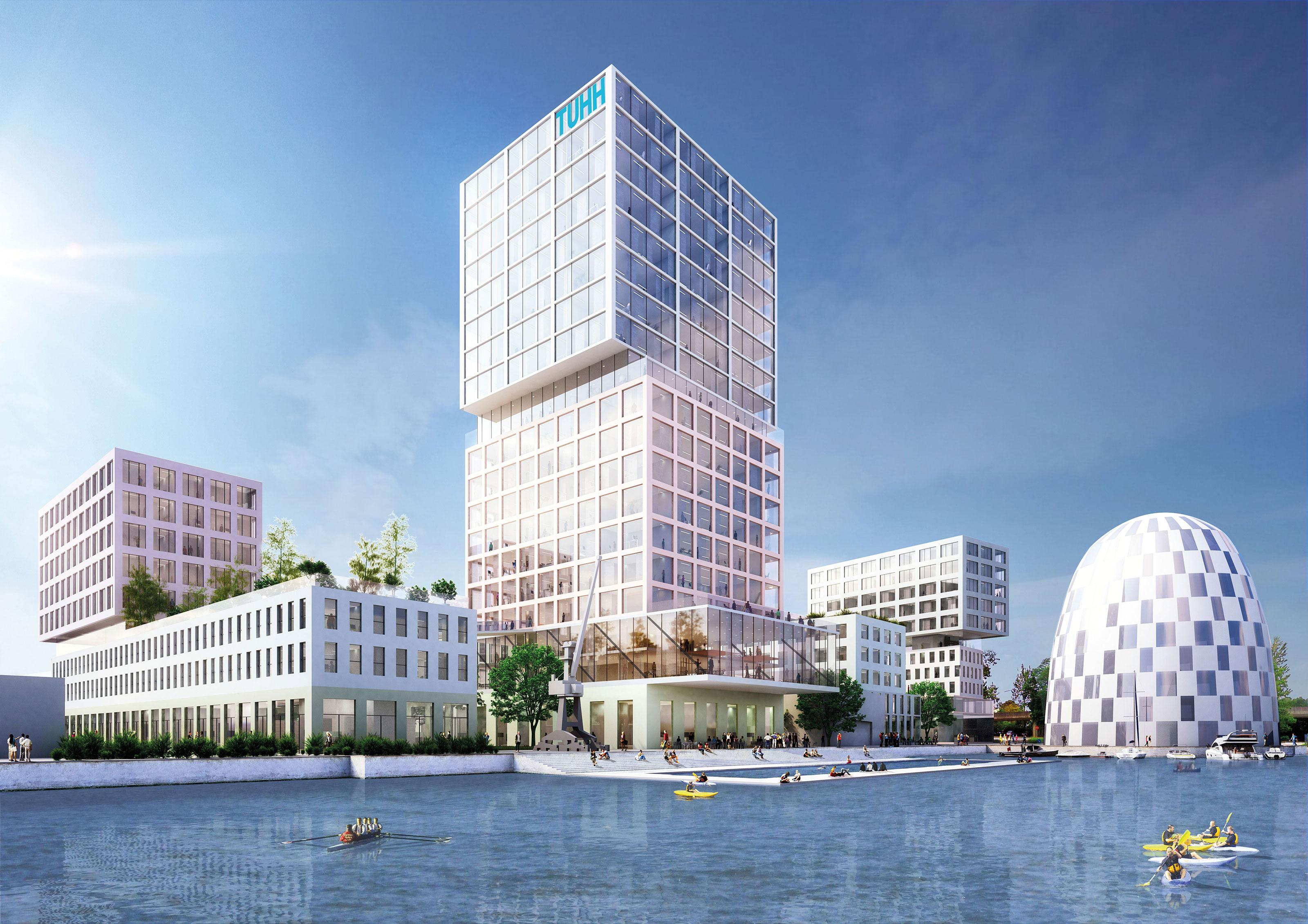
The institute is located in the newly built Hamburg Innovation Port
(www.hamburg-innovation-port.com/wp-content/uploads/2018/09/01-HIPtuhhlogowasser_web.jpg),
which is located right at the Harburg harbour with great views of the
harbour and Hamburg's famous opera house (Elbphilharmonie). Several
other computer science institutes of the TU Hamburg are located in the
area, as well as DASHH - Data Science in Hamburg, the Helmholtz Graduate
School for the Structure of Matter, and the German Air and Space
Research Center (DLR). They are all located in the Free and Hanseatic
City of Hamburg, which is Germany's second largest city, home to a
population of about 1.8 million people. The city is famous for its wide
offers of entertainment, culture and attractions, with several
universities and much research in algorithms.

TU Hamburg offers several attractive benefits, including subsidized
public transport for the Hamburg metropolitan area, a sports centre on
campus, family-friendly working hours, healthy campus initiatives, and
more. For international staff, German classes are offered.

An excellent Masters degree --- either already obtained or to be
completed soon --- in (Applied) Mathematics, Computer Science,
Operations Research, Engineering or related field is required. Affinity
with optimization, algorithms, or discrete mathematics is preferred. In
particular, background in algorithms and complexity, or mathematical
optimization is appreciated. Programming experience is considered a plus.

Interested individuals should submit their applications by 18 July 2024.
For a full job description and details on how to apply see
https://www.tuhh.de/algo/jobs/phd-positions. Any questions regarding the
position should be directed to Prof. Matthias Mnich (algo@tuhh.de).

Hamburg University of Technology regards diversity as an integral part
of academic excellence and is committed to employment equity and
accessibility for all employees. As such, we encourage applications from
women, persons with disabilities, members of diverse gender identities,
and others who may contribute to the further diversification of ideas.
In Hamburg, you will have the opportunity to work across disciplines and
collaborate with an international community of scholars and a diverse
student body.
**********************************************************
*
* Contributions to be spread via DMANET are submitted to
*
* DMANET@zpr.uni-koeln.de
*
* Replies to a message carried on DMANET should NOT be
* addressed to DMANET but to the original sender. The
* original sender, however, is invited to prepare an
* update of the replies received and to communicate it
* via DMANET.
*
* DISCRETE MATHEMATICS AND ALGORITHMS NETWORK (DMANET)
* http://www.zaik.uni-koeln.de/AFS/publications/dmanet/
*
**********************************************************

[DMANET] PhD and Postdoc positions in Quantum Computing (Bochum)

Dear all,

The Quantum Information group at Ruhr University Bochum is currently
looking for PhD students and postdocs broadly in quantum computing and
information. The PhD position could also be an entry point for motivated
students to get into this exciting and fast-moving field. Please see our
homepage for more details: https://qi.rub.de/hiring. The application
deadline is on July 27.

Best wishes,
Michael

**********************************************************
*
* Contributions to be spread via DMANET are submitted to
*
* DMANET@zpr.uni-koeln.de
*
* Replies to a message carried on DMANET should NOT be
* addressed to DMANET but to the original sender. The
* original sender, however, is invited to prepare an
* update of the replies received and to communicate it
* via DMANET.
*
* DISCRETE MATHEMATICS AND ALGORITHMS NETWORK (DMANET)
* http://www.zaik.uni-koeln.de/AFS/publications/dmanet/
*
**********************************************************

[DMANET] 2 Professorships (W3) of Data Science at Friedrich-Alexander-Universität Erlangen-Nürnberg

The Faculty of Sciences at Friedrich-Alexander-Universität
Erlangen-Nürnberg invites applications for up to two W3 professorships
at the Department of Data Science (DDS). DDS invites applications from
candidates who have outstanding expertise in the mathematical aspects of
data science. We are open to applications from candidates from both
early and advanced stages in their careers.

The professorships are expected to cover essential research topics in
the field of data science. Successful candidates are expected to have an
outstanding profile in a current area of research, such as statistical
learning theory, mathematical foundations of machine learning,
probabilistic machine learning, modern algorithms for data analysis,
mathematical analysis of large volumes of data, high-dimensional
statistics, reinforcement learning, deep learning, optimization and
machine learning, or the basics of foundation models.

Details can be found here:

www.datascience.nat.fau.de/w3-positions


**********************************************************
*
* Contributions to be spread via DMANET are submitted to
*
* DMANET@zpr.uni-koeln.de
*
* Replies to a message carried on DMANET should NOT be
* addressed to DMANET but to the original sender. The
* original sender, however, is invited to prepare an
* update of the replies received and to communicate it
* via DMANET.
*
* DISCRETE MATHEMATICS AND ALGORITHMS NETWORK (DMANET)
* http://www.zaik.uni-koeln.de/AFS/publications/dmanet/
*
**********************************************************

Monday, July 1, 2024

[DMANET] Tenure-track in Discrete Mathematics at the University of Innsbruck

Dear Colleagues,

(Sorry if you get this message multiple times, I've just learnt about this mailing list.)

The University of Innsbruck (Austria) has opened a Tenure-track position in Discrete Mathematics.
You can find all the information at this webpage: https://lfuonline.uibk.ac.at/public/karriereportal.details?asg_id_in=14269
The legally binding announcement is in German.

The deadline for applications is July 19, 2024.

I would be grateful if you could distribute this announcement among potential candidates.

Feel free to contact me in case of any questions:
alexander.glazman@uibk.ac.at<mailto:alexander.glazman@uibk.ac.at>
https://www.uibk.ac.at/mathematik/personal/aglazman/

Best regards,
Alexander Glazman


**********************************************************
*
* Contributions to be spread via DMANET are submitted to
*
* DMANET@zpr.uni-koeln.de
*
* Replies to a message carried on DMANET should NOT be
* addressed to DMANET but to the original sender. The
* original sender, however, is invited to prepare an
* update of the replies received and to communicate it
* via DMANET.
*
* DISCRETE MATHEMATICS AND ALGORITHMS NETWORK (DMANET)
* http://www.zaik.uni-koeln.de/AFS/publications/dmanet/
*
**********************************************************

[DMANET] Second Call: Lecturer in Algorithms and Complexity at the University of Bristol, UK

The School of Computer Science at the University of Bristol is looking to appoint an outstanding candidate for a lectureship (roughly equivalent to the level of Assistant Professor in the North American system) in Algorithms and Complexity. Our aim is to hire an ambitious theorist with a proven track record of high-quality publications whose ambition is to develop and pursue their independent research agenda. We will consider applicants from all subfields within Algorithms and Complexity research.

You will join our steadily growing Algorithms and Complexity research group, which is internationally recognized for their work on algorithms and lower bounds in the fields of sublinear algorithms, randomized algorithms, graph and string algorithms, and parameterized and fine-grained complexity. We offer a vibrant research environment with opportunities for collaborations with the members of the Algorithms and Complexity group as well as with the world-leading academics in the school of Mathematics.

Application Deadline: July 15th

For more information and for submitting your application, please visit:

https://www.bristol.ac.uk/jobs/find/details/?jobId=350015&jobTitle=Lecturer%20in%20Algorithms%20and%20Complexity%20

For informal queries please contact:

- Dr Christian Konrad for enquiries regarding the Algorithms and Complexity group.
christian.konrad@bristol.ac.uk<mailto:christian.konrad@bristol.ac.uk>

- Professor Mike Fraser for enquiries regarding the School of Computer Science.
mmike.fraser@bristol.ac.uk<mailto:mike.fraser@bristol.ac.uk>

**********************************************************
*
* Contributions to be spread via DMANET are submitted to
*
* DMANET@zpr.uni-koeln.de
*
* Replies to a message carried on DMANET should NOT be
* addressed to DMANET but to the original sender. The
* original sender, however, is invited to prepare an
* update of the replies received and to communicate it
* via DMANET.
*
* DISCRETE MATHEMATICS AND ALGORITHMS NETWORK (DMANET)
* http://www.zaik.uni-koeln.de/AFS/publications/dmanet/
*
**********************************************************

[DMANET] 2024 IEEE HONET: Submission Deadline Extended

Due to multiple requests, we are pleased to announce an extension of the submission deadline for the 2024 IEEE HONET Conference.

CALL FOR PAPERS
2024 IEEE 21st International Conference on Smart Communities: Improving Quality of Life using AI, Robotics and IoT (HONET)
December 03-05, 2024
University of Doha for Science & Technology
Doha, Qatar
https://honet-ict.org

We are delighted to announce our keynote speakers:
- Dr. Gordon Cheng: Fellow IEEE, Professor and Coordinator Center of Competence Neuro-Engineering in ECE Department, Technical University Munich, Germany
- Dr. James Won-Ki Hong: Professor, Dept. of Computer Science and Engineering, Dir. Distributed Processing & Networks Management Lab, Pohang University of Science and Technology (POSTECH), Korea
- Dr. Mohammad Shahidehpour: Fellow IEEE, Bodine Chair Professor and Director, Galvin Center for Electricity Innovation, Illinois Institute of Technology

SPONSORS:
- University of Doha for Science & Technology, Doha, Qatar
- HONET-ICT cf. Center for Opto-electronics and Optical Communication, UNC Charlotte, Charlotte NC 28223, USA
- IEEE Qatar Section
- IEEE North Carolina Council

TOPICS OF INTEREST:
Authors are invited to submit R&D and concept papers presenting original research work related to the practice and theory related to the scope of HONET thematic areas. Related proposals for Workshops and Tutorials will be considered. All submissions must describe original and pertinent research, development, and future vision. The topics of interest include, but are not limited to the ones shown below.

These topics should be discussed in terms of research findings, concepts, state-of-the-art, standards, implementations, developments, field trials/experiments, educational goals, and new applications. Submitted or substantially similar papers must not be under review currently for any other publication.

1. AI & IoT
a. Enhancing the capabilities of Smart Communities using AI
b. Machine Learning models for Smart Cities (LSTM, Deep Learning, Transformers)
c. Realizing Smart Localities using IoT
2. Robotics
a. Robotics & Automation
b. Autonomous Vehicles and Charging Technologies
c. Computer Vision
3. Computer and Communication Networks and Network Security
a. Wireless Networks
b. Photonic Networks
c. 5G Communication and beyond
d. Software Defined Networks (SDN)
e. Network Security and Forensic Analysis
4. Energy and Power Technologies
a. Renewable Energy Sources
b. Smart-Grids and Robust Infrastructure
c. Smart Storage and Demand & Response
d. Micro Grid Analytics and Management
e. Smart Grid and Smart Cities
5. Photonics
a. LEDs, Lasers and Solar Cells and Panels
b. Packaging

STEERING COMMITTEE
M. Yasin Akhtar Raja, Senior Member IEEE, Optica and Fellow SPIE, Prof. Phys. & Optical Science,
Optoelectronics & Optical Communication, UNC Charlotte, NC, USA

Rachid Benlamri, Prof. & VP Academics, University of Doha for Science & Technology, Doha, Qatar

Glenn D. Boreman, Prof. and Chair Physics & Optical Science, Fellow IEEE, SPIE and Optica,
Dir. Center for Optoelectronics & Optical Communication, UNC Charlotte, USA

M. Iqbal Choudhary, Prof., Coordinator General COMSATS, Islamabad, Pakistan

GENERAL CHAIRS
Rachid Benlamri, Prof. & VP Academics, University of Doha for Science & Technology, Doha, Qatar

M. Yasin Akhtar Raja, Senior Member IEEE, Optica and Fellow SPIE, Prof. Physics & Optical Science,
Optoelectronics & Optical Communication, UNC Charlotte, NC, USA

CONFERENCE CHAIRS
Zakaria Maamar, Prof., University of Doha for Science & Technology, Doha, Qatar

Mohammad Ilyas, SMIEEE, Prof., Dept. EE & CS, College of Engineering and Computer Science, Florida Atlatic University, Boca Raton, Florida, USA


IMPORTANT DATES:
Full Len Papers Due: 31 Jul 2024
Short Papers Due: 31 Jul 2024
Acceptance Notification: 31 Aug 2024
Camera Ready Due: 15 Sep 2024
Registration Deadline: 15 Sep 2024
Program Available: 01 Oct 2024


Accepted and presented papers will be published in the conference proceedings and submitted to IEEE Xplore as well as other Abstracting and Indexing (A&I) databases.

Visit https://honet-ict.org for more details and instructions on paper submission.
Instructions for paper submission: https://honet-ict.org/author-inst.html
Submit your paper: https://edas.info/N32390

IEEE HONET 2024
TPC Chairs

**********************************************************
*
* Contributions to be spread via DMANET are submitted to
*
* DMANET@zpr.uni-koeln.de
*
* Replies to a message carried on DMANET should NOT be
* addressed to DMANET but to the original sender. The
* original sender, however, is invited to prepare an
* update of the replies received and to communicate it
* via DMANET.
*
* DISCRETE MATHEMATICS AND ALGORITHMS NETWORK (DMANET)
* http://www.zaik.uni-koeln.de/AFS/publications/dmanet/
*
**********************************************************

[DMANET] Combinatorial Reconfiguration Workshop - Last call for presentations

CALL FOR PRESENTATIONS

=======================================================
The 5th Combinatorial Reconfiguration Workshop

October 7-11, 2024
Nishijin Plaza, Kyushu University, Japan

Submission deadline: July 7, 23:59 (AoE)
=======================================================

* Aim and Scope
Combinatorial Reconfiguration studies reachability and related questions
over combinatorial structures. (See, e.g., a survey at
https://doi.org/10.3390/a11040052 ) These types of questions arise in
many areas of computer science, mathematics, and related fields. In
addition to presenting the latest research findings related to
combinatorial reconfiguration, a major feature of this workshop is to
allocate ample time for participants to engage in working sessions
tackling open problems. Our previous workshops have each resulted in new
    collaborations, many stemming from open problem sessions during
which researchers have a chance to meet and work together for the first
time.

* Call for Presentations
We are seeking participants interested in presenting in one or more of
the following types of sessions:
- Contributed talks
- Mentoring sessions
- Open problem sessions

All topics relating to any aspect or application of combinatorial
reconfiguration are welcome, including both published and unpublished
work. Presentations of ongoing work and open problems are encouraged.

Mentoring sessions are designed for newcomers to the area to obtain
feedback from more senior members in the community, including on work in
progress.

Open problem sessions will be used as the starting point for working
sessions during the workshop, allowing for new collaborations to be
formed. We will accommodate new open problem presentations suggested
during the workshop if time permits; submitting open problems by the
submission deadline will ensure a reserved time slot.

Please feel free to propose more than one type of presentation. For each
proposed presentation, please provide a title and a single paragraph
explaining what will be discussed, via the Google form below. If you are
submitting more than one proposal, use the Google form once for each
proposal. There will be no formal refereeing process; however, the
Program Committee reserves the right to reject contributions that are
substantially off-topic.

https://forms.gle/satzTguSbj9FjDTcA


We anticipate that the length of presentations will be approximately
20-30 minutes (or less at the request of the presenter); however, exact
times will be determined only when we know how many presentations have
been accepted.

* Important Dates:
- Submission deadline: July 7, 23:59 (AoE)
- Notification: July 19

* Invited Speakers:
- Jean Cardinal (Université libre de Bruxelles, Belgium)
- Naoto Ohsaka (CyberAgent, Inc., Japan)

* Program Committee:
- Nicolas Bousquet (CNRS, Université Claude Bernard Lyon 1, France)
- Takehiro Ito (Tohoku University, Japan), Chair
- Naomi Nishimura (University of Waterloo, Canada)
- Akira Suzuki (Tohoku University, Japan)

* Organizing Committee:
- Takehiro Ito (Tohoku University, Japan), Chair
- Naoyuki Kamiyama (Kyushu University, Japan)
- Akira Suzuki (Tohoku University, Japan)

* Contact
Please send any questions to reconf.workshop2024@grp.tohoku.ac.jp

* Support
- Institute of Mathematics for Industry, Joint Usage/Research Center in
Kyushu University (Reference No. 2024a037)
- JSPS Grant-in-Aid for Scientific Research (Grant No. JP24H00686)


--
Nicolas Bousquet, for the program committee


**********************************************************
*
* Contributions to be spread via DMANET are submitted to
*
* DMANET@zpr.uni-koeln.de
*
* Replies to a message carried on DMANET should NOT be
* addressed to DMANET but to the original sender. The
* original sender, however, is invited to prepare an
* update of the replies received and to communicate it
* via DMANET.
*
* DISCRETE MATHEMATICS AND ALGORITHMS NETWORK (DMANET)
* http://www.zaik.uni-koeln.de/AFS/publications/dmanet/
*
**********************************************************

[DMANET] Digital Data Processing DDP 2024

Fourth International Conference on Digital Data Processing (DDP 2024)
Yeshiva University. New York. US
September 30-October 01, 2024
(www.socio.org.uk/ddp)
(IEEE Xplore indexed)

As technology advances in different sub-domains of computing, data-driven models are becoming increasingly important. The data-dependent world now faces many challenges in terms of data accuracy and data privacy. High-impact advancements include machine learning, artificial intelligence, deep learning and many more. Data is growing exponentially in terms of diversity and complexity. One organization or industry processes over a few million transactions per hour and stores hundreds of billions of data. We live in a world with a great need for more efficient data analysis and processing. Data analytics can reveal hidden patterns, complex relationships, internal information relations, and even segmentation. Data applications have opened up new possibilities in every aspect of our lives. Studying data and its structure, dynamics, and modern data technologies is ongoing. There is a great deal of literature and research on data management, but it does not address the data processing needs. Many studies focus on developing models and systems for analyzing large datasets.

Data analysis leads to application domains that have a systematic impact on decisions. The knowledge gained from the data analysis enables the generation of critical information for multiple domains. In this conference, we review and discuss the latest trends in data management, the opportunities and challenges, and how they have affected organizations' ability to develop effective business and technology strategies and stay up-to-date in data technology. We also highlight current open research directions in data analytics that need further attention.

The proposed conference will discuss topics not limited to

Data applications in various domains and activities
Data in cloud
Real-world data processing
Data inaccuracy and reliability issues
Data Ecosystem
Business Analytics
New data analytics techniques
Physical and management challenges
Synthetic data
Data synthesis
Crowdsourcing and Sensing
Data modelling
Deep learning techniques
Data fusion
Descriptive analytics, Diagnostic analytics, Predictive Analytics, and Prescriptive analytics
Machine learning impact on data processing
Network optimization
Data in Biomedical Engineering
Data in Materials science and mechanics
Data handling and applications in domains
Wireless Networking Data Management
Data of Electronic & Embedded Systems
Multi-media Systems Data
Artificial Intelligence Models and Systems Data
E-Computing Data
Renewable Energies Data

General Chair

Honggang Wang, Yeshiva University, USA

Program Chairs

Youshan Zhang, Yeshiva University, USA
Ezendu Ariwa, Warwick University, UK
Simon Fong, University of Macau, Macau

Program Co-chairs

Martin Lopez Nores, University of Vigo, Spain

Keynote Speakers

1. Xiaofan (Fred) Jiang, Columbia University
2. Edwin Chihchuan Kan, Cornell University

Publications

All accepted and presented papers will be submitted to IEEE Xplore for publication and indexing.

The DDP 2024 has a co-located workshop on Data Analytics in Biomedicine

Modified versions of the papers will appear in the following journals.

Journal of Digital Information Management
International Journal of Computational Linguistics
Information Services & Use

Important Dates

Submission of Papers: July 15, 2024
Notification of Acceptance/Rejection: August 15, 2024
Camera-ready: September 15, 2024
Registration: September 15, 2024
Conference Dates: September 30- October 01, 2024

Paper submission

Papers should follow the IEEE template. Submissions at http://socio.org.uk/ddp/paper-submission/

Contact: ddp@socio.org.uk

**********************************************************
*
* Contributions to be spread via DMANET are submitted to
*
* DMANET@zpr.uni-koeln.de
*
* Replies to a message carried on DMANET should NOT be
* addressed to DMANET but to the original sender. The
* original sender, however, is invited to prepare an
* update of the replies received and to communicate it
* via DMANET.
*
* DISCRETE MATHEMATICS AND ALGORITHMS NETWORK (DMANET)
* http://www.zaik.uni-koeln.de/AFS/publications/dmanet/
*
**********************************************************

[DMANET] HIGHLIGHTS '24: Last Call for Participation (Registration deadline 7th July)

The registration deadline for HIGHLIGHTS 2024 and Jewels of Automata Theory
2024 is this *Sunday 7th July*. (See the full CfP below.)

*Registration page:* https://framaforms.org/highlights
-and-jewels-of-automata-theory-2024-1715936947

Please note there was a typo in the previous communication: the
registration fee for on-site attendance is *85.25€* (instead of 80.25€).

*Registration to Highlights' Collaborative Research Weak:*
If you consider staying for HCRW, you can indicate it in the registration
form, and share your plans in the Zulip chat (registration at
https://highlights-conference.org/2024/zulip).HIGHLIGHTS'24, JEWELS OF
AUTOMATA THEORY '24, (Bordeaux, France, 16-20 September 2024) AND HCRW
(21-27 September)

*HIGHLIGHTS'24* and *Jewels of Automata Theory '24* are jointly scheduled *from
September 16 to September 20, 2024* at the *University of Bordeaux, France*,
in *LaBRI*. They will be followed by the *Highlights Collaborative Research
Week (HCRW)*, from *September 21 to 27, 2024*.

*HIGHLIGHTS'24* is the twelfth in the series of international conferences
"Highlights of Logic, Games and Automata", aiming at integrating the
community working in algorithmic model theory, automata theory, databases,
games for logic and verification, logic and verification. Papers from these
areas are dispersed across many conferences, which makes them difficult to
follow. A visit to the HIGHLIGHTS conference should offer a wide picture of
the latest research in the field and a chance to meet everybody in the
community, not just those who happen to publish in one particular
proceedings volume. There are no publications.

Jewels of Automata Theory 2024 will survey a wide picture of research in
automata theory and related mathematical fields. It will consist of invited
lectures which describe significant progress over the past years, and will
be a meeting point for both young and senior researchers to learn and to
discuss about automata theory, its connections with mathematics and its
applications.

*HIGHLIGHTS'24* key features:

- HIGHLIGHTS is a conference without publications, where speakers give
short presentations of their best work.
- The 2024 edition is colocated with Jewels of Automata Theory a
conference featuring invited talks on mathematical aspects of automata
theory.
- A chat of the conference is available during the event, and throughout
the year.
- There is an early round of submissions and notifications to help with
travel planning.
- The *Highlights' Collaborative Research Week* (*HCRW*) offers means
for research collaborations/discussions between participants. HCRW is
scheduled after the conference.
- The *Highlights Extended Stay Support Scheme* (*HESSS*) helps
participants find collaborators and organise visits in the vicinity of
HIGHLIGHTS.
- Highlights has now an environmental chair, Antoine Amarilli, in charge
of assessing the carbon footprint of the event.

We encourage you to attend and present your best work - be it already
published or not - at *HIGHLIGHTS'24*.
SCOPE

Representative areas include, but are not restricted to:

- Algebraic models of computation
- Algorithmic model theory
- Automata theory
- Databases
- Games for logic and verification
- Logic
- Verification

IMPORTANT DATES AND INFORMATION

- Registration to the chat of the conference at
https://highlights-conference.org/2024/zulip (no need if you did it last
year)
- HIGHLIGHTS'24 webpage: https://highlights-conference.org/2024/
- Jewels of Automata Theory'24 webpage:
https://highlights-conference.org/2024/jewels
- HCRW page: https://highlights-conference.org/2024/hcrw
- HESSS page: https://highlights-conference.org/2024/hesss
- Submission page:
https://openreview.net/group?id=highlights-conference.org/Highlights/2024/Conference
- Registration page:
https://framaforms.org/highlights-and-jewels-of-automata-theory-2024-1715936947
- Registration deadline: July 7, 2024
- Early submission deadline: April 15, 2024
- Regular submission deadline: June 17, 2024
- Conference: September 16-20, 2024.
- *Highlights' Collaborative Research Weak* (*HCRW*): September 21 - 27,
2024.

MODALITIES OF ATTENDANCE

*HIGHLIGHTS'24* is an event that will take place on-site (barring
unforeseen circumstances), and the preferred form of participation is in
person. Remote attendance via a video stream will also be offered, but with
limited possible interactions for these participants.

Submission to Highlights'24 is open to everyone, and attendance to the
conference is not a requirement. The selection procedure will not take into
account in-person attendance. Authors who do not intend to attend
Highlights'24 in-person must commit to this choice when submitting their
talk proposal. If accepted, authors of such talk proposals will have the
opportunity to share a prerecorded video of their talk, which will be made
available on the conference website.

Before coming from far away, please review how your trip and international
flights are contributing to climate change. We encourage you to take the
train as much as possible, possibly taking the opportunity for visiting
colleagues on the way and thus decomposing the travel into smaller pieces.

More generally, we encourage you to make the most of your stay. This means
extending your journey to the previous and/or following weeks for more
scientific activities in Bordeaux and around. Several initiatives are here
to help you in this task:

- You can participate in the *Highlights' Collaborative Research
Week* (*HCRW
<https://highlights-conference.org/2024/hcrw>, September 21-27*) in the
week after HIGHLIGHTS, in Bordeaux.
- You can use the *Highlights Extended Stay Support Scheme* (*HESSS
<https://highlights-conference.org/2024/hesss>*) for finding
collaborators and organising visits.

SUBMISSIONS AND GUIDELINES

Submissions should take the form of a short abstract describing the content
of the presentation and its interest. It should serve as a proposal for a
presentation. Hence, submissions should have a single author — the speaker.
They can concern any recently published, to be published, or ongoing work
of the speaker. We expect you to present your favourite result of the year,
so there should be at most one submission per speaker. The abstract should
list co-authors, if any. Optionally, an extended abstract of up to two
pages may be attached as a PDF file.

We encourage both young and senior researchers to present.

The *submission deadline is Monday, June 17*, with a *notification by June
28*.

Submissions will not lead to publications. There are no formal proceedings
and we encourage the presentation of work published or presented elsewhere.

The talk (which is short, around 10 minutes) can be doubled with a poster.
Further information about poster submissions will be provided.

*Submission page:*
https://openreview.net/group?id=highlights-conference.org/Highlights/2024/Conference

(Note that it is required to have an account with openreview.net to submit
an abstract.)
REGISTRATION

Participants to HIGHLIGHTS'24 and Jewels of Automata Theory '24 must
register before *Sunday, July 7* by completing the form in the webpage
indicated below.

*Registration page*:
https://framaforms.org/highlights-and-jewels-of-automata-theory-2024-1715936947

The registration fee for on-site attendance is 85.25 EUR. Online attendance
is free, but registration is required.
HIGHLIGHTS COLLABORATIVE RESEARCH WEAK (HCRW)

*HIGHLIGHTS'24* will be followed by the *Highlights' Collaborative Research
Week* (*HCRW*), *from September 21 to 27 (including Saturday) at the
University of Bordeaux*.

Participants to HCRW are free to organise any scientific activity they
wish. Possibilities can be to

- meet someone in particular and work together,
- organise or attend a seminar/workshop/reading group,
- gather for solving open problems,
- solicit, offer and participate in a lecture.
Working spaces will be provided on site for these activities to take
place.

We encourage participants to offer activities in advance.

- HCRW webpage: https://highlights-conference.org/2024/hcrw
- If you intend to participate to HCRW, post it on the zulip stream.
- To offer or suggest activities, send your proposals to Théo Matricon:
theomatricon[at]gmail[dot]com

Confirmed workshops

- *Algebraic methods in automata theory.*
Possible topics include semigroups, decidability of classes of
languages, algebras, categories, monads, etc.
- TBA

HIGHLIGHTS EXTENDED STAY SUPPORT SCHEME (HESSS)

The *HESSS* is an incentive for collaborations between participants of the
conference and researchers working in research groups reachable by train
from the conference location. The objective is to foster interactions with
low carbon footprint. The mechanism is as follows:

- Research groups willing to participate in the scheme are listed on the
webpage: https://highlights-conference.org/2024/hesss. These groups are
offering to fund collaborations between HIGHLIGHTS participants and their
members.
- The pair of a HIGHLIGHTS participant and a member of a listed research
group submit a proposal, which takes the form of an email containing names,
period of collaboration, and a sentence describing the planned activity. It
has to be sent to the *HESSS* contact person of the research unit
(better through zulip).
- The decision of acceptance is up to the research group. In particular,
it may be subject to scientific scope, number of requests, or e.g.,
favouring distant participants.
- The only strict rule is that the visit should be around HIGHLIGHTS,
and no airplane should be taken by the visitor to travel from HIGHLIGHTS to
the visit location.

INVITED TALKS Joint invited speaker

- Mikołaj Bojańczyk (University of Warsaw, Poland)

HIGHLIGHTS'24:

- Albert Atserias (Technical University of Catalonia, Spain)
- Pablo Barcelo (Universidad Católica de Chile)
- Laure Daviaud (University of East Anglia, UK)

Jewels of Automata Theory'24

- Nathanaël Fijalkow (University of Bordeaux, France)
- Artur Jeż (University of Wrocław, Poland)
- Jarkko Kari (University of Turku, Finland)
- Barbara König (University Duisburg-Essen, Germany)
- Jérôme Leroux (University of Bordeaux, France)
- Anca Muscholl (University of Bordeaux, France)
- Karin Quaas (University of Leipzig, Germany)
- Daniel Smertnig (University of Ljubljana, Slovenia)
- Tatiana Starikovskaya (ENS Paris, France)
- Wolfgang Thomas (University of Aachen, Germany)
- Marc Zeitoun (University of Bordeaux, France)
- Georg Zetzsche (MPI-SWS Kaiserslautern, Germany)

COMMITTEES PROGRAM COMMITTEE HIGHLIGHTS'24

- C. Aiswarya (Chennai Mathematical Institute, India)
- Shaull Almagor (Technion, Israel)
- Christel Baier (TU Dresden, Germany)
- Azadeh Farzan (Univ. of Toronto, Canada)
- Sam van Gool (IRIF, France)
- Ichiro Hasuo (National Institute of Informatics, Japan)
- Bartek Klin (Univ. of Oxford, UK; chair)
- Barbara König (Univ. of Duisburg-Essen, Germany)
- Karoliina Lehtinen (LIS, Aix-Marseille Univ., France)
- Anthony Widjaja Lin (TU Kaiserslautern, Germany)
- Anca Muscholl (LaBRI, Univ. Bordeaux, France)
- Ana Sokolova (Univ. of Salzburg, Austria)
- Szymon Toruńczyk (Univ. of Warsaw, Poland)
- Sophie Pinchinat (IRISA Rennes, France)

ORGANISING COMMITTEE

- Sylvain Lombardy
- Corto Mascle
- Théo Matricon
- Rémi Morvan
- Vincent Penelle
- Pierre Vandenhove

SAFETOC COUNSELOR

- Rémi Morvan

STEERING COMMITTEE

- Antoine Amarilli (environmental chair)
- León Bohn (webmaster)
- Antonio Casares (publicity chair)
- Supratik Chakraborty
- Thomas Colcombet (chair)
- Sławek Lasota
- Sophie Tison

PROGRAM COMMITTEE Jewels of Automata Theory'24

- Manfred Droste(chair)
- Jorge Almeida
- Patricia Bouyer
- Véronique Bruyère
- Thomas Colcombet
- Laurent Doyen
- Dora Giammarresi
- Juhani Karhumäki
- Bartek Klin
- Markus Lohrey
- Sylvain Lombardy
- Damian Niwiński
- Jacques Sakarovitch
- Sylvain Schmitz
- Marinella Sciortino
- Jeffrey Shallit
- Alexandra Silva
- Benjamin Steinberg

**********************************************************
*
* Contributions to be spread via DMANET are submitted to
*
* DMANET@zpr.uni-koeln.de
*
* Replies to a message carried on DMANET should NOT be
* addressed to DMANET but to the original sender. The
* original sender, however, is invited to prepare an
* update of the replies received and to communicate it
* via DMANET.
*
* DISCRETE MATHEMATICS AND ALGORITHMS NETWORK (DMANET)
* http://www.zaik.uni-koeln.de/AFS/publications/dmanet/
*
**********************************************************