Monday, September 7, 2020

[DMANET] Two postdoc position at

Two PostDoc positions to start working in the AI Institute this fall inSophia Antipolis. The required profiles can be found at these URLS:


ProfileA

https://recrutement.skema.edu/?page=advertisement_display&id=533

 ProfileB


https://recrutement.skema.edu/?page=advertisement_display&id=535


On behalf of Davide La Torre

**********************************************************
*
* Contributions to be spread via DMANET are submitted to
*
* DMANET@zpr.uni-koeln.de
*
* Replies to a message carried on DMANET should NOT be
* addressed to DMANET but to the original sender. The
* original sender, however, is invited to prepare an
* update of the replies received and to communicate it
* via DMANET.
*
* DISCRETE MATHEMATICS AND ALGORITHMS NETWORK (DMANET)
* http://www.zaik.uni-koeln.de/AFS/publications/dmanet/
*
**********************************************************

[DMANET] CFP: IEEE Conferences (ISPA, BDCloud, SocialCom, SustainCom), 17-19 December 2020 (Virtual and New Dates)

[Please accept our apologies if you receive multiple copies of this email]


*** IEEE (ISPA-2020, BDCloud-2020, SocialCom-2020, SustainCom-2020
International Conferences) ***


To be held virtually in England, UK, 17-19 December 2020.


The 18th IEEE International Symposium on Parallel and Distributed
Processing with Applications (ISPA-2020)

https://hpcn.exeter.ac.uk/ispa2020


The 10th IEEE International Conference on Big Data and Cloud Computing
(BDCloud-2020)

https://hpcn.exeter.ac.uk/bdcloud2020


The 13th IEEE International Symposium on Social Computing and Networking
(SocialCom-2020)

https://hpcn.exeter.ac.uk/socialcom2020


The 10th IEEE International Conference on Sustainable Computing and
Communications (SustainCom-2020)

https://hpcn.exeter.ac.uk/sustaincom2020


Sponsored by

IEEE, IEEE Computer Society, and IEEE Technical Committee of Scalable
Computing (TCSC)


IMPORTANT DATES

===============

Paper Submission Deadline: 12 September 2020

Authors Notification: 18 October 2020

Camera-Ready Paper Due: 17 November 2020

Early Registration Due: 17 November 2020

Conference Date: 17-19 December 2020

VIRTUAL/REMOTE CONFERENCE

=========================

After evaluating the current COVID-19 situation and associated travel
restrictions, the conference will be held virtually with remote
presentation on 17-19 December 2020 as the safety and well-being of all
conference participants are of the highest priority. Accepted papers will
be submitted for inclusion in IEEE Xplore Digital Library after they are
presented at the virtual conference. The paper submission deadline has been
extended to 12 September 2020 as we understand many are facing unexpected
challenges at this time.


PAPER SUBMISSION GUIDELINE

==========================

All papers need to be submitted electronically through the conference
websites with PDF format. The materials presented in the papers should not
be published or under submission elsewhere. Each paper is limited to 8
pages (or 10 pages with over length charge) including figures and
references using IEEE Computer Society Proceedings Manuscripts style (two
columns, single-spaced, 10 fonts).

Manuscript Templates for Conference Proceedings can be found at

https://www.ieee.org/conferences_events/conferences/publishing/templates.html

Once accepted, the paper will be included into the IEEE conference
proceedings published by IEEE Computer Society Press (indexed by EI).


JOURNAL SPECIAL ISSUES

======================

Distinguished papers selected from the conferences and associated
workshops, after further extensions, will be recommended for submission and
publication in the Special Issues of the following prestigious journals:


- IEEE Transactions on Industrial Informatics

- Computer Networks (Elsevier)

- Future Generation Computer Systems (Elsevier)

- Journal of Parallel and Distributed Computing (Elsevier)

- Knowledge-Based Systems (Elsevier)

- Neurocomputing (Elsevier)

- Information Fusion (Elsevier)

- IEEE/CAA Journal of Automatics Sinica

- IEEE Transactions on Network Science and Engineering

- IEEE ACCESS

- Sensors

**********************************************************
*
* Contributions to be spread via DMANET are submitted to
*
* DMANET@zpr.uni-koeln.de
*
* Replies to a message carried on DMANET should NOT be
* addressed to DMANET but to the original sender. The
* original sender, however, is invited to prepare an
* update of the replies received and to communicate it
* via DMANET.
*
* DISCRETE MATHEMATICS AND ALGORITHMS NETWORK (DMANET)
* http://www.zaik.uni-koeln.de/AFS/publications/dmanet/
*
**********************************************************

Sunday, September 6, 2020

[DMANET] Launching Lipizzaner project (Distributed Co-Evolutionary GAN Training)

At the Anyscale Learning For All (ALFA) research team at CSAIL MIT, we are
launching the Lipizzaner framework to train Generative Adversarial Networks
by using spatially distributed co-evolutionary algorithms. Most of the
information is on our website at http://lipizzaner.csail.mit.edu/

We have designed and developed Lipizzaner framework to provide resilient
and robust GAN training. Lipizzaner is open-source and it is freely
available in our GitHub repository (
https://github.com/ALFA-group/lipizzaner-gan).

An overview of Lipizzaner can be found in the following Medium post:
https://medium.com/@jamaltoutouh/lipizzaner-a-framework-for-co-evolutionary-distributed-gan-training-7a725fb17e49

The main features of Lipizzaner are:
- Fast convergence because the weights are updated by gradient-based steps
- Improved convergence due to training hyperparameters evolution
- Diverse sample generation because the method returns a mixture of
generators trained by using EC
- Scalability due to spatial distribution topology and asynchronous
parallelism
- Robustness and resilience

It includes a number of datasets ready to be used: CIFAR-10, MNIST,
MNIST-Fashion, CelebA, SVHN, Chest X-Ray COVID-19 images, etc.

In the following days, we will post a series of tutorials and new
documentation.

Get updated. Follow us on twitter: @LipizzanerGAN

PS: We are tweaking Lipizzaner 2.0.... so, we will launch really soon

PPS: See a list of most relevant papers related to Lipizzaner:
J. Toutouh, E. Hemberg, U. O'Reilly. Analyzing the Components of
Distributed Coevolutionary GAN Training. In The Sixteenth International
Conference on Parallel Problem Solving from Nature (PPSN XVI). pages. 10,
2020. arxiv.org/abs/2008.01124
J. Toutouh, E. Hemberg, U. O'Reilly. Re-purposing Heterogeneous Generative
Ensembles with Evolutionary Computation. In Genetic and Evolutionary
Computation Conference (GECCO '20), pages. 10, 2020. DOI:
10.1145/3377930.3390229
J. Toutouh, E. Hemberg, U. O'Reilly. Data Dieting in GAN Training. In: Iba
H., Noman N. (eds) Deep Neural Evolution. Natural Computing Series.
Springer, Singapore. DOI: 10.1007/978-981-15-3685-4_14
Jamal Toutouh, Erik Hemberg, and Una-May O'Reilly. Spatial Evolutionary
Generative Adversarial Networks. In Genetic and Evolutionary Computation
Conference (GECCO '19), July 13–17, 2019, Prague, Czech Republic. ACM, New
York, NY, USA, 9 pages. https://doi.org/10.1145/3321707.3321860
A. Al-Dujaili, T. Schmiedlechner, E. Hemberg, U. O'Reilly. Towards
distributed coevolutionary GANs. In AAAI 2018 Fall Symposium, 2018.
T. Schmiedlechner, I. Ng Zhi Yong, A. Al-Dujaili, E. Hemberg, U. O'Reilly.
Lipizzaner: A System That Scales Robust Generative Adversarial Network
Training. In NeurIPS 2018 Workshop on System for Machine Learning, 2018.


----------------------------------------------

Jamal Toutouh, PhD

- Postdoctoral Fellow at MIT CSAIL

+ MIT Postdoctoral Association Board Member

+ ECUSA Association Board Member

email: toutouh@mit.edu

website: jamal.es

twitter: @jamtou

**********************************************************
*
* Contributions to be spread via DMANET are submitted to
*
* DMANET@zpr.uni-koeln.de
*
* Replies to a message carried on DMANET should NOT be
* addressed to DMANET but to the original sender. The
* original sender, however, is invited to prepare an
* update of the replies received and to communicate it
* via DMANET.
*
* DISCRETE MATHEMATICS AND ALGORITHMS NETWORK (DMANET)
* http://www.zaik.uni-koeln.de/AFS/publications/dmanet/
*
**********************************************************

Saturday, September 5, 2020

[DMANET] Fwd: iABC’21 CFP

*CALL FOR PAPERS*

*1st International Applied Bioinformatics Conference*

*(**iABC'21**)*

www.iabconference.com

Istanbul University

https://www.istanbul.edu.tr/en/_

Istanbul, Turkey

June 23-26, 2021


*SCOPE*

The 1st *international Applied Bioinformatics Conference* (iABC'21) will
serve as an excellent international convention for sharing knowledge,
challenges and results in applied research in Bioinformatics and
Informatics. The conference especially welcomes work centered on the
application of Bioinformatics concepts and algorithms for biological
knowledge generation and welcomes topics relating to challenges of
biological applications and use cases which are still not solved properly
in order to open new directions for further informatics research. iABC'21
also invites papers relating to cutting edge information technology applied
on biological use cases, Bioinformatics tools/workflows, best practices,
calls for novel algorithms, translation of novel algorithms, and
workshops/hands-on tutorials of novel Bioinformatics tools and workflows.


*TOPICS* Topics of interest include, but are not limited to:

● eHealth, Diagnostics and Clinical Applications

○ Biomedical Data Mining

○ Biomedical Computing

○ Biomedical Intelligence

○ Biomedical Signal and Image Analysis

○ Biomedical Text Mining and Ontologies

○ Biomedical Knowledge Visualization

○ Clinical Data Analysis

○ Clinical Decision Support and Informatics

○ Electronic Health Record

○ Healthcare Information Systems

○ Health Data Acquisition, Analysis and Mining

○ Healthcare Knowledge Representation and Reasoning

○ Medical Informatics

○ Medical Robotics

● Applied Bioinformatics

○ Workflow Management / Bioinformatics Analysis Pipelines

○ Bioinformatics Algorithms

○ Biological Databases

○ Biological Sensors

○ Computational Modeling and Data Integration

○ Functional Genomics and Proteomics

○ Gene Expression Array Analysis

○ Genome-Phenome Analysis

○ Machine Learning for Biomedical Data Analysis

○ Metabolic Pathway Analysis

○ Modelling of Molecular, Cellular, and Organ Pathways

○ Nano-Bio-Computing

○ Nano-Medicine

○ Neuro-Engineering

○ Pattern Recognition and Soft Computing Techniques

○ Systems Biology

○ Tissue Engineering

○ Translational Bioinformatics

● Biological Challenges

○ Challenging Biological Use Cases

○ Hands On Discussion

○ Biomarker Discovery

○ Cell Engineering

○ Drug Discovery

○ Mass Spectrometry

○ DNA Sequencing

○ Biological Knowledge Visualization

○ Biological Data Transfer

*PAPER SUBMISSION DETAILS*

Authors are invited to submit electronically original contributions in
English. Submitted papers should not exceed 5 pages in pdf in IEEE format <
https://www.ieee.org/conferences/publishing/templates.html>, they will be
evaluated by at least three referees from iABC'21 Scientific Board.

One of the authors of an accepted paper must register to iABC'21 conference
and present the paper. For paper registration and electronic submission see
<http://confdriver.ifs.tuwien.ac.at/dexa2019/><
https://easychair.org/conferences/?conf=iabc21> starting from October 2020.

*ACCEPTED PAPERS*

Extended versions, 12-15 pages, of selected accepted conference papers will
be invited for submission to a special issue in *Journal of Integrative
Bioinformatics* (JIB) <https://www.degruyter.com/view/j/jib> or in*
International Journal of Bioinformatics Research and Applications* (IJBRA) <
https://www.inderscience.com/index.php>.

*IMPORTANT DATES*

Submission of abstracts: December 01, 2020

Early registration: March 01, 2021

Submission of full papers: March 08, 2021

Notification of acceptance: March 30, 2021

Camera-ready copies: April 01, 2021

Conference: June 23-26, 2021

*REGISTRATION FEES*

Registration fees are as follows:

*Turkey*

*Asia **& Africa*

*Europe*

*US & Canada*

*Student *

€75

€100

€200

€200

*Academic *

€150

€200

€400

€400

*Other*

€250

€350

€650

€650

Early registration discount will be finalized on June 5, 2021. After this
date fees listed below will not be applicable.

*Turkey*

*Asia **& Africa*

*Europe*

*US & Canada*

*Student *

€55

€75

€150

€150

*Academic *

€115

€150

€300

€300

*Other*

€190

€265

€490

€490

These fees include no accommodation or any other services.

*GENERAL CHAIRPERSONS*

Jens Allmer, University of Applied Sciences, Mülheim an der Ruhr, Germany

Mourad Elloumi, LaTICE, University of Tunis, Tunisia

*STEERING COMMITTEE*

Jens Allmer, University of Applied Sciences, Mülheim an der Ruhr, Germany

Mourad Elloumi, LaTICE, University of Tunis, Tunisia

Robert Heyer, University of Magdeburg, Magdeburg, Germany

Giuseppe Lancia, University of Udine, Italy

Hasan Oğul, Østfold University College, Halden, Norway

Davide Verzotto, Institute for Informatics and Telematics, CNR, and
University of Pisa, Italy

Malik Yousef, Zefat Academic College, Zefat, Israel

*ORGANIZING COMMITTEE*

Jens Allmer, University of Applied Sciences, Mülheim an der Ruhr, Germany

Emine Şeküre Nazli Arda, Istanbul University, Turkey

Mourad Elloumi, LaTICE, University of Tunis, Tunisia

Marcel Friederichs, University Bielefeld, Germany

Robert Heyer, University of Magdeburg, Magdeburg, Germany

Giuseppe Lancia, University of Udine, Italy

Hasan Oğul, Østfold University College, Halden, Norway

Björn Sommer, University Konstanz, Germany

Davide Verzotto, Institute for Informatics and Telematics, CNR, Italy

Malik Yousef, Zefat Academic College, Zefat, Israel

*PROGRAM COMMITTEE*

Davide Verzotto, Institute for Informatics and Telematics, CNR, Italy (PC
Chair)

Loai AbdAllah, Yezreel Valley Academic College, Israel

Lefteris Angelis, Aristotle University of Thessaloniki, Greece

Chandra Sekhar Rao Annavarapu, India Institute of Technology, Dhanbad, India

Andres Aravena, Istanbul University, Istanbul, Turkey

Ercan Arican, Istanbul University, Istanbul, Turkey

Emine Şeküre Nazli Arda, Istanbul University, Turkey

Ikbal Agah Ince, Acibadem University, Istanbul, Turkey

Jens Allmer, University of Applied Sciences, Mülheim an der Ruhr, Germany

Haider Banka, India Institute of Technology, Dhanbad, India

Ömür Baysal, Mugla Sitki Kocman University, Mugla, Turkey

Mounir Ben Ayed, University of Sfax, Tunisia

Balkiss Bouhaouala-Zahar, University of Tunis-El Manar, Tunisia

Supaporn Chairungsee, Walailak University, Nakhonsithammarat, Thailand

Ming Chen, Zhejiang University, China

Bhaskar DasGupta, University of Illinois at Chicago, Chicago, USA

Mourad Elloumi, LaTICE, University of Tunis, Tunisia

Çigdem Erol, Istanbul University, Istanbul, Turkey

Gilda Eslami, Shahid Sadoughi University of Medical Sciences, Yazd, Iran

Roberto Grossi, University of Pisa, Italy

Sevinç Gulsecen, Istanbul University, Istanbul, Turkey

Robert Harrison, Georgia State University, Atlanta, Georgia, USA

Keywan Hassani-Pak, Rothamsted Research, UK

Robert Heyer, University of Magdeburg, Magdeburg, Germany

Ralf Hofestädt, University Bielefeld, Germany

Sibel Uğur İşeri, Istanbul University, Istanbul, Turkey

Daisuke Kihara, Purdue University, West Lafayette, USA

Aleksey Kochetov, University Novosibirsk, Russia

Rachel Kolodny, University of Haifa, Israel

Giuseppe Lancia, University of Udine, Italy

Thierry Lecroq, University of Rouen, France

Giosuè Lo Bosco, University of Palermo, Italy

Abdelouahid Lyhyaoui, Abdelmalek Essaadi University, Tangier, Morocco

Vladimir Makarenkov, University of Québec, Montréal, Canada

Christos Makris, University of Patras, Greece

Amal Maurady, Abdelmalek Essaadi University, Tangier, Morocco

Hasan Oğul, Østfold, University College, Halden, Norway

Yuri Orlov, University Novosibirsk and University Moscow, Russia

Nehir Ozdemir Ozgenturk, Yildiz Technical University, Istanbul, Turkey

Arup Kumar Pal, India Institute of Technology, Dhanbad, India

Marco Pellegrini, Institute for Informatics and Telematics, CNR, Italy

Pierre Peterlongo, INRIA/Irisa, Rennes, France, France

Pinar Pir, Gebze Technical University, Gebze, Turkey

Solon Pissis, Centrum Wiskunde & Informatica, Amsterdam, Netherlands

Nadia Pisanti, University of Pisa, Italy

Alberto Policriti, University of Udine, Italy

Ravi Rastogi, University of Bisha, Bisha, Saudi Arabia

Chris Rawlings, Rothamsted Research, UK

Ahmed Rebai, Centre of Biotechnology of Sfax, Sfax, Tunisia

Blagoj Ristevsk, Bitola University, Macedonia

Hatem Saleh, Egyptian Organization for Biological Products and Vaccines,
Cairo, Egypt

Rodrigo Santamaria, University of Salamanca, Spain

Mohammad Sohel Rahman, Bangladesh University of Eng. and Tech., Dhaka,
Bangladesh

Falk Schreiber, University Konstanz, Germany

Marinella Sciortino, University of Palermo, Palermo, Italy

Haïtham Sghaier, National Center for Nuclear Sciences and Technology,
Tunis, Tunisia

Oussama Souiai, Pasteur Institute of Tunis, Tunisia

Terje Marken Steinum, Istanbul University, Istanbul, Turkey

Bahar Taneri, Eastern Mediterranean University, Famagusta, North Cyprus

Cemal Ün, Ege University, Izmir, Turkey

Ekrem Varoğlu, Eastern Mediterranean University, Famagusta, North Cyprus

Emanuel Weitschek, Uninettuno University, Rome, Italy

Paul Yoo, University of London, UK

Malik Yousef, Zefat Academic College, Zefat, Israel

Farhana Zulkernine, School of Computing Queen's University Kingston,
Ontario, Canada

***

**********************************************************
*
* Contributions to be spread via DMANET are submitted to
*
* DMANET@zpr.uni-koeln.de
*
* Replies to a message carried on DMANET should NOT be
* addressed to DMANET but to the original sender. The
* original sender, however, is invited to prepare an
* update of the replies received and to communicate it
* via DMANET.
*
* DISCRETE MATHEMATICS AND ALGORITHMS NETWORK (DMANET)
* http://www.zaik.uni-koeln.de/AFS/publications/dmanet/
*
**********************************************************

Friday, September 4, 2020

[DMANET] PhD positions in Algorithmic Graph Theory

PHD POSITIONS IN ALGORITHMIC GRAPH THEORY AT HAMBURG UNIVERSITY OF
TECHNOLOGY (TUHH)
--
The Institute of Algorithms and Complexity at TUHH: Hamburg University
of Technology (www.algo.tuhh.de <https://tuhh.de>) in Hamburg, Germany
invites applications for two fully-paid PhD positions. The successful
candidate will join the project "Resilient Broadcasting via Independent
Spanning Trees". The position is offered with an employment contract for
3 years, and comes with social security and generous travel money

The position is within Institute for Algorithms and Complexity
(www.algo.tuhh.de <https://www.algo.tuhh.de>), whose research covers a
broad spectrum of algorithmic research; this includes big data
algorithms, foundations of data science, combinatorial optimization,
approximation and parameterized algorithms, and applications in
operations research and discrete mathematics. The institute hosts
several international researchers, so English is used on a daily basis
as a working language.

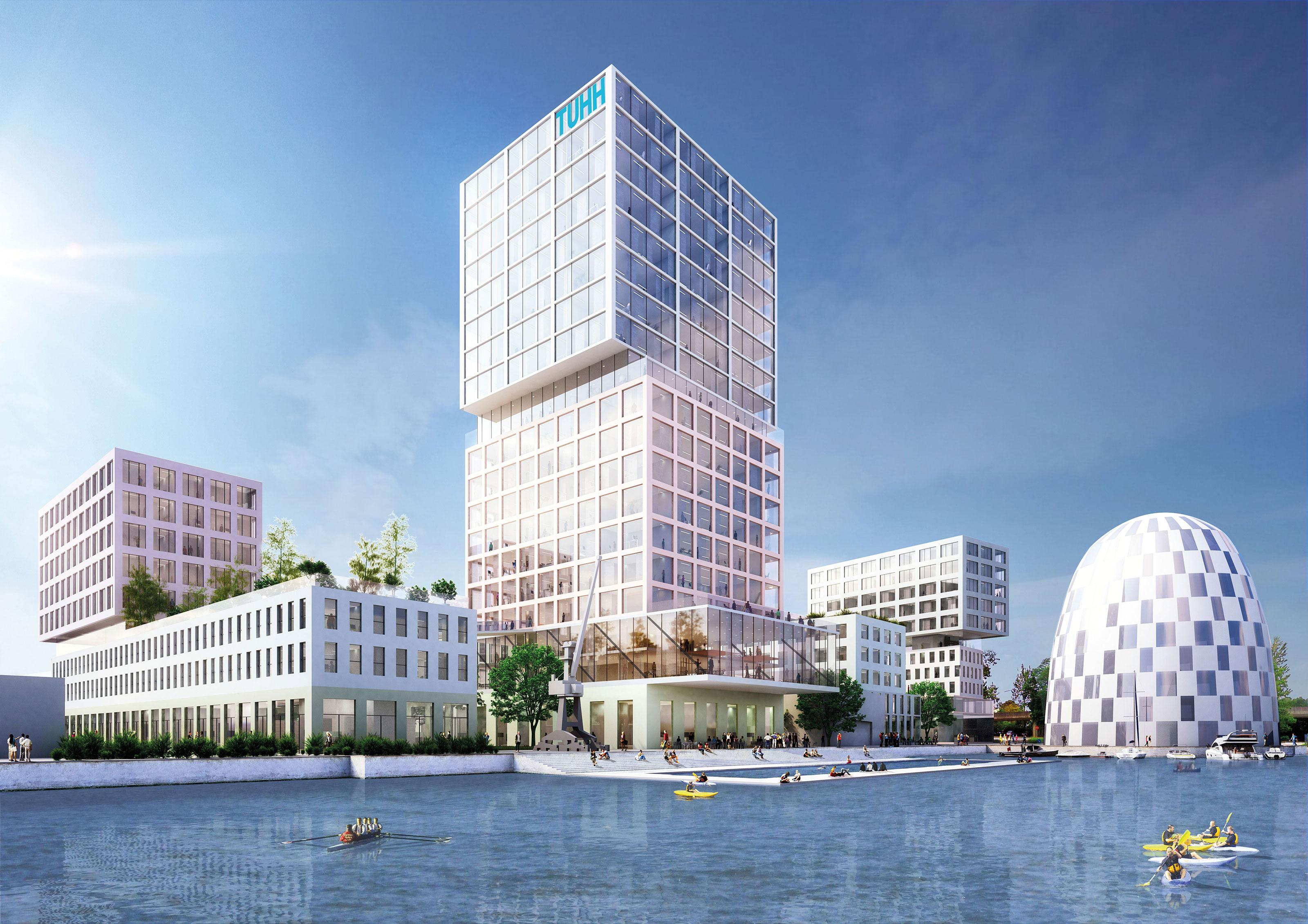
The institute is located in the newly built Hamburg Innovation Port
(www.hamburg-innovation-port.com/wp-content/uploads/2018/09/01-HIPtuhhlogowasser_web.jpg
<https://www.hamburg-innovation-port.com/wp-content/uploads/2018/09/01-HIPtuhhlogowasser_web.jpg>),
which is located right at the Harburg harbour with great views of the
harbour and Hamburg's famous opera house (Elbphilharmonie). Several
other institutes of the TU Hamburg are located in the area, as well as
DASHH - Data Science in Hamburg, the Helmholtz Graduate School for the
Structure of Matter, and the German Air and Space Research Center (DLR).
They are all located in the Free and Hanseatic City of Hamburg, which is
Germany's second largest city, home to a population of about 1.8 million
people. It is a famous city of entertainment, trade and commerce, with
several universities and much research in algorithms.

TU Hamburg offers several attractive benefits, including subsidized
public transport for the Hamburg metropolitan area, a sports centre on
campus, family-friendly working hours, healthy campus initiatives, and more.

An excellent Master degree in Computer Science, (Applied) Mathematics,
Operations Research, Engineering or related field is required. Affinity
with optimization, algorithms, complexity theory, or discrete
mathematics is preferred. The research focus will be on structural and
algorithmic graph theory, and centers around the famous Independent
Spanning Tree Conjecture. Candidates should therefore have an excellent
background in graph theory and/or efficient algorithms. Solid English
mathematical writing skills
and basic teaching experience are desirable.

The position comes with a mild teaching load (10% of work time), which
is generally conducted in English. The salary of the position is
determined according to level TV-L E-13 of the German public sector. The
exact amount of salary depends on experience, family circumstances, tax
classification and other factors. Generous travel funding is available,
for attending conferences and workshops, and visiting other researchers.
Interested individuals should apply using the official application
portal of the vacancy:
https://stellenportal.tuhh.de/jobposting/a608e7f7ed78caf364a17eac5f5fc9670ccc2465.
Applications can also be submitted in English. Applications received by
22 September 2020 will receive full consideration. Applications should
include a curriculum vitae, a letter of motivation, names and contact
information of two references who are acquainted with the applicant's
previous academic and/or research/professional activity, a detailed list
of university courses with grades. Any questions regarding the position
should be directed to Matthias Mnich (matthias.mnich@tuhh.de
<mailto:matthias.mnich@tuhh.de>).

Hamburg University of Technology regards diversity as an integral part
of academic excellence and is committed to employment equity and
accessibility for all employees. As such, we encourage applications from
women, persons with disabilities, members of diverse gender identities,
and others who may contribute to the further diversification of ideas.
In Hamburg, you will have the opportunity to work across disciplines and
collaborate with an international community of scholars and a diverse
student body.


**********************************************************
*
* Contributions to be spread via DMANET are submitted to
*
* DMANET@zpr.uni-koeln.de
*
* Replies to a message carried on DMANET should NOT be
* addressed to DMANET but to the original sender. The
* original sender, however, is invited to prepare an
* update of the replies received and to communicate it
* via DMANET.
*
* DISCRETE MATHEMATICS AND ALGORITHMS NETWORK (DMANET)
* http://www.zaik.uni-koeln.de/AFS/publications/dmanet/
*
**********************************************************

Thursday, September 3, 2020

[DMANET] SIROCCO schedule 2021 and CfP

Dear all,

please note that SIROCCO 2021 will have a new schedule with an earlier
submission deadline already in *November 2020*:

Submission deadline: 26 November 2020, AoE

Notification: 28 January 2021

Camera ready: 25 February 2021

Conference: 28 June - 1 July, 2021

More information and TPC will soon appear on our website:

https://sirocco2021.ii.uni.wroc.pl/

Original papers are solicited from all areas of study of local structural
knowledge and global communication and computational complexities. Among
the typical areas are distributed computing, communication networks, game
theory, parallel computing, social networks, mobile computing (including
autonomous robots), peer to peer systems, and communication complexity.
Keeping with the tradition of SIROCCO, new areas are always welcome.

Tomasz Jurdziński and Stefan Schmid


--


Stefan Schmid

Professor, Computer Science

University of Vienna, Austria

Research Group: https://ct.cs.univie.ac.at/

Personal: https://www.univie.ac.at/ct/stefan/

**********************************************************
*
* Contributions to be spread via DMANET are submitted to
*
* DMANET@zpr.uni-koeln.de
*
* Replies to a message carried on DMANET should NOT be
* addressed to DMANET but to the original sender. The
* original sender, however, is invited to prepare an
* update of the replies received and to communicate it
* via DMANET.
*
* DISCRETE MATHEMATICS AND ALGORITHMS NETWORK (DMANET)
* http://www.zaik.uni-koeln.de/AFS/publications/dmanet/
*
**********************************************************

[DMANET] [EXTENDED DEADLINE] Call for Papers Special Session on Computational Intelligence for Energy Management and Storage [IJCCI 2020]

Dear Colleagues,
we are organising a Special Session on Computational Intelligence for Energy Management and Storage at the International Joint Conference on Computational Intelligence (IJCCI) 2020. Due to COVID-19 issues, IJCCI 2020 will also be held virtually.

Please find below the scope of the session and some related topics.

Scope: The increasing amount of fuel consumption and CO2 pollutions pushed both academia and industrial partners towards the development and implementation of sustainable and advanced energy management strategies. In most cases, the (possibly joint) reduction of costs and emissions leads to the definition of hard optimization problems, possibly mixed-integers and non-convex, which can be solved more effectively (albeit approximately) using computational intelligence techniques.

With this special session, we aim at collecting research and application papers describing current approaches on data-driven modelling for intelligent energy management and storage. This special session aims at being cross-disciplinary: prospective papers may regard neural, fuzzy and evolutionary approaches, or their hybridisation. Surveys and positions papers are also welcome.

Topics include, but are not limited to
• Energy Storage Systems: Modelling, System/Parameters Identification, State of Charge/State of Health Estimation, Cell Balancing
• Design of Energy Management Systems in Scenarios Such as: Smart Grids, Microgrids, Hybrid/Electric Vehicles, Smart Buildings
• Optimal Energy Flows in Smart Grids and Microgrids (Especially Integration with Storage Systems and Renewable Energy Sources)
• Life Cycle Analysis and Optimization of Energy Storage Systems
• Intelligent Control of Hybrid/Electric Vehicles
• Battery Systems: Fast Charging Strategies

Dates [EXTENDED]:
Paper Submission: September 21, 2020
Authors Notification: September 28, 2020
Camera Ready and Registration: October 6, 2020

More info can be found at the dedicated special session website: http://www.ijcci.org/CI4EMS.aspx <http://www.ijcci.org/CI4EMS.aspx>

Looking forward to your contributions.

All the best,
Alessio Martino, PhD

Alessio Martino PostDoctoral Research Fellow
University of Rome "La Sapienza" | Dept. of Information Engineering, Electronics and Telecommunications
p: +39 0644585745 <tel:+39 0644585745>
w: web.uniroma1.it/dip_diet/en <https://web.uniroma1.it/dip_diet/en>
e: alessio.martino@uniroma1.it <mailto:alessio.martino@uniroma1.it>
a: Via Eudossiana 18, 00184 Rome, Italy
<https://www.researchgate.net/profile/Alessio_Martino> <https://www.linkedin.com/in/alessioxmartino> <https://join.skype.com/invite/omvT1LoeWLcF>
This email and its attachments may be confidential and are intended solely for the use of the intended recipient. If you are not the intended recipient of this email and its attachments, you must take no action based upon them, nor must you copy or show them to anyone. Please contact the sender if you believe you have received this email in error. Any views or opinions expressed are solely those of the author and do not necessarily represent those of the University.

--
________________________________________________________
Le informazioni
contenute in questo messaggio di posta elettronica sono strettamente
riservate e indirizzate esclusivamente al destinatario. Si prega di non
leggere, fare copia, inoltrare a terzi o conservare tale messaggio se non
si è il legittimo destinatario dello stesso. Qualora tale messaggio sia
stato ricevuto per errore, si prega di restituirlo al mittente e di
cancellarlo permanentemente dal proprio computer.
The information contained
in this e mail message is strictly confidential and intended for the use of
the addressee only.  If you are not the intended recipient, please do not
read, copy, forward or store it on your computer. If you have received the
message in error, please forward it back to the sender and delete it
permanently from your computer system.

--


**********************************************************
*
* Contributions to be spread via DMANET are submitted to
*
* DMANET@zpr.uni-koeln.de
*
* Replies to a message carried on DMANET should NOT be
* addressed to DMANET but to the original sender. The
* original sender, however, is invited to prepare an
* update of the replies received and to communicate it
* via DMANET.
*
* DISCRETE MATHEMATICS AND ALGORITHMS NETWORK (DMANET)
* http://www.zaik.uni-koeln.de/AFS/publications/dmanet/
*
**********************************************************

[DMANET] CALDAM 2021 CFP [Deadline: September 28, 2020, AoE]

The International Conference on Algorithms and Discrete Applied Mathematics
(CALDAM), held under aegis of the Association for Computer Science and
Discrete Mathematics (ACSDM), is intended to bring together researchers
working in the areas of algorithms and applied discrete mathematics and
provide a high-quality forum for the dissemination and discussion of
research results in these broad areas.

The seventh edition of CALDAM (CALDAM 2021) will be organized by the
Department of Computer Science & Engineering, Indian Institute of
Technology Ropar from 11th to 13th of February 2021.

The conference web page is located at: http://www.iitrpr.ac.in/caldam2021/

The last date for paper submission is September 28, 2020, AoE.

*CALL FOR PAPERS*

IMPORTANT UPDATE: Due to the COVID-19 situation, all authors at CALDAM 2021
now have the option of giving an online talk at the conference, if they
cannot attend the conference physically at IIT Ropar during February 11-13,
2021.

See the registration page (
http://www.iitrpr.ac.in/caldam2021/registration.html) for more details.

CALDAM 2021 invites papers describing original research in the areas of
design, analysis and experimental evaluation of algorithms and in discrete
applied mathematics. Papers must be typeset using LaTeX/LaTeX2e and may not
exceed 12 pages in LNCS style, including bibliographic references. Further
details may be included in a clearly marked appendix that will be read at
the discretion of the program committee. Only electronic submission is
allowed. Submitted papers must describe previously unpublished work and may
not be submitted concurrently to another conference with refereed
proceedings or to a refereed journal.

*CALDAM TOPICS*

Approximation Algorithms | Combinatorial Algorithms | Combinatorial
Optimization | Computational Complexity | Computational Geometry | Data
Structures | Experimental Algorithm Methodologies | Graph Algorithms |
Graph Drawing | Parallel and Distributed Algorithms | Parameterized
Complexity | Network Optimization | Online Algorithms | Randomized
Algorithms | Combinatorics | Graph Theory | Discrete Geometry

*PROCEEDINGS*

As in earlier CALDAMs, the proceedings of accepted papers of CALDAM 2021
will be published in the Lecture Notes in Computer Science by Springer.
Also, selected papers of CALDAM 2021 are likely to be published in a
special issue of Discrete Applied Mathematics (DAM) journal of Elsevier.

*IMPORTANT DATES*

Last date for Paper Submission: September 28, 2020, AoE

Notification of Acceptance: November 8, 2020

Camera-ready Version: November 25, 2020

Conference: February 11-13, 2021

**********************************************************
*
* Contributions to be spread via DMANET are submitted to
*
* DMANET@zpr.uni-koeln.de
*
* Replies to a message carried on DMANET should NOT be
* addressed to DMANET but to the original sender. The
* original sender, however, is invited to prepare an
* update of the replies received and to communicate it
* via DMANET.
*
* DISCRETE MATHEMATICS AND ALGORITHMS NETWORK (DMANET)
* http://www.zaik.uni-koeln.de/AFS/publications/dmanet/
*
**********************************************************

[DMANET] CFP: IEEE Conferences (ISPA, BDCloud, SocialCom, SustainCom), 17-19 December 2020 (Virtual and New Dates)

[Please accept our apologies if you receive multiple copies of this email]


*** IEEE (ISPA-2020, BDCloud-2020, SocialCom-2020, SustainCom-2020
International Conferences) ***


To be held virtually in England, UK, 17-19 December 2020.


The 18th IEEE International Symposium on Parallel and Distributed
Processing with Applications (ISPA-2020)

https://hpcn.exeter.ac.uk/ispa2020


The 10th IEEE International Conference on Big Data and Cloud Computing
(BDCloud-2020)

https://hpcn.exeter.ac.uk/bdcloud2020


The 13th IEEE International Symposium on Social Computing and Networking
(SocialCom-2020)

https://hpcn.exeter.ac.uk/socialcom2020


The 10th IEEE International Conference on Sustainable Computing and
Communications (SustainCom-2020)

https://hpcn.exeter.ac.uk/sustaincom2020


Sponsored by

IEEE, IEEE Computer Society, and IEEE Technical Committee of Scalable
Computing (TCSC)


IMPORTANT DATES

===============

Paper Submission Deadline: 12 September 2020

Authors Notification: 18 October 2020

Camera-Ready Paper Due: 17 November 2020

Early Registration Due: 17 November 2020

Conference Date: 17-19 December 2020

VIRTUAL/REMOTE CONFERENCE

=========================

After evaluating the current COVID-19 situation and associated travel
restrictions, the conference will be held virtually with remote
presentation on 17-19 December 2020 as the safety and well-being of all
conference participants are of the highest priority. Accepted papers will
be submitted for inclusion in IEEE Xplore Digital Library after they are
presented at the virtual conference. The paper submission deadline has been
extended to 12 September 2020 as we understand many are facing unexpected
challenges at this time.


PAPER SUBMISSION GUIDELINE

==========================

All papers need to be submitted electronically through the conference
websites with PDF format. The materials presented in the papers should not
be published or under submission elsewhere. Each paper is limited to 8
pages (or 10 pages with over length charge) including figures and
references using IEEE Computer Society Proceedings Manuscripts style (two
columns, single-spaced, 10 fonts).

Manuscript Templates for Conference Proceedings can be found at

https://www.ieee.org/conferences_events/conferences/publishing/templates.html

Once accepted, the paper will be included into the IEEE conference
proceedings published by IEEE Computer Society Press (indexed by EI).


JOURNAL SPECIAL ISSUES

======================

Distinguished papers selected from the conferences and associated
workshops, after further extensions, will be recommended for submission and
publication in the Special Issues of the following prestigious journals:


- IEEE Transactions on Industrial Informatics

- Computer Networks (Elsevier)

- Future Generation Computer Systems (Elsevier)

- Journal of Parallel and Distributed Computing (Elsevier)

- Knowledge-Based Systems (Elsevier)

- Neurocomputing (Elsevier)

- Information Fusion (Elsevier)

- IEEE/CAA Journal of Automatics Sinica

- IEEE Transactions on Network Science and Engineering

- IEEE ACCESS

- Sensors

**********************************************************
*
* Contributions to be spread via DMANET are submitted to
*
* DMANET@zpr.uni-koeln.de
*
* Replies to a message carried on DMANET should NOT be
* addressed to DMANET but to the original sender. The
* original sender, however, is invited to prepare an
* update of the replies received and to communicate it
* via DMANET.
*
* DISCRETE MATHEMATICS AND ALGORITHMS NETWORK (DMANET)
* http://www.zaik.uni-koeln.de/AFS/publications/dmanet/
*
**********************************************************

[DMANET] CTW2020: REGISTRATIONS ARE OPEN

------------------------------------------------------------------------------
[Please accept our apologies if you receive multiple copies of this email]
-----------------------------------------------------------------------------
REGISTRATIONS ARE OPEN

CTW2020: 18th Cologne-Twente Workshop on Graphs and Combinatorial
Optimization
September 14-16, 2020
ONLINE

PLENARY SPEAKERS:
Dan Bienstock (Columbia University, USA)
Marco Sciandrone (Università di Firenze, Italia)

The complete program is available on

http://ctw2020.iasi.cnr.it

Please note registration is compulsory to attend the conference online.
Registration deadline is September 10.

Thank you very much.

Best regards.
Claudio Gentile.

----------------------------------------------------------------------------
SCOPE
The Cologne-Twente Workshop on Graphs and Combinatorial Optimization 2020
welcomes contributions on theory and applications of discrete algorithms,
graphs, operations research with discrete variables, and combinatorial
optimization in the wider sense.

The series of Cologne-Twente Workshops on Graphs and Combinatorial
Optimization started with meetings organized every two years by the
universities of Cologne and Twente. The organizational base was later
expanded by other universities. Since 2003 the workshop is held (almost)
every year.

CTWs are especially intended to let doctoral students and young researchers
present the results of their research activities in a friendly and highly
interactive atmosphere.


CTW2020 PROGRAM COMMITTEE
Ali Fuat Alkaya, Marmara U.
Christoph Buchheim, TU Dortmund
Francesco Carrabs, U. Salerno
Alberto Ceselli, U. Milano
Roberto Cordone, U. Milano
Ekrem Duman, Ozyegin U.
Yuri Faenza, Columbia U.
Bernard Gendron, IRO – U. Montreal & CIRRELT
Claudio Gentile, IASI-CNR
Johann Hurink, U. Twente
Ola Jabali, Politecnico di Milano
Leo Liberti, CNRS & LIX Polytechnique Palaiseau
Frauke Liers, FAU Erlangen-Nuremberg
Bodo Manthey, U. Twente
Gaia Nicosia, U. Roma Tre
Tony Nixon, U. Lancaster
Andrea Pacifici, U. Roma Tor Vergata
Ulrich Pferschy, U. Graz
Stefan Pickl, U. Bundeswehr München
Michael Poss, LIRMM – U. Montpellier & CNRS,
Bert Randerath, U. Koeln
Giovanni Righini, U. Milano
Heiko Roeglin, U. Bonn
Oliver Schaudt, U. Koeln
Rainer Schrader, U. Koeln
Giuseppe Stecca, IASI-CNR
Frank Vallentin, U. Koeln
Paolo Ventura, IASI-CNR
Maria Teresa Vespucci, U. Bergamo
Angelika Wiegele, Alpen-Adria U. Klagenfurt

CTW2020 ORGANIZING COMMITTEE
Fabio Furini, IASI-CNR & Paris-Dauphine U.
Claudio Gentile, IASI-CNR
Leo Liberti, CNRS-LIX
Gaia Nicosia, U. RomaTre
Andrea Pacifici, U. TorVergata Roma
Giovanni Rinaldi, IASI-CNR
Giuseppe Stecca, IASI-CNR
Paolo Ventura, IASI-CNR

--
*http://ctw2020.iasi.cnr.it <http://ctw2020.iasi.cnr.it>*
*18th Cologne-Twente Workshop on Graphs and Combinatorial Optimization*
*Moving ONLINE - September 14-16, 2020*
--
Claudio Gentile
Istituto di Analisi dei Sistemi ed Informatica "Antonio Ruberti" (IASI-CNR)
Via dei Taurini, 19 - I 00185 Roma Italy.
Tel: +39 06 4993 7128 - Fax: +39 06 49937106 - e-mail: gentile@iasi.cnr.it

**********************************************************
*
* Contributions to be spread via DMANET are submitted to
*
* DMANET@zpr.uni-koeln.de
*
* Replies to a message carried on DMANET should NOT be
* addressed to DMANET but to the original sender. The
* original sender, however, is invited to prepare an
* update of the replies received and to communicate it
* via DMANET.
*
* DISCRETE MATHEMATICS AND ALGORITHMS NETWORK (DMANET)
* http://www.zaik.uni-koeln.de/AFS/publications/dmanet/
*
**********************************************************

[DMANET] SAGT 2020 - Call for Participation

SAGT 2020 - Call for Participation
13th INTERNATIONAL SYMPOSIUM ON ALGORITHMIC GAME THEORY
https://www.uni-augsburg.de/de/fakultaet/mntf/math/prof/opt/team/harks/sagt2020/
September 16 - 18, 2020

SAGT 2020 will be held virtually via zoom and will feature 3 invited talks by
- Dirk Bergemann (Yale)
- Paul Dütting (LSE)
- Ruta Mehta (University of Illinois)

and 24 contributed talks in the areas of
- Stable matchings
- Auctions
- Markets
- Congestion Games
- Games on Graphs
- Scheduling Games
- Flows over Time
- Social Choice
- Cooperative Games
- Voting

The full program is available at
https://www.uni-augsburg.de/de/fakultaet/mntf/math/prof/opt/team/harks/sagt2020/program/

Participation in the symposium is free, but registration is required under
https://www.uni-augsburg.de/de/fakultaet/mntf/math/prof/opt/team/harks/sagt2020/registration/

Tobias Harks and Max Klimm
(on behalf of the PC)
**********************************************************
*
* Contributions to be spread via DMANET are submitted to
*
* DMANET@zpr.uni-koeln.de
*
* Replies to a message carried on DMANET should NOT be
* addressed to DMANET but to the original sender. The
* original sender, however, is invited to prepare an
* update of the replies received and to communicate it
* via DMANET.
*
* DISCRETE MATHEMATICS AND ALGORITHMS NETWORK (DMANET)
* http://www.zaik.uni-koeln.de/AFS/publications/dmanet/
*
**********************************************************

[DMANET] Extended Deadline: First Indo-American Knowledge Graph and Semantic Web Conference (KGSWC-2020)

*#Apologies if you receive multiple posts. *

Dear Researchers


We are organizing the first Indo-American International Conference with the
collaboration of the second Ibero-American International Conference. We
are looking for your contribution. Please contribute your research.

http://www.kgswc.org/

We are also happy to announce the extended submission deadline for
KGSWC-2020.

Important Dates
==============
Submission Deadline: September 15 2020
Notification Due: October 10, 2020
Final Version Due: October 20, 2020

Our Eminent Speakers
==============
1. Prof. Dr. Amit Sheth
2. Prof. Dr. Soren Auer
3. Prof. Dr. Pascal Hitzler
4. Dr. Juan F. Sequeda

Submissions and Proceedings
=============================
KGSWC 2020 invites to submit high-quality unpublished research papers on
the topics of the conference. The submissions cannot be under review or
acceptance for publication in a journal or another conference. The papers
will be reviewed by at least three independent reviewers and submitted for
plagiarism detection check.
The submissions must be written in English using the Springer style
(LNCS/CCIS one-column page format) (http://www.springer.com/
computer/lncs/lncs+authors?SGWID=0-40209-0-0-0
).
We receive full papers (12-15 pages) and short papers (6-8 pages) and may
be submitted in PDF via the Easychair system below:
https://easychair.org/conferences/?conf=kgswc2020

It is planned to publish the proceedings of KGSWC 2020 with Springer in
their Communications in Computer and Information Science (CCIS) series
(approved)

We are looking for your contribution!!!


*Contact us:*

==========

*Dr. Sanju Tiwari *tiwsanju17@gmail.com

--
Best Regards
Dr. Sanju Mishra Tiwari
Member IEEE
Member Machine Intelligence Research Labs(MIR Lab), USA

**********************************************************
*
* Contributions to be spread via DMANET are submitted to
*
* DMANET@zpr.uni-koeln.de
*
* Replies to a message carried on DMANET should NOT be
* addressed to DMANET but to the original sender. The
* original sender, however, is invited to prepare an
* update of the replies received and to communicate it
* via DMANET.
*
* DISCRETE MATHEMATICS AND ALGORITHMS NETWORK (DMANET)
* http://www.zaik.uni-koeln.de/AFS/publications/dmanet/
*
**********************************************************

Wednesday, September 2, 2020

[DMANET] CFP (15 Sep Deadline): 1st WCTCP'2020 with IEEE Healthcom 2020, Shenzhen, China

[Apologies, if you receive multiple copies of this CFP]

Dear Colleagues,

The deadline is approaching fast. Kindly consider submitting your valuable
works to this workshop. Please find the CFP below.

Regards,
M. LAHBY
Workshop Chair

============================================
*CALL FOR PAPERS*
***********************************************************************************
1st International Workshop on Wireless Communication Technologies for
Combating Pandemic (WCTCP'2020)
https://healthcom2020.ieee-healthcom.org/workshops

in conjunction with the IEEE International Conference on E-health
Networking, Application & Services (IEEE Healthcom 2020), December 12-15
2020, Shenzhen, China
https://healthcom2020.ieee-healthcom.org/
***********************************************************************************

==========Scope of the workshop:==========

In the recent time, Coronavirus Disease 2019 (COVID-19) has been declared a
global pandemic impacting nearly 213 countries/territories and the number
of confirmed cases around the world has reached over 11 million. With the
exponential growth of the number of infected people and rapid spread of the
virus over different continents, the attitudes and behaviors concerning
both private users and business users of various technologies have shifted
due to the life under quarantine.

In this context, various wireless communication and positioning
technologies are making a significant impact on critical roles of many
services such as healthcare automation, E-education, E-Commerce, Industry,
supply chain automation, etc. The objective of this workshop is to bring
together researchers and practitioners to discuss how wireless
communication technologies can combat COVID-19 or other pandemic through
facilitating various services as mentioned.

==========Topics ==========

Authors are invited to submit previously unpublished papers to this
workshop.

Topics include, but are not limited to:

Machine Learning for COVID-19 or other pandemic
Deep Learning for COVID-19 or other pandemic
Big Data for COVID-19 or other pandemic
Blockchain technology for COVID-19 or other pandemic
IoT solutions for COVID-19 or other pandemic
Edge computing for COVID-19 or other pandemic
Software-Defined Networking (SDN) solutions for COVID-19 or other
pandemic
5G for combating the COVID-19 or other pandemic
Telemedicine and mHealth solutions
Data mining of medical patient records
Internet of Medical Things (IoMT) for COVID-19 or other pandemic
Security and privacy issues
Cloud Computing Security for COVID-19 or other pandemic
Smart city for combating the COVID-19 or other pandemic
Data model for COVID-19 or other pandemic
Mobile technology solutions for COVID-19 or other pandemic

==========Submission==========:

Paper Submission:

Prospective authors are invited to submit their papers using EDAS via the
following link:
https://www.edas.info/newPaper.php?c=27143

A full paper should not have more than six (6) IEEE style pages including
results, figures and references. Max. 2 extra pages are allowed with extra
charges $75 per page. Papers will be reviewed with the standard reviewing
procedure (with at least 3 independent anonymous reviews).

All of the accepted papers will be published on IEEE Xplore.

During the initial paper submission process via EDAS, it is the authors'
responsibility to ensure that the author list and the paper title of the
submitted PDF file is an exact match to the author list and paper title on
the EDAS registration page. In particular, the EDAS registration page must
include all co-authors, not just the submitting author.

Failure to comply with this rule might result in your paper being withdrawn
from the review process. Please be aware that the author list of an
accepted paper can NOT be changed in the final manuscript.

The submitted manuscripts can be prepared in Word, or Latex using the IEEE
templates, but authors should finally submit the manuscript in PDF format
and make sure that the file will print on a printer that uses letter size
(8.5 x 11) paper. The official language of the meeting is English.

Only PDF files will be accepted for the review process, and all submissions
must be done through EDAS.

TEMPLATES (download from this link):
https://sites.google.com/ucd.ac.ma/wctcp/submission?authuser=0

==========Technically sponsored by: ==========
IEEE Communications Society

===========Important Dates=================
Paper Submission: September 15, 2020
Acceptance Notification: October 15, 2020
Camera Ready Submission: October 31, 2020
Conference Dates: 12-15 December 2020

=============Committees==============

Workshop Chairs

Mohamed LAHBY, University HASSAN II of Casablanca, Morocco,
mohamed.lahby@univh2c.ma
Al-Sakib Khan Pathan, Independent University, Bangladesh,
spathan@ieee.org

Workshop Co-Chairs

Halima Bensmail, Qatar Computing Research Institute-HBKU, Qatar,
hbensmail@hbku.edu.qa
Abderrahim Sekkaki, University HASSAN II of Casablanca,Morocco,
abderahim.sekkaki@univh2c.ma
Utku KOSE, Suleyman Demirel University, Turkey, utkukose@sdu.edu.tr

+++++++++++++++++++++++++++++++++++++++++++++
--


*Dr. M.Lahby*

Laboratory of Mathematics and Applications, University Hassan II, Ecole
Normale Supérieure (ENS) Casablanca, Morocco

mlahby@gmail.com
GSM : +212 6 65 29 23 76
In the world of Linux, who needs Windows and Gates

**********************************************************
*
* Contributions to be spread via DMANET are submitted to
*
* DMANET@zpr.uni-koeln.de
*
* Replies to a message carried on DMANET should NOT be
* addressed to DMANET but to the original sender. The
* original sender, however, is invited to prepare an
* update of the replies received and to communicate it
* via DMANET.
*
* DISCRETE MATHEMATICS AND ALGORITHMS NETWORK (DMANET)
* http://www.zaik.uni-koeln.de/AFS/publications/dmanet/
*
**********************************************************

[DMANET] [ICSOC 2020] Call for Demos and PhD Symposium (Deadlines extended)

[Apologies for multiple cross-posting]


The 18th International Conference on Service-Oriented Computing
- ICSOC 2020 -
December 14-17, 2020
CALL FOR PAPERS (including demonstrations and PhD symposium papers)
Website: https://icsoc2020.connect.rs/
Social links: https://twitter.com/icsoc2020
Submission site: https://www.conftool.com/icsoc2020/

----------------------------------------------------------------------------------------------------------------- Last year ICSOC was run as a presence event similar to all the years before since 2003. But this year, everything will be different: In the spirit of physical distancing, and in order to secure the well-being of the members of the community, we are moving completely into a digital format - with new topics and new ideas. All lectures and discussions can be found in our lecture area that will be available soon. As a result, the participation will be fully free of charge. The participants still need to register to collect their access information though.


ICSOC, the International Conference on Service-Oriented Computing, is the premier international forum for academics, industry researchers, developers, and practitioners to report and share groundbreaking work in service-oriented computing. ICSOC fosters cross-community scientific excellence by gathering experts from various disciplines, such as business-process management, distributed systems, computer networks, wireless and mobile computing, cloud computing, cyber-physical systems, networking, scientific workflows, services science, data science, management science, and software engineering.
************* Call for Demonstrations **********************
https://icsoc2020.connect.rs/call-for-demonstrations/

The goal of the ICSOC Demo track is to provide opportunities for participants from both academia and industry to present their latest development in Service Oriented Computing. The following proposals are particularly welcome:


· Novel Service Applications and Implementations (interactive systems), including:

§ Data Science: Services for Organizing, Curating, Annotating, Linking, Analyzing, Mining and Visualizing Data/Big Data

§ Artificial Intelligence: AI-enabled Services and Process Automation

§ Crowdsourcing Services

§ Internet of Things (IoT) Services

§ Edge Services

· Service-oriented Architecture Showcases

· Testbeds for Service Technologies and Concepts

· Design-support tools (platforms, Open APIs)

· Integration platform for SOA, SaaS, and APIs

· Best practices for microservices and API Engineering


Important dates

- Demonstration submission: September 30, 2020

- Notifications of Acceptance: October 25, 2020

- Camera-ready submission: November 5, 2020

- Authors registration deadline: November 5, 2020

************ Call for PhD symposium papers ****************
https://icsoc2020.connect.rs/call-for-phd-symposium-papers/

The ICSOC Ph.D. Symposium 2020 is an international forum for Ph.D. students working in all areas related to the service-oriented computing. It is intended to bring together Ph.D. students working on foundations, techniques, tools, and applications of service-oriented computing, and provide them an opportunity to present and discuss their research to an audience of peers and senior faculty in a supportive environment, as well as to participate in a number of plenary sessions with service-oriented computing academics.

We particularly encourage Ph.D. students who are still developing their research methodology or are somewhere in the middle of their research program to submit their preliminary results to this symposium.

Important dates

- Submission Deadline: September 30, 2020

- Authors Notification: October 25, 2020

- Camera-ready submission: November 5, 2020

- Authors registration due: November 5, 2020


**********************************************************
*
* Contributions to be spread via DMANET are submitted to
*
* DMANET@zpr.uni-koeln.de
*
* Replies to a message carried on DMANET should NOT be
* addressed to DMANET but to the original sender. The
* original sender, however, is invited to prepare an
* update of the replies received and to communicate it
* via DMANET.
*
* DISCRETE MATHEMATICS AND ALGORITHMS NETWORK (DMANET)
* http://www.zaik.uni-koeln.de/AFS/publications/dmanet/
*
**********************************************************

[DMANET] CALL FOR NOMINATIONS: 16th annual "COIN-OR Cup"

CALL FOR NOMINATIONS: 16th annual "COIN-OR Cup" competition sponsored
by the COIN-OR Foundation.

The COIN-OR Cup recognizes and celebrates the best contributions to
open source operations research software development and use
associated with the COIN-OR software collection. To remind you,
COIN-OR stands for "COmputational INfrastructure for OPerations
Research". It is the definitive collection of free open source
operations research software that lets you concentrate on your
research instead of re-implementing software. See
https://www.coin-or.org. Get on board!

GUIDELINES FOR COIN-OR CUP SUBMISSIONS:

A submission or nomination must contain:
1. A synopsis of an effective use of COIN-OR or valuable contribution
to COIN-OR (or both!), including an explanation of its significance.
Maximum 3 pages (pdf format).
2. Copies of relevant papers or documents (pdf format).
We especially encourage nominations describing effective use of
COIN-OR that the community may not know about.
Self-nominations are welcome and encouraged.

Submission deadline: Friday, October 23, 2020.

Please e-mail your submissions to coin-cup@coin-or.org in a single
zipped archive, containing a description of your submission and copies
of all relevant papers/documents in pdf format.
The winner should accept the prize virtually after the 2020 INFORMS
Annual Meeting so we can all celebrate appropriately (see below).

CELEBRATION:
The 2020 COIN-OR Cup will be awarded at a celebration on Monday,
November 16 after the INFORMS Annual meeting, which will be held
virtually this year.
All entrants, supporters, and other interested parties are welcome to
join the celebration! Details of the event will be announced later.
**********************************************************
*
* Contributions to be spread via DMANET are submitted to
*
* DMANET@zpr.uni-koeln.de
*
* Replies to a message carried on DMANET should NOT be
* addressed to DMANET but to the original sender. The
* original sender, however, is invited to prepare an
* update of the replies received and to communicate it
* via DMANET.
*
* DISCRETE MATHEMATICS AND ALGORITHMS NETWORK (DMANET)
* http://www.zaik.uni-koeln.de/AFS/publications/dmanet/
*
**********************************************************

[DMANET] [Virtual][**14+ Special Issues**][Submission Deadline: Sep. 25] CFP IEEE DependSys 2020: The 6th IEEE International Conference on Dependability in Sensor, Cloud, and Big Data Systems and Applications, Dec. 14-16

[Apologies if you receive multiple copies of this message]
Call For Papers
=============================================================================
The 6th IEEE International Conference on Dependability in Sensor, Cloud,
and Big Data Systems and Applications (IEEE DependSys 2020), 14-16 December
2020
[Virtual][**14+ Special Issues**][Submission Deadline: Sep. 25]

http://cse.stfx.ca/~dependsys/2020/index.html

** NEWS: **
The IEEE DependSys 2020 Conference was planned to be held in Fiji, December
14-16, 2020. Given the COVID-19 pandemic and associated travel
restrictions, as the safety of people is of the highest priority, the
conference will be held virtually on December 14-16, 2020.

IEEE DependSys 2020 conference is the 6th event in the series of
conferences which offers a timely venue for bringing together new ideas,
techniques, and solutions for dependability and its issues in sensor,
cloud, and big data systems and applications. As we are deep into the
Information Age, huge amounts of data are generated every day from sensors,
individual archives, social networks, Internet of Things, enterprises and
Internet in various scales and format which will pose a major challenge to
the dependability of our designed systems. As these systems often tend to
become inert, fragile, and vulnerable after a period of running.
Effectively improving the dependability of sensor, cloud, big data systems
and applications has become increasingly critical.

This conference provides a forum for individuals, academics, practitioners,
and organizations who are developing or procuring sophisticated computer
systems on whose dependability of services they need to place great
confidence. Future systems need to close the dependability gap in face of
challenges in different circumstances. The emphasis will be on differing
properties of such services, e.g., continuity, effective performance,
real-time responsiveness, ability to overcome data fault, corruption,
anomaly, ability to avoid catastrophic failures, prevention of deliberate
privacy intrusions, reliability, availability, sustainability,
adaptability, heterogeneity, security, safety, and so on.


=============================================================================
IEEE DependSys 2020 is sponsored by IEEE, IEEE Computer Society, and IEEE
Technical Committee on Scalable Computing (TCSC). All accepted papers will
be submitted to IEEE Xplore and Engineering Index (EI). Best Paper Awards
will be presented to high quality papers. Distinguished papers, after
further revisions, will be published in 14+ SCI & EI indexed prestigious
journals (confirmed).
1. Information Fusion (IF: 13.669)
SI on Fusion from Big Data to Smart Data
https://www.journals.elsevier.com/information-fusion/call-for-papers/special-issue-on-fusion-from-big-data-to-smart-data
2. Information Fusion (IF: 13.669)
SI on Data Fusion for Trust Evaluation
https://www.journals.elsevier.com/information-fusion/call-for-papers/special-issue-on-data-fusion-for-trust-evaluation
3. IEEE Transactions on Industrial Informatics (IF: 9.112)
SI on Digital Twinning: Integration AI-ML and Big Data Analytics for
Virtual Representation
http://www.ieee-ies.org/images/files/tii/ss/2020/Digital_Twinning_Integrating_AI-ML_and_Big_Data_Analytics_for_Virtual_Representation_2020-4-30.pdf
4. Future Generation Computer Systems (IF: 6.125)
SI on Artificial Intelligence for Cyber Defence and Smart Policing
https://www.journals.elsevier.com/future-generation-computer-systems/call-for-papers/artificial-intelligence-for-cyber-defence-and-smart-policing
5. Digital Communications and Networks (IF: 5.382)
SI on Blockchain-enabled Technologies for Cyber-Physical Systems and Big
Data Applications
http://www.keaipublishing.com/en/journals/digital-communications-and-networks/call-for-papers/blockchainenabled-technologies-for-cyberphysica/
6. IEEE Transactions on Network Science and Engineering (IF: 5.213)
SI on Computing and Networking for Cyber-Physical-Social Systems
https://www.comsoc.org/publications/journals/ieee-tnse/cfp/computing-and-networking-cyber-physical-social-systems
7. IEEE/CAA Journal of Automatics Sinica (IF: 5.129)
SI on Blockchain for Internet-of-Things and Cyber-Physical Systems:
Emerging Trends, Issues and Challenges
http://www.ieee-jas.org/news/news_en/9248195c-6d90-4868-9962-263ed9ba12f3_en.htm
8. Neurocomputing (IF: 4.438)
SI on Edge Intelligence: Neurocomputing Meets Edge Computing
https://www.journals.elsevier.com/neurocomputing/call-for-papers/edge-intelligence-neurocomputing-meets-edge-computing
9. IEEE Access (IF: 3.745)
SI on Reliability in Sensor-Cloud Systems and Applications (SCSA)
https://ieeeaccess.ieee.org/special-sections/reliability-in-sensor-cloud-systems-and-applications-scsa/
10. Journal of Cloud Computing (IF: 2.788)
SI on Security and Privacy Issues for AI in Edge-Cloud Computing
https://journalofcloudcomputing.springeropen.com/securityprivacyaiedgecloud?from=singlemessage
11. Journal of Systems Architecture (IF: 2.552)
SI on Ubiquitous Edge Computing for Next Generation IoT and 6G:
Architecture, Modelling and Systems
https://www.journals.elsevier.com/journal-of-systems-architecture/call-for-papers/ubiquitous-edge-computing-for-next-generation
12. Journal of Systems Architecture (IF: 2.552)
SI on High-Performance-Computing-Communications for Cyber-Physical-Social
Systems
https://www.journals.elsevier.com/journal-of-systems-architecture/call-for-papers/high-performance-computing-communications
13. MDPI Electronics (IF: 2.412)
SI on Blockchain-based Technology for Mobile Application
https://www.mdpi.com/journal/electronics/special_issues/BTMA
14. Software: Practice and Experience
SI on Software and Hardware Co-Design for Sustainable Cyber-Physical
Systems
https://onlinelibrary.wiley.com/pb-assets/assets/page/journal/1097024x/SI_softandhard.pdf

* More special issues will be added later.


==================
Important Dates
==================
Submission Deadline (Hard): 25 September 2020
Authors Notification Date: 25 October 2020
Final Manuscript Due: 15 November 2020
Conference Date: 14-16 December 2020


==================
Topics of interest include, but are not limited to
==================
Track 1: Dependability and Security Fundamentals and Technologies
- Concepts, theory, principles, standardization and modelling, and
methodologies
- Dependability of sensor, wireless, and Ad-hoc networks, software defined
networks
- Dependability issues in cloud/fog/edge
- Security and privacy
- Security/privacy in cloud/fog/edge
- Homomorphic encryption, differential privacy
- Blockchain security
- Artificial intelligence
- Big data foundation and management
- Dependable IoT supporting technologies

Track 2: Dependable and Secure Systems
- Dependable sensor systems
- Dependability and availability issues in distributed systems
- Cyber-physical systems (e.g. automotive, aerospace, healthcare, smart
grid systems)
- Database and transaction processing systems
- Safety and security in distributed computing systems
- Self-healing, self-protecting, and fault-tolerant systems
- Dependability in automotive systems
- Dependable integration
- Dependability in big data systems
- Software system security

Track 3: Dependable and Secure Applications
- Sensor and robot applications
- Big data applications
- Cloud/fog/edge applications
- Datacenter monitoring
- Safety care, medical care and services
- Aerospace, industrial, and transportation applications
- Energy, smart grid, IoT, CPS, smart city, and utility applications
- Decentralized applications, federated learning applications
- Mobile sensing applications, detection and tracking

Track 4: Dependability and Security Measures and Assessments
- Dependability metrics and measures for safety, trust, faith, amenity,
easiness, comfort, and worry
- Levels and relations, assessment criteria and authority
- Dependability measurement, modeling, evaluation, and tools
- Dependability evaluation
- Software and hardware reliability, verification and validation
- Evaluations and tools of anomaly detection and protection in sensor,
cloud, big data systems


==================
Paper Submission
==================
All papers need to be submitted electronically through the conference
submission website (https://edas.info/N27703) with PDF format. The
materials presented in the papers should not be published or under
submission elsewhere. Each paper is limited to 8 pages (or 10 pages with
over length charge) including figures and references using IEEE Computer
Society Proceedings Manuscripts style (two columns, single-spaced, 10
fonts). You can confirm the IEEE Computer Society Proceedings Author
Guidelines at the following web page: http://www.computer.org/web/cs-cps/

Manuscript Templates for Conference Proceedings can be found at:
https://www.ieee.org/conferences_events/conferences/publishing/templates.html

Once accepted, the paper will be included into the IEEE conference
proceedings published by IEEE Computer Society Press (indexed by EI). At
least one of the authors of any accepted paper is requested to register the
paper at the conference.


==================
Organizing Committee
==================
General Chairs
- Mohammad Zulkernine, Queen's University, Canada
- Aniello Castiglione, University of Naples Parthenope, Italy
- Alireza Jolfaei, Macquarie University, Australia

Program Chairs
- Salimur Choudhury, Lakehead University, Canada
- Qinghua Lu, CSIRO, Australia
- Jun Feng, Huazhong University of Science and Technology, China

Steering Committee
- Jie Wu, Temple University, USA (Chair)
- Md Zakirul Alam Bhuiyan, Fordham University, USA (Chair)
- Guojun Wang, Guangzhou University, China
- Vincenzo Piuri, University of Milan, Italy
- Jiannong Cao, Hong Kong Polytechnic University, Hong Kong
- Laurence T. Yang, St. Francis Xavier University, Canada
- Sy-Yen Kuo, National Taiwan University, Taiwan
- Yi Pan, Georgia State University, USA
- A. B. M Shawkat Ali, The University of Fiji, Fiji
- Mohammed Atiquzzaman, University of Oklahoma, USA
- Al-Sakib Khan Pathan, Southeast University, Bangladesh
- Kenli Li, Hunan University, China
- Shui Yu, University of Technology Sydney (UTS), Australia
- Yang Xiang, Swinburne University of Technology, Australia
- Kim-Kwang Raymond Choo, The University of Texas at San Antonio, USA
- Kamruzzaman Joarder, Federation University and Monash University,
Australia


--
Dr. Jun Feng
Huazhong University of Science and Technology
Mobile: +86-18827365073
WeChat: junfeng10001000
E-Mail: junfeng989@gmail.com

**********************************************************
*
* Contributions to be spread via DMANET are submitted to
*
* DMANET@zpr.uni-koeln.de
*
* Replies to a message carried on DMANET should NOT be
* addressed to DMANET but to the original sender. The
* original sender, however, is invited to prepare an
* update of the replies received and to communicate it
* via DMANET.
*
* DISCRETE MATHEMATICS AND ALGORITHMS NETWORK (DMANET)
* http://www.zaik.uni-koeln.de/AFS/publications/dmanet/
*
**********************************************************

[DMANET] Postdoc position/Scientific Coordinator in Vienna

The*Vienna Graduate School on Computational Optimization (VGSCO)*is a
joint research and training program of the*University of Vienna*,*TU
Wien*,*IST Austria*and*Vienna University of Economics and
Business*funded by the*Austrian Science Funds (FWF)*. Its main goal is
to give PhD candidates a comprehensive training in different areas of
optimization with special emphasis on algorithmic and numerical aspects.
It fosters scientific collaboration between the PhD students and their
advisors representing a broad spectrum of topics and areas in the field
of optimization.

The VGSCO currently announces the position of a

Scientific Coordinator

in the area of Computational Optimization.

The position is meant to provide a young scientist in the first years
after obtaining a PhD with support to broaden and deepen his/her
research agenda. Applicants should have successfully completed their PhD
in mathematics, statistics or computer science. He/She will complement
research areas pursued at the VGSCO and will conduct original research
independently. He/She will participate in the Graduate School's
teaching, research and administrative activities and contribute to
linking the Graduate School with the national and international
scientific community, cooperating with other academic
departments/institutions and supporting the PhD students. He/She will
also administrate the series of guest lectures and workshops. Employment
(40 hrs/week) is based on a 3-year contract

The applicants are expected to have an excellent background in
computational optimization and to demonstrate a strong interest in
research in that field as well as an excellent command of written and
spoken English. He/She should have a good record of innovative research
papers, be able to comprehend complex issues and communicate them in a
structured way. He/She should like to work in an international team, be
willing to transfer research standards to PhD students and introduce
them into the scientific network.

Required documents for a successful application include:

·    Completed PhD thesis and degree (certificate and transcripts); if
the defense is not yet accomplished,
     please communicate the date this is envisaged

·    Motivation letter expressing the candidate's visions and expectations

·    CV including scientific interests, publications and scientific
achievements

Applications should be submitted via email tovgsco@univie.ac.at.
Deadline for applications is*September 20, 2020*.

For further information, please contact Prof. Dr. Radu Ioan Boţ at the
Faculty of Mathematics, University of Vienna, atvgsco@univie.ac.at.
Further information on the Vienna Graduate School on Computational
Optimization can be found on the websitehttps://vgsco.univie.ac.at/.

As part of the University we pursue a non-discriminatory employment
policy and value equal opportunities, as well as diversity
(http://diversity.univie.ac.at <http://diversity.univie.ac.at/>). The
university lays special emphasis on increasing the number of women in
senior and in academic positions. Given equal qualifications, preference
will be given to female applicants.


**********************************************************
*
* Contributions to be spread via DMANET are submitted to
*
* DMANET@zpr.uni-koeln.de
*
* Replies to a message carried on DMANET should NOT be
* addressed to DMANET but to the original sender. The
* original sender, however, is invited to prepare an
* update of the replies received and to communicate it
* via DMANET.
*
* DISCRETE MATHEMATICS AND ALGORITHMS NETWORK (DMANET)
* http://www.zaik.uni-koeln.de/AFS/publications/dmanet/
*
**********************************************************

Tuesday, September 1, 2020

[DMANET] Announcement: ICFCA 2021 -- 16th Intern. Conf. on Formal Concept Analysis (June 29 -- July 2, 2021, Strasbourg, France)

================================================================================

 ICFCA 2021

 16th International Conference on Formal Concept Analysis

 June 29 -- July 2, 2021, Strasbourg, France

 Web: <icfca2021.sciencesconf.org>
 Mail: icfca2021@sciencesconf.org

================================================================================

* Overview

Formal Concept Analysis emerged in the 1980's from attempts to restructure
lattice theory in order to promote better communication between lattice
theorists and potential users of lattice theory. Since its early years,
Formal
Concept Analysis has developed into a research field in its own right with a
thriving theoretical community and a rapidly expanding range of
applications in
information and knowledge processing including visualization, data analysis
(mining) and knowledge management and discovery.

The ICFCA conference series aims at bringing together researchers and
practitioners working on theoretical or applied aspects of Formal Concept
Analysis within major related areas such as Mathematics and Computer and
Information Sciences and their diverse applications to fields like Software
Engineering, Linguistics, Life and Social Sciences, etc.

* Topics

Main topics of interest include, but are not limited to:

** Fundamental aspects of FCA

- FCA theory
- Lattice theory
- Lattice drawing
- Philosophical foundations
- Algorithms and complexity theory

** Bridging FCA to information sciences and artificial intelligence

- FCA and logic, e.g., semantic web, description logics
- FCA and conceptual structures, e.g., concept graphs, knowledge spaces
- FCA and data analysis, e.g., hierarchical classification, dataorganization
- FCA and data mining, e.g., pattern mining
- FCA and information retrieval, e.g. exploratory search, navigation,querying
- FCA and machine learning, e.g., learning with hypothesis, feature selection
- FCA and database theory, e.g., dependencies, rules, data cubes
- FCA and software engineering
- FCA and morphological mathematics

** Understanding, modelling real-world data and phenomena with FCA

- Analysis of "big data" with FCA, e.g., sampling, parallel computing
- Analysis of social networks and their dynamics
- Applications for scientific data analysis, e.g., in biology or health care
- Applications for sensors data and user interactions traces
- Other FCA applications

* Submission Details

We invite scientific publications on theory and applications of Formal Concept
Analysis. Papers of up to sixteen pages may be submitted in the PDF format via
the Easychair system. Details will soon be announced on the conference website and in the CfP.


* Important Dates

Submission of abstract: *Junuary 18, 2021*
Submission of full paper: *January 25, 2021*
Notification of acceptance: March 16, 2021
Camera ready due: April 5, 2021
Conference: June 29 -- July 2, 2021

* Organization

The conference will be hosted by Université de Strasbourg

** Conference Chairs

Florence Le Ber, ICUBE, Université de Strasbourg, CNRS, ENGEES, France
Agnès Braud, ICUBE, Université de Strasbourg, CNRS, France

** Program Chairs

Aleksey Buzmakov, Hiher School of Economics, Russia
Tom Hanika, KDE, Universität Kassel, Germany


_______________________________________________
fca-list mailing list
fca-list@cs.uni-kassel.de
https://mail.cs.uni-kassel.de/mailman/listinfo/fca-list

**********************************************************
*
* Contributions to be spread via DMANET are submitted to
*
* DMANET@zpr.uni-koeln.de
*
* Replies to a message carried on DMANET should NOT be
* addressed to DMANET but to the original sender. The
* original sender, however, is invited to prepare an
* update of the replies received and to communicate it
* via DMANET.
*
* DISCRETE MATHEMATICS AND ALGORITHMS NETWORK (DMANET)
* http://www.zaik.uni-koeln.de/AFS/publications/dmanet/
*
**********************************************************

[DMANET] novel works for DCs - OR and optimization (Online Resources, IFORS)

Operational Research for Developing Countries
Novel contributions added --- online

The aim of the IFORS Developing Countries Online Resources page is to offer the OR worker all publicly-available materials on the topic of OR for Development. It also aims to provide a venue for people who are working in the area to share their completed or in-process work, learn from others, and stimulate comments and discussions on the work. Regarding IFORS Developing Countries OR resources website, its regular updates - and your possible submission of "free" (not copyright protected) material, you might occasionally visit

http://ifors.org/developing_countries/index.php?title=Main_Page.

With this open resources page we aim to make research and application results better accessible to the many friends in the Developing Countries. We would be glad about interest.

"Operational Research" (OR) is the discipline of applying advanced analytical methods to help make better decisions. By using techniques such as problem structuring methods and mathematical modelling to analyze complex situations, Operational Research gives executives the power to make more effective decisions and build more productive systems.

The International Federation of Operational Research Societies (IFORS; http://ifors.org/) is an almost 60-year old organization which is currently composed of 51 national societies. Regional Groups of IFORS are: ALIO (The Latin American Ibero Association on Operations Research), APORS (The Association of Asian-Pacific Operational Research Societies), EURO (The Association of European Operational Research Societies), NORAM (The Association of North American Operations Research Societies). IFORS conferences are taking place every three years. On IFORS 2020, Seoul, South Korea, please refer to http://www.ifors2020.kr/.

Thank you very much for your attention.

With kind regards,
best wishes,
Gerhard-Wilhelm Weber

PS: Feedback is welcome via gerhard.weber@put.poznan.pl.
**********************************************************
*
* Contributions to be spread via DMANET are submitted to
*
* DMANET@zpr.uni-koeln.de
*
* Replies to a message carried on DMANET should NOT be
* addressed to DMANET but to the original sender. The
* original sender, however, is invited to prepare an
* update of the replies received and to communicate it
* via DMANET.
*
* DISCRETE MATHEMATICS AND ALGORITHMS NETWORK (DMANET)
* http://www.zaik.uni-koeln.de/AFS/publications/dmanet/
*
**********************************************************

[DMANET] CFP - MAES@ICPR2020 workshop - INVITED TALK ANNOUNCED!

                     MAES2020 workshop at ICPR2020

           ---===== Apologies for multiple posting =====---
          Please distribute this call to interested parties
_______________________________________________________________________

   Machine Learning Advances Environmental Science (MAES@ICPR2020)

                           workshop at the
   25th International Conference on Pattern Recognition (ICPR2020)
                  Milan, Italy, January 10, 2021
         >>> https://sites.google.com/view/maes-icpr2020/ <<<


          S U B M I S S I O N S     A R E    O P E N   ! ! !

    * PLEASE NOTE THAT PAPERS NOT ACCEPTED IN THE ICPR2020 GENERAL *
      SESSION AND FITTING MAES TOPICS COULD BE SUBMITTED HERE !!!

    ----> https://easychair.org/conferences/?conf=maesicpr2020 <----


              /// Submission deadline: 10 October 2020 ///

_______________________________________________________________________

 === Aim & Scope ===

Environmental data are growing steadily in volume, complexity and
diversity to Big Data mainly driven by advanced sensor technology.
Machine learning can offer superior techniques for unravelling
complexity, knowledge discovery and predictability of Big Data
environmental science.

The aim of the workshop is to provide a state-of-the-art survey of
environmental research topics that can benefit from Machine Learning
methods and techniques. To this purpose the workshop welcomes papers on
successful environmental applications of machine learning and pattern
recognition techniques to  diverse domains of Environmental Research,
for instance, recognition of biodiversity in thermal, photo and acoustic
images, natural hazards analysis and prediction, environmental remote
sensing, estimation of environmental risks, prediction of the
concentrations of pollutants in geographical areas, environmental
threshold analysis and predictive modelling, estimation of Genetical
Modified Organisms (GMO) effects on non-target species.

The workshop will be the place to make an analysis of the advances of
Machine Learning for the Environmental Science and should indicate the
open problems in environmental research that still have not properly
benefited from Machine Learning.

Extended papers of this workshop will be published as a special issue in
the journal of Environmental Modelling and Software, Elsevier.


*** Due to the COVID situation, the workShop may be held in a hybrid or
online format. All accepted papers will be published. ***


 === Invited Talk ===

"Harnessing big environmental data by machine learning", prof. Friedrich
Recknagel, School of Biological Sciences, University of Adelaide, Australia

(prof. Recknagel's bio:
http://www.adelaide.edu.au/directory/friedrich.recknagel)
(talk abstract:
https://drive.google.com/file/d/12BFBiG4pwN-6TRKCy0OuGHOgue4YbOKJ/view?usp=sharing)


 === Important Dates ===

-  10 October  2020 - workshop submission deadline
-  10 November 2020 - author notification
-  15 November 2020 - camera-ready submission
-   1 December 2020 - finalized workshop program


 === Organizers ===

  Francesco Camastra, Universita' di Napoli Parthenope, Italy
 Friedrich Recknagel, University of Adelaide, Australia
    Antonino Staiano, Universita' di Napoli Parthenope, Italy


 == Publicity chair ==

      Fabio Bellavia, Universita' di Palermo, Italy

_______________________________________________________________________

 Contacts: antonino.staiano@uniparthenope.it
           francesco.camastra@uniparthenope.it

 Workshop: https://sites.google.com/view/maes-icpr2020/
 ICPR2020: https://www.micc.unifi.it/icpr2020/


**********************************************************
*
* Contributions to be spread via DMANET are submitted to
*
* DMANET@zpr.uni-koeln.de
*
* Replies to a message carried on DMANET should NOT be
* addressed to DMANET but to the original sender. The
* original sender, however, is invited to prepare an
* update of the replies received and to communicate it
* via DMANET.
*
* DISCRETE MATHEMATICS AND ALGORITHMS NETWORK (DMANET)
* http://www.zaik.uni-koeln.de/AFS/publications/dmanet/
*
**********************************************************