Thursday, September 25, 2025

[DMANET] PhD position in Classic and Quantum-Inspired Algorithms at Hamburg University of Technology

PHD POSITION IN CLASSIC AND QUANTUM-INSPIRED ALGORITHMS AT HAMBURG
UNIVERSITY OF TECHNOLOGY (TUHH)

The Institute of Algorithms and Complexity at TUHH: Hamburg University
of Technology (www.algo.tuhh.de) in Hamburg, Germany offers an exciting
opportunity to work as a PhD student at the forefront of
algorithms/optimization and quantum computing.

The successful candidate will research algorithms --- both classic and
quantum-inspired --- for discrete/combinatorial optimization problems,
mathematical programming, algorithmic game theory, or related field. We
provide close supervision and support by a panel of established
professors and scientists. Transferable skills and career development
are an integral part of the PhD program. The working language of the
institute is English.

The position is part of the Hamburg Quantum Computing Project
(https://www.physik.uni-hamburg.de/en/iqp/hqc/about-hqc.html), which is
co-financed by the European Union. Hamburg offers a vibrant and diverse
environment in quantum computing, both on the physics side as well as
the software/algorithms side. Indeed, Hamburg is considered the Quantum
Innovation Capital (https://www.hqic.de/de/), with an entire academic
and industrial ecosystem on quantum computing. Thus, there are many
opportunities for academic and industrial transfer at the forefront of
the quantum computing revolution.

This is a full-time position (100%) which comes with an employment
contract for 3 years and social security. The salary of the position is
determined according to level TV-L E-13 of the German public sector. The
exact amount of salary depends on experience, family circumstances, tax
classification and other factors. Travel funding is available, for
attending conferences and workshops, and visiting other researchers.

The successful candidate will join the TUHH Institute for Algorithms and
Complexity (www.algo.tuhh.de), whose research covers a broad spectrum of
algorithmic research; this includes algorithmic game theory,
combinatorial optimization, approximation and parameterized algorithms,
and applications in operations research and discrete mathematics. The
Institute for Algorithms and Complexity at TU Hamburg currently hosts
several international researchers, so English is used on a daily basis
as a working language.

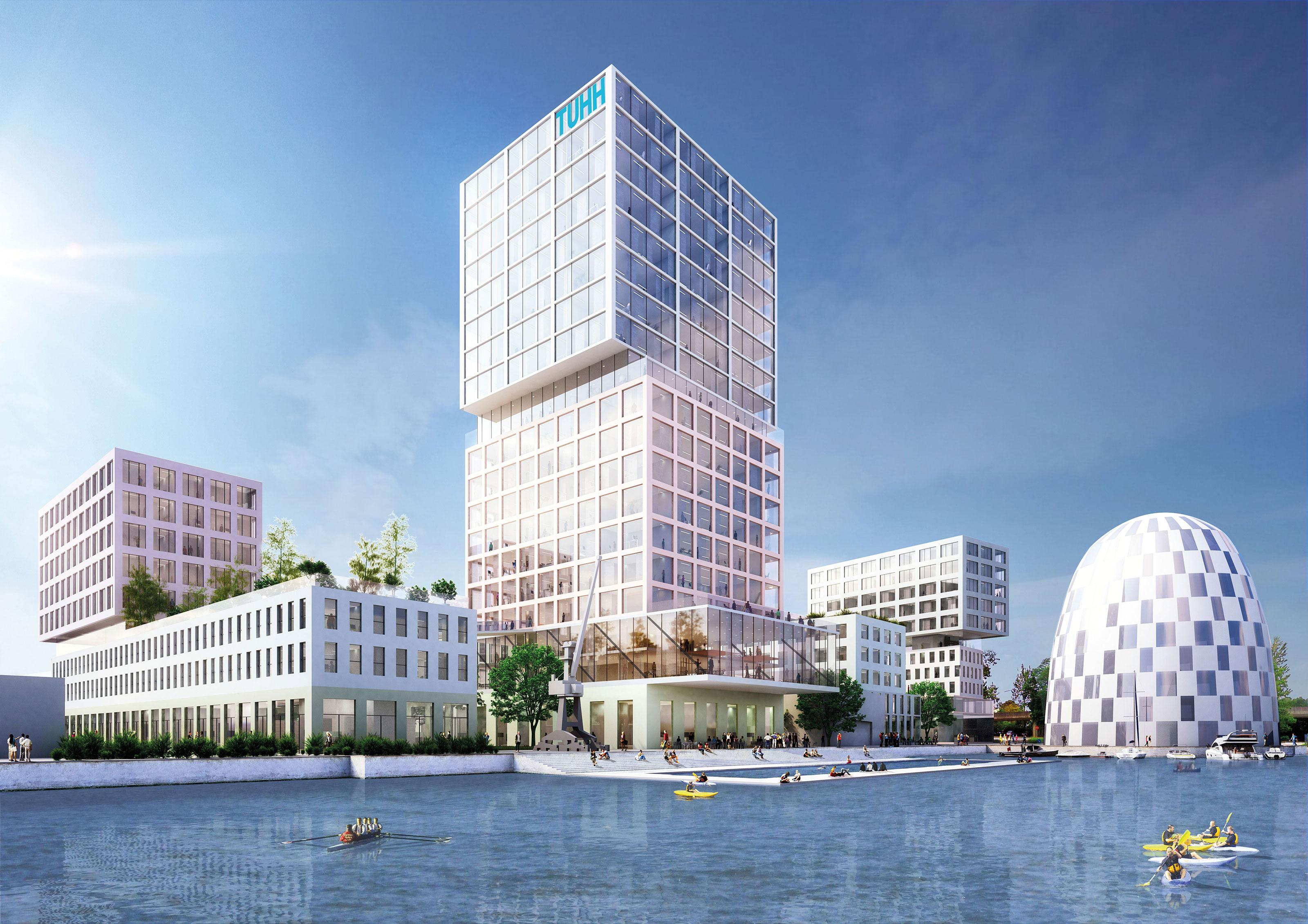
The institute is located in the newly built Hamburg Innovation Port
(www.hamburg-innovation-port.com/wp-content/uploads/2018/09/01-HIPtuhhlogowasser_web.jpg),
which is located right at the Harburg harbour with great views of the
harbour and Hamburg's famous opera house (Elbphilharmonie). Several
other computer science institutes of the TU Hamburg are located in the
area, as well as DASHH - Data Science in Hamburg, the Helmholtz Graduate
School for the Structure of Matter, and the German Air and Space
Research Center (DLR). They are all located in the Free and Hanseatic
City of Hamburg, which is Germany's second largest city, home to a
population of about 1.8 million people. The city is famous for its wide
offers of entertainment, culture and attractions, with several
universities and much research in algorithms.

Hamburg University of Technology (TUHH) is one of the leading technical
universities in Germany, with almost 10,000 students in various
engineering subjects. It is part of Germany's national Strategy of
Excellence. Its goal is to develop Technology for Humanity. For its
staff, it offers several attractive benefits, including a sports centre
on campus, family-friendly working hours, healthy campus initiatives,
and German classes for internationals.

An excellent Masters degree --- either already obtained or to be
completed soon --- in (Applied) Mathematics, Computer Science,
Operations Research, Engineering or related field is required. Affinity
with optimization, algorithms, or discrete mathematics is preferred. In
particular, background in algorithms and complexity, or mathematical
optimization is appreciated. Programming experience is considered a plus.

Interested individuals should submit their applications by 10 October
2025. For a full job description and details on how to apply see
https://www.tuhh.de/algo/jobs/phd-positions.

Hamburg University of Technology regards diversity as an integral part
of academic excellence and is committed to employment equity and
accessibility for all employees. As such, we encourage applications from
women, persons with disabilities, members of diverse gender identities,
and others who may contribute to the further diversification of ideas.
In Hamburg, you will have the opportunity to work across disciplines and
collaborate with an international community of scholars and a diverse
student body.

**********************************************************
*
* Contributions to be spread via DMANET are submitted to
*
* DMANET@zpr.uni-koeln.de
*
* Replies to a message carried on DMANET should NOT be
* addressed to DMANET but to the original sender. The
* original sender, however, is invited to prepare an
* update of the replies received and to communicate it
* via DMANET.
*
* DISCRETE MATHEMATICS AND ALGORITHMS NETWORK (DMANET)
* http://www.zaik.uni-koeln.de/AFS/publications/dmanet/
*
**********************************************************

[DMANET] Call for Submissions: Doctoral Symposium at ACM ICDCN 2026 || Deadline Approaching ||

The deadline for the Doctoral Symposium at ACM ICDCN 2026 is approaching!


Call for Doctoral Symposium

ICDCN 2026 will host a Doctoral Symposium to encourage Ph.D. students to present and discuss their research with peers in their fields. This symposium is best suited for students who already have a plan outlined for their dissertation in the broad areas of Distributed Computing and Computer Networking. The symposium will provide an opportunity for students to obtain helpful feedback on their research from academics and practitioners from leading universities and industries.


PhD students working in any area of the main conference track can submit their research proposal for this symposium.


Eligibility

Those who are enrolled as a full-time student in a Ph.D. program at any university as on date of submission of the proposal are eligible. Ph.D. students with a well-formulated problem and initial technical approach/results are particularly encouraged to apply as they would benefit from the feedback from the symposium. Although this forum is primarily targeted toward Ph.D. students, BS (Undergraduate) and MS (Postgraduate) students who have formulated a research project and obtained some good results will also be considered and hence are encouraged to apply.


Submission Guidelines

Submissions to the Doctoral Symposium should include the following


* Research paper/proposal (max. 2 pages, including references, tables, figures)
* Curriculum Vitae (1 page)

A research paper must include a clear problem statement of the research, technical approaches for the problem, the novelty of the problem and/or the approaches, and the results obtained so far. The student author should be clearly indicated, and the advisor(s) should be listed as co-authors.


Curriculum Vitae must contain the participant's name, affiliation, advisor's name, the theme of research, degrees obtained so far, current status in their degree, and expected graduation date.


All papers must be submitted in PDF format through EasyChair at the following link, selecting "ICDCN 2025 - Doctoral Symposium":


easychair link to submission: https://easychair.org/conferences?conf=icdcn2026


Formatting Instructions

All figures, appendices, and references must fit within the 2-page limit. Paper reviewing is single-blind and submissions should list author names on the front page. Your submission must be in PDF format with all fonts embedded and be formatted according to the official ACM Proceedings format. Submissions that do not meet the page limit, size, and formatting requirements will not be reviewed. Word and LaTeX templates are available here<https://www.acm.org/publications/proceedings-template>. Please note that ACM uses 9-pt fonts in all conference proceedings, and the style (both LaTeX and Word) implicitly define the font size to be 9- pt. Page limit for camera ready submission is 2 pages.


Symposium Details

All submissions will be reviewed following a single-blind review mechanism, and the primary student author of the proposals that are accepted will have the opportunity to give a brief oral presentation at ICDCN. No-show without approval from chairs is not allowed and will lead to the submission being withdrawn from the proceedings. The accepted submissions will be included in the ICDCN proceedings as a 2-page extended abstract. The authors of accepted papers will also get a chance to present their work in a poster format in the session. Specific details of the same will be shared on this page.


There will be the Doctoral Symposium Presentation award based on the feedback received from the evaluation committee.


Important Dates (All the deadlines are in AoE)

Submission deadline: 1st October 2025

Notification deadline: 4th November 2025

Camera-ready deadline: 10th November 2025


Important note to authors about the new ACM open access publishing model


ACM has introduced a new open access publishing model for the International Conference Proceedings Series (ICPS). Authors based at institutions that are not yet part of the ACM Open program and do not qualify for a waiver will be required to pay an article processing charge (APC) to publish their ICPS article in the ACM Digital Library. To determine whether or not an APC will be applicable to your article, please follow the detailed guidance here: https://www.acm.org/publications/icps/author-guidance.


Further information may be found on the ACM website, as follows:


Full details of the new ICPS publishing model: https://www.acm.org/publications/icps/faq.

Full details of the ACM Open program: https://www.acm.org/publications/openaccess.

Please direct all questions about the new model to icps-info@acm.org<mailto:icps-info@acm.org>
The ICDCN Doctoral Symposium provides the opportunity to authors based at institutions that are not yet part of the ACM Open program and do not qualify for a waiver to withdraw from publishing the doctoral symposium paper in the conference proceedings. These authors will still be allowed to present their work at the conference.


Thanks & Regards,
Debasree Das

----

Debasree Das
Research Assistant
Chair of Mobile Systems
University of Bamberg
Webpage: https://debasree08.github.io/debasree/
An der Webrei 5
96047 Bamberg
Room: WE5/05.131


**********************************************************
*
* Contributions to be spread via DMANET are submitted to
*
* DMANET@zpr.uni-koeln.de
*
* Replies to a message carried on DMANET should NOT be
* addressed to DMANET but to the original sender. The
* original sender, however, is invited to prepare an
* update of the replies received and to communicate it
* via DMANET.
*
* DISCRETE MATHEMATICS AND ALGORITHMS NETWORK (DMANET)
* http://www.zaik.uni-koeln.de/AFS/publications/dmanet/
*
**********************************************************

Wednesday, September 24, 2025

[DMANET] [CfP] AI-SEC-2026: The 2nd International Workshop on Artificial Intelligence for Cybersecurity, Victoria University of Wellington, New Zealand (Hybrid conference), April 8-10 2026.

[Apologies if you receive multiple copies of this CfP.]

********************************************************************************
The 2nd International Workshop on Artificial Intelligence for Cybersecurity (AI-SEC-2026), in conjunction with the 40th International Conference on Advanced Information Networking and Applications (AINA-2026) Conference, Victoria University of Wellington, New Zealand (remote participation is possible), April 8-10, 2026.
https://sites.google.com/community.unipa.it/ai-sec2026
********************************************************************************

About the Workshop: The AI-SEC 2026 workshop aims to bring together researchers, industry professionals, and practitioners to discuss the latest advancements in artificial intelligence for cybersecurity. The workshop will focus on innovative AI techniques and real-world applications that strengthen system and network security, counter evolving cyber threats, and ensure the robustness of AI models in distributed environments. Topics of Interest: All topics related to the contribution of artificial intelligence approaches to network and distributed system security are welcome. These include, but are not limited to:
• AI for the detection of threats and anomalies in Software-defined Networking
• AI-Enhanced security for Mobile Ad-hoc Networks and Wearable Systems
• AI-assisted techniques for security in web applications
• Detection and mitigation of AI-enabled cyberattacks
• AI-assisted techniques for network intrusion detection
• Security in IoT and pervasive networks with AI
• AI-assisted authentication and network access control
• Network forensic analysis using AI
• AI-powered malware detection in distributed settings
• AI-based context-aware network diagnostic and threat detection
• AI for data security and privacy in distributed systems
• Vulnerability assessment of AI and related technologies in distributed computing systems
• AI for physical layer and cross-layer security
• Applications of AI methods for wireless and mobile security
• AI-based fault tolerance in distributed systems
• AI-enhanced Trust Management in Multi-agent Systems

SUBMISSION GUIDELINES
We welcome research papers up to 10 pages. Submissions should be made in PDF format following the Lecture Notes Style of Springer Proceedings (template available here: https://voyager.ce.fit.ac.jp/conf/aina/2026/public/For-the-authors-LECTURE-NOTES-TEMPLATES.zip). For detailed submission instructions, please visit https://voyager.ce.fit.ac.jp/conf/aina/2026/Papersummit.

Paper submission link: https://edas.info/newPaper.php?c=34048&track=132262.

All accepted papers will be included in the conference proceedings of the Lecture Notes series published by Springer. Proceedings will be sent by Springer for indexing in SCOPUS. Authors of accepted papers will be given instructions for submitting the camera-ready version and the copyright form.

IMPORTANT DATES
Submission Deadline: November 15, 2025
Author Notification: January 10, 2026
Camera-Ready Submission: January 25, 2026

**********************************************************
*
* Contributions to be spread via DMANET are submitted to
*
* DMANET@zpr.uni-koeln.de
*
* Replies to a message carried on DMANET should NOT be
* addressed to DMANET but to the original sender. The
* original sender, however, is invited to prepare an
* update of the replies received and to communicate it
* via DMANET.
*
* DISCRETE MATHEMATICS AND ALGORITHMS NETWORK (DMANET)
* http://www.zaik.uni-koeln.de/AFS/publications/dmanet/
*
**********************************************************

Tuesday, September 23, 2025

[DMANET] Call for Papers: EvoMUSART 2026 (15th International Conference on AI in Music, Sound, Art & Design)

Call for Papers for the 15th International Conference on Artificial
Intelligence in Music, Sound, Art and Design (EvoMUSART) · Please
distribute · Apologies for cross-posting
------------------------------------------------

The 15th International Conference on Artificial Intelligence in Music,
Sound, Art and Design (EvoMUSART) will take place on 8–10 April 2026, in
Toulouse, France, as part of the evo* event.

*EvoMUSART webpage:* www.evostar.org/2026/evomusart
*Submission deadline:* 1 November 2025
*Conference: *8-10 April 2026
*Location:* Toulouse, France


EvoMUSART is a multidisciplinary conference that brings together
researchers who are working on the application of Artificial Neural
Networks, Evolutionary Computation, Swarm Intelligence, Cellular Automata,
Alife, and other Artificial Intelligence techniques in creative and
artistic fields such as Visual Art, Music, Architecture, Video, Digital
Games, Poetry, or Design.

This conference offers researchers and practitioners in the field an
opportunity to present, promote, and discuss ongoing work in these areas.

Submissions must be at most *14 pages in Springer LNCS format (excluding
references)*. Each submission must be anonymised for a double-blind review
process.

Accepted papers will be presented orally or as posters at the event and
included in the EvoMUSART proceedings published by Springer Nature in a
dedicated volume of the Lecture Notes in Computer Science series.


Indicative topics include, but are not limited to:

- Systems that create drawings, images, animations, sculptures, poetry,
text, designs, webpages, buildings, *etc.;*
- Systems that create musical pieces, sounds, instruments, voices, sound
effects, sound analysis, *etc.;*
- Systems that create artefacts such as game content, architecture,
furniture, based on aesthetic and functional criteria;
- Robotic-based Evolutionary Art and Music;
- Other related artificial or generative techniques in the fields of
Computer Music, Computer Art, *etc.*
- Techniques for automatic fitness assignment;
- Systems in which an analysis or interpretation of the artworks is used
in conjunction with artificial intelligence techniques to produce novel
objects;
- Systems that resort to artificial intelligence approaches to perform
the analysis of image, music, sound, sculpture, or some other types of
artistic object or resource.
- Systems in which artificial intelligence is used to promote the
creativity of a human user;
- New ways of integrating the user in the evolutionary cycle;
- Analysis and evaluation of: the artistic potential of biologically
inspired art and music; the artistic processes inherent to these
approaches; the resulting artefacts;
- Collaborative distributed artificial art environments;
- Contextualisation of creative AI in cultural, economic, social,
political or ecological discourse;
- Computational Aesthetics, Experimental Aesthetics; Emotional Response,
Surprise, Novelty;
- Representation techniques;
- Surveys of the current state-of-the-art in the area; identification of
weaknesses and strengths; comparative analysis and classification;
- Validation methodologies;
- Studies on the applicability of these techniques to related areas;
- New models designed to promote the creative potential of biologically
inspired computation.


More information on the submission process and topics:
www.evostar.org/2026/evomusart

Flyer of EvoMUSART 2026:
http://www.evostar.org/2026/flyers/evomusart

Papers published in previous editions of evoMusArt:
https://evomusart-index.dei.uc.pt


We look forward to seeing you at EvoMUSART 2026 in Toulouse!

The EvoMUSART 2026 organisers
Penousal Machado
Juan J. Romero
Sérgio M. Rebelo (publication chair)

**********************************************************
*
* Contributions to be spread via DMANET are submitted to
*
* DMANET@zpr.uni-koeln.de
*
* Replies to a message carried on DMANET should NOT be
* addressed to DMANET but to the original sender. The
* original sender, however, is invited to prepare an
* update of the replies received and to communicate it
* via DMANET.
*
* DISCRETE MATHEMATICS AND ALGORITHMS NETWORK (DMANET)
* http://www.zaik.uni-koeln.de/AFS/publications/dmanet/
*
**********************************************************

[DMANET] CloudAM 2025 - 14th International Workshop on Cloud and Edge Computing, and Applications Management (Extended hard deadline)

*** CALL FOR PAPERS ***
14th International Workshop on Cloud and Edge Computing, and Applications Management (CloudAM 2025)
In conjunction with the 18th IEEE/ACM International Conference on Utility and Cloud Computing (UCC 2025)
01-04 December, 2025
Nantes, France

https://sites.google.com/unizar.es/cloudam2025

### Background ###
Cloud computing, virtualization and virtualized (eScience) applications have been generating substantial interest in the community for more than a decade, and this interest enabled the development of several architectures, techniques, and mechanisms for cloud and edge computing. With the actual deployment of edge computing infrastructures, exemplified with Fog Computing and Mobile Cloud Computing, the interest in these developments is still prominent. Cloud and edge infrastructures can work together to fulfill requirements from a variety of applications, composing the so-called Cloud Continuum to the edge. Clouds must provide appropriate levels of performance to large groups of diverse users, and those clouds are accessed through virtualized wide area networks, where edge/fog devices can act as a first layer of computing capacity closer to the user. Management systems are essential for that and thereby for the future success of the fog-cloud hierarchy. New systems, methods, and approaches for cloud and edge computing, virtualization and (eScience) applications management are to be discussed at this workshop.

Overall topics of interest include but are not limited to:

- Autonomic cloud computing
- Big data / complex event processing in the cloud-edge hierarchy
- Business models for cloud, fog, and edge computing
- Cloud, fog, and edge APIs
- Cloud, fog, and edge computing environments
- Cloud, fog, and edge data management
- Cloud, fog, and edge load balancing
- Cloud, fog, and edge scalable monitoring
- Cloud, fog, and edge (micro)services orchestration
- Cloud, fog, and edge scheduling
- Computing Continuum - IoT/Smart Cities integration
- Data center management
- Green cloud computing and energy consumption optimization
- Environmental impacts of Clouds
- Hybrid clouds
- Management of virtual slices and virtualized hardware resources
- Mobile clouds and mobile edge computing
- Multi-cloud/Inter-clouds
- Social clouds
- Network-specific mechanisms for optimized cloud access
- Performance modeling & evaluation
- Policy-driven service/resource life-cycle management
- QoS/QoE management
- Security and privacy in the cloud-edge hierarchy
- Self-distributed systems in the cloud-edge hierarchy
- Scientific workflows management and optimization

Important Dates
Paper submission due: 03 October, 2025 (Hard deadline)
Notification to authors: 17 October, 2025
Camera-ready papers due: 20 October, 2025
Workshop date: 01-04 December 2025


Submission Guidelines
The CloudAM workshop invites authors to submit original and unpublished work. Manuscripts are submitted in PDF format and should not exceed 6 pages single-spaced double-column, using the ACM format. Additional pages might be purchased upon the approval of the proceedings chair.

Submission Link on Easychair: https://easychair.org/conferences/?conf=cloudam2025

Submission is double-blind. This means that author information shouldn't be indicated in any part of the submission including acknowledgements, citations, discussion of related work, etc. that would make the authorship apparent. Submissions containing author identifying information may be subject to rejection without review.

Submission requires the willingness of at least one of the authors to register as author, non-student rate and present the paper in person.

At least one author of each paper must be registered for the conference for the paper to be published in the proceedings. The conference proceedings will be published by ACM and made available online via the IEEE Xplore Digital Library and ACM Digital Library.


Please check the CloudAM website for updated information: https://sites.google.com/unizar.es/cloudam2025

WORKSHOP TECHNICAL COMMITTEE
Abderrahmane Maaradji, UDST, Qatar
Amel Benna, CERIST, Algeria
Agustin Caminero, Universidad Nacional de Educacion a Distancia, Spain
Christophe Cerin, Univ. Paris13, France
Claudio Geyer, Federal Univeristy of Rio Grande do Sul, Brazil
Daniel Balouek, Inria, France
Eddy Caron, Univ. Lyon1, France
Felix Freitag, Universitat Politècnica de Catalunya, Spain
Fabio Costa, Federal University of Goias, Brazil
Gleb Radchenko, South Ural State University, Russia
Helio Guardia, Federal University of São Carlo, Brazil
Ioan Petri, Cardiff University, UK
Jose Angel Bañares, University of Zaragoza, Spain
Jeremy Mechouche, Devoteam, France
Luciano Baresi, Politecnico di Milano, Italy
Michael Bauer, University of Western Ontario, Canada
Pedro Valderas, UPV, Spain
Vladimir Vlassov, KTH Royal Institute of Technology, Sweden
Wilson Akio Higashino, Google, USA


WORKSHOP CHAIRS
Carlo Puliafito - University of Pisa, Italy
Laurent Lefevre - Inria, France
Luiz Bittencourt - Universidade Estadual de Campinas (UNICAMP), Brazil
Zakaria Benomar - Thales cortAIx Labs, France


WORKSHOP HONORARY CHAIRS
Bruno Schulze - LNCC, BR
Rafael Tolosana-Calasanz - UNIZAR, ES

**********************************************************
*
* Contributions to be spread via DMANET are submitted to
*
* DMANET@zpr.uni-koeln.de
*
* Replies to a message carried on DMANET should NOT be
* addressed to DMANET but to the original sender. The
* original sender, however, is invited to prepare an
* update of the replies received and to communicate it
* via DMANET.
*
* DISCRETE MATHEMATICS AND ALGORITHMS NETWORK (DMANET)
* http://www.zaik.uni-koeln.de/AFS/publications/dmanet/
*
**********************************************************

[DMANET] || Deadline Extended || Call for Workshop Papers: ICDCN 2026 Workshops

==============================================================
Call for Workshop Papers: ICDCN 2026 Workshops
==============================================================
**** Paper Submission Deadline Extended to 6th Oct., 2025 ****

The 27th International Conference on Distributed Computing and Networking (ICDCN 2026) invites submissions to its accepted workshops, to be held jointly with the conference in Nara, Japan, January 6 to 9, 2026. Submissions are welcomed on the following workshops:

- ASCENT: Advances in Systems and Computation at the Edge and HPC Networks (https://sites.google.com/view/ascent-icdcn2026/)

- DistLLM: 1st Workshop on Reimagining Distributed Computing for LLMs (https://sites.google.com/view/distllm2026/)

- Computing with Deep Neural Networks in Distributed Framework (https://rajatkde.github.io/Workshop-on-Computing-with-Deep-Neural-Networks-in-Distributed-Framework/cfp.html)

- MUSICAL2026: 5th International Workshop on Mobile Ubiquitous Systems, Infrastructures, Communications and AppLications (https://sites.google.com/view/iw-musical2026/)

- IW-NDSC: International Workshop on Networked and Distributed Technologies for Smart Cities (https://sites.google.com/view/iwndsc2026/)

- Industrial Workshop: Real-World Applications and Deployments in Distributed Computing and Networking (https://sites.google.com/view/industrial-icdcn2026)


Submission Details:
- Submission Portal Opens: 1 August 2025
- Paper Submission Deadline: 15 September 2025 => Extended to 6 October 2025
- Notification of Acceptance: 25 October 2025
- Camera-Ready Papers Due: 15 November 2025


All workshop papers must be submitted via the common EasyChair portal for ICDCN 2026: https://easychair.org/conferences?conf=icdcn2026

Prospective authors are encouraged to consult the individual workshop webpages for detailed topics, formats, and submission instructions. Workshops cover edge and HPC networking, distributed intelligence, deep learning frameworks, mobile ubiquitous systems, smart-city technologies, and industrial-scale distributed deployments.

Accepted and presented papers from ICDCN 2026 workshops will be published by The ACM International Conference Proceeding Series (ICPS), which is indexed by ACM, DBLP, Scopus, and other indexing bodies. The proceedings will be available through the ACM digital library.

We look forward to your participation and contributions to the vibrant technical discussions at ICDCN 2026.

=============================================================================
Important note to authors about the new ACM open access publishing model
=============================================================================

ACM has introduced a new open access publishing model for the International Conference Proceedings Series (ICPS). Authors based at institutions that are not yet part of the ACM Open program and do not qualify for a waiver will be required to pay an article processing charge (APC) to publish their ICPS article in the ACM Digital Library. To determine whether or not an APC will be applicable to your article, please follow the detailed guidance here: https://www.acm.org/publications/icps/author-guidance.

Further information may be found on the ACM website, as follows:

- Full details of the new ICPS publishing model: https://www.acm.org/publications/icps/faq.

- Full details of the ACM Open program: https://www.acm.org/publications/openaccess.

Please direct all questions about the new model to icps-info@acm.org<mailto:icps-info@acm.org>.


Thanks & Regards,
Debasree Das

----

Debasree Das
Research Assistant
Chair of Mobile Systems
University of Bamberg
Webpage: https://debasree08.github.io/debasree/
An der Webrei 5
96047 Bamberg
Room: WE5/05.131

**********************************************************
*
* Contributions to be spread via DMANET are submitted to
*
* DMANET@zpr.uni-koeln.de
*
* Replies to a message carried on DMANET should NOT be
* addressed to DMANET but to the original sender. The
* original sender, however, is invited to prepare an
* update of the replies received and to communicate it
* via DMANET.
*
* DISCRETE MATHEMATICS AND ALGORITHMS NETWORK (DMANET)
* http://www.zaik.uni-koeln.de/AFS/publications/dmanet/
*
**********************************************************

[DMANET] AAMAS 2026: First Call for Nominations for the 2026 IFAAMAS Influential Paper Award

*** First Call for Nominations for the 2026 IFAAMAS Influential Paper Award ***

The 25th International Conference on Autonomous Agents and Multiagent
Systems (AAMAS 2026)

May 25-29, 2026, 5* Coral Beach Hotel & Resort, Paphos, Cyprus

http://www.cs.ucy.ac.cy/~george/GPLists_2021/lm.php?tk=ZG1hbmV0CQkJZG1hbmV0QHpwci51bmkta29lbG4uZGUJQUFNQVMgMjAyNjogRmlyc3QgQ2FsbCBmb3IgTm9taW5hdGlvbnMgZm9yIHRoZSAyMDI2IElGQUFNQVMgSW5mbHVlbnRpYWwgUGFwZXIgQXdhcmQJMzg1CUdvb2dsZV9MaXN0cwkxNzUJY2xpY2sJeWVzCW5v&url=https%3A%2F%2Fcyprusconferences.org%2Faamas2026%2F


The International Foundation for Autonomous Agents and Multi-Agent Systems (IFAAMAS)
in 2006 established an award to recognize publications in the autonomous agents and multiagent systems field that have made influential and long-lasting contributions. Candidates for this award are papers that have proved a key result, led to the development of a new subfield, demonstrated a significant new application or system, or simply presented a new way of thinking about a topic that has proved influential. A list of previous winners of this award appears at http://www.cs.ucy.ac.cy/~george/GPLists_2021/lm.php?tk=ZG1hbmV0CQkJZG1hbmV0QHpwci51bmkta29lbG4uZGUJQUFNQVMgMjAyNjogRmlyc3QgQ2FsbCBmb3IgTm9taW5hdGlvbnMgZm9yIHRoZSAyMDI2IElGQUFNQVMgSW5mbHVlbnRpYWwgUGFwZXIgQXdhcmQJMzg1CUdvb2dsZV9MaXN0cwkxNzUJY2xpY2sJeWVzCW5v&url=http%3A%2F%2Fwww.ifaamas.org%2Faward-influential.html .

This award is presented annually at the AAMAS Conference.

Winning papers must have been published at least 10 years before the first day of the conference. Therefore, papers eligible for the 2026 award must have been published earlier than May 2016, and in a recognized scientific forum (e.g., journal, conference, or workshop).

The criteria that will be considered in the selection for the award are:

1. Opened up new research line(s) within and even outside AAMAS;
2. Broad impact, e.g. started new fields, new conferences, new journals;
3. Broadly inspired the community;
4. Posed and/or solved an issue seen as fundamental to the field.

To nominate a publication for this award, please send by October 31, 2025 the full
reference plus a brief statement (200 words or fewer) arguing for the significance of the paper to the chair of the 2026 IFAAMAS Influential Paper Award committee, Maria Gini (gini@umn.edu).

**********************************************************
*
* Contributions to be spread via DMANET are submitted to
*
* DMANET@zpr.uni-koeln.de
*
* Replies to a message carried on DMANET should NOT be
* addressed to DMANET but to the original sender. The
* original sender, however, is invited to prepare an
* update of the replies received and to communicate it
* via DMANET.
*
* DISCRETE MATHEMATICS AND ALGORITHMS NETWORK (DMANET)
* http://www.zaik.uni-koeln.de/AFS/publications/dmanet/
*
**********************************************************

Monday, September 22, 2025

[DMANET] 47th Australasian Combinatorics Conference: early-bird registration closes soon

The 47th Australasian Combinatorics Conference (47ACC) will be held at Victoria University of Wellington, New Zealand, 1-5 December 2025.

The early bird registration deadline closes soon (on 3 October), so get in quick for the early-bird registration price! Registrations will remain open until 14 November.

The invited speakers are:
* Johannes Carmesin, TU Freiberg, Germany
* Katie Clinch, University of Queensland, Australia
* Jim Geelen, University of Waterloo, Canada
* Eunjung Kim, KAIST and DIMAG-IBS, Korea; and CNRS, France
* Karen Meagher, University of Regina, Canada
* Kerri Morgan, RMIT University, Australia
* Luke Morgan, University of Western Australia
* Rajko Nenadov, University of Auckland, New Zealand

As well as invited talks, the conference will consist of contributed talks -- researchers in any area of discrete mathematics and its applications are warmly invited to attend and contribute a talk. Student talks will be eligible to win the CMSA Anne Penfold Street Student Prize for the best student talk at the conference. Registration will automatically include a one-year membership of CMSA, if not already a life member. The conference will also consist of an excursion, a conference dinner, and the CMSA Annual General Meeting. See https://sms.wgtn.ac.nz/events/47ACC for more info.

Organisers: Nick Brettell and Dillon Mayhew.
Contact: 47AustCombCon@gmail.com

**********************************************************
*
* Contributions to be spread via DMANET are submitted to
*
* DMANET@zpr.uni-koeln.de
*
* Replies to a message carried on DMANET should NOT be
* addressed to DMANET but to the original sender. The
* original sender, however, is invited to prepare an
* update of the replies received and to communicate it
* via DMANET.
*
* DISCRETE MATHEMATICS AND ALGORITHMS NETWORK (DMANET)
* http://www.zaik.uni-koeln.de/AFS/publications/dmanet/
*
**********************************************************

[DMANET] EuroVis 2026: Call for workshops - 1 Week left - Submit via PCS

EuroVis 2026: Call for Workshops - 2nd Reminder - PCS Submission Track Available

https://eurovis.org.uk/workshops/

We solicit workshops related to all areas of visualization. These informal workshops in EuroVis provide a setting for participants to discuss advanced topics in visualization, involve experts in the field, disseminate work in progress, and promote new ideas. Workshops at EuroVis are open to all registered attendees ("invitation only" workshops will not be approved).

Important Dates

* Proposal Submission: Monday, September 29, 2025
* Notification: Monday, October 13, 2025

All deadlines are at 11:59 pm (23:59) AoE Anywhere on Earth (AoE<https://time.is/Anywhere_on_Earth>)

Workshops should:

* Emphasize emerging ideas, concepts, or technologies that are currently too nascent or too interdisciplinary for a full symposium;
* Encourage information flow not solely from the presenters to the audience but rather engage the participation of all attendees, for example, through collective or small group discussions.

Possible topics may include emerging or persisting problems, developing research agendas, networking to find common interests and possibilities for cooperation, interacting with domain experts involving analysis of their domain problems, etc.
When choosing workshop topics to propose, please consider pre-approved workshops and try to avoid large overlaps:

* EGPGV
* EuroVA

Note that workshops remain extremely well attended, but as new associated events and publication formats are introduced to EuroVis, the number of submitted papers may drop from previous years. So, a more interactive format (rather than one based mainly on presentations of submitted papers) is encouraged.

Submission requirements

Workshop proposals should include:

* a title,
* the contact details of the organizers,
* a brief description of the organizers' background, related publications, and research,
* the planned activities (e.g., mainly talks, mainly interactive sessions, a mix), including an outline schedule for the program—workshops are strongly encouraged, though not required, to consider ways to engage all participants interactively,
* the intended result and impact of the workshop,
* a brief justification for why this workshop is necessary (e.g., why would the topic benefit from a more informal setting, in what ways is the topic emergent or a relatively poor fit for the main conference program, etc.),
* a chosen measure for a successful CFP (e.g., number of submissions), possibly including an outline for a "backup policy" (e.g., changing the workshop format or voluntarily withdrawing the workshop before acceptance notification is sent, but should not require the workshop organizers to submit emergency papers to their own workshop),
* a statement of the organization and the development of the list of participants (intended size, detailed selection procedures, and timeline for finalizing workshop presenters),
* a list of any special technology needed,
* the number of poster slots requested, if the workshop intends to feature posters, and
* the proposed dates for the call for participation, author notification, and camera-ready deadlines (author notification must be before the early registration deadline for EuroVis; for inclusion of materials in the EG digital library and/or the downloadable proceedings, the camera-ready deadline must be 4 weeks prior to the conference).

Because the number of workshop time slots is limited, half-day workshop proposals are strongly encouraged. However, well-justified full-day proposals will also be considered. Full-day proposals may optionally state what changes would be implemented to allow the workshop schedule to fit within a half day.

If the proposed workshop is a follow-up of a previous workshop, please include a critical reflection of the prior workshop(s), including a discussion of the results and evidence of impact.

The proposal should not exceed four pages. Please use the template file from https://www.eurovis2025.lu/fileadmin/files/egPublStyle-EuroVis_full-short-stars-posters-edu_2025.zip

Attendance

At least one author for each paper must register and attend the conference in person.

Evaluation criteria

The workshops aim to include various topics and a healthy mix of new and recurring events. Repeat submissions will be partially judged by the previous workshop's success. Workshop success will be judged subjectively, but popularity, research impact, visibility, and attendee feedback will all be considered. Specifically, the workshop proposals will be evaluated according to the following criteria:

* The potential for inspiring people, being influential, and opening new lines of research,
* The degree to which the workshop provides a more interactive environment for participants—all things being equal, preference will be given to workshops that emphasize participant interaction,
* The coherence of the proposed topic and the degree to which it would benefit from a workshop environment,
* The ability to attract people and make them excited about the workshop,
* The appropriateness with respect to EuroVis topics,
* If this workshop has special needs, the feasibility of the proposed plan, including financial, logistics, scheduling, and coordination impact, is also important.

The workshop chairs will balance the proposed topics to support the diversity of topics within EuroVis and complement the main program.

Organizers should consider what steps they will take to encourage diverse participants in their workshop (e.g., a balance of experience, background, gender, etc.) to make participation as inclusive as possible.

If accepted, workshops are required to prepare a short summary (50–100 words) for the workshop website and the web program.

Workshop Support

The workshop organizers will receive the following support from the EuroVis conference:

* One complimentary 1-day registration for an invited speaker,
* Room and AV support suitable for around 50 attendees,
* Food and beverages for attendees: coffee breaks throughout the day, Sunday evening opening reception, space in the poster display area, if requested (from a limited pool set aside for standard workshops; available space depends on the specifics of the venue; early requests given priority over late requests),
* PCS (Precision Conference Solutions) support for managing submissions and the review process,
* EuroGraphics Digital Library publication of the workshop proceedings, if requested (considered archival).

Note that each workshop participant will need to register to attend the EuroVis conference.

Workshop Chairs

* Angelos Chatzimparmpas, Utrecht University
* Guido Reina, Universität Stuttgart
* Cagatay Turkay, University of Warwick
**********************************************************
*
* Contributions to be spread via DMANET are submitted to
*
* DMANET@zpr.uni-koeln.de
*
* Replies to a message carried on DMANET should NOT be
* addressed to DMANET but to the original sender. The
* original sender, however, is invited to prepare an
* update of the replies received and to communicate it
* via DMANET.
*
* DISCRETE MATHEMATICS AND ALGORITHMS NETWORK (DMANET)
* http://www.zaik.uni-koeln.de/AFS/publications/dmanet/
*
**********************************************************

[DMANET] Dutch Day on Optimization 2025: Registration and Call for Contributions

Dear all,
Registration for the Dutch Day on Optimization 2025 is now open. The event will take place on November 13th in Tilburg, bringing together the Dutch optimization community. Registration is free, but mandatory for catering purposes.

Please register (deadline: October 26, 23:59 (CEST)) via the following link: https://forms.gle/LLQUSHVuk5TNGXxP8

The day will feature longer invited talks by Karen Aardal (TU Delft), Ahmadreza Marandi (TU Eindhoven) and Ward Romeijnders (University of Groningen). In addition to invited talks, the program will feature seven contributed talks.

Call for Contributed Talks
Contributed talks are a great opportunity to showcase your work to a national audience. Contributed talks of 15 minutes are open to PhD students, postdocs, and assistant professors. We welcome topics from the complete OR spectrum, from theoretical to applied work.

If you are interested in giving a contributed talk, please send a title and abstract (plain text, LaTeX code permitted) to m.h.h.schootuiterkamp@tilburguniversity.edu<mailto:m.h.h.schootuiterkamp@tilburguniversity.edu> by September 30. If we receive more applications than available places, a selection will be made with priority given to PhD students and postdocs. Selected speakers will be informed by October 15.

For more details on the event, program, and updates, please see:
https://www.tilburguniversity.edu/current/events/dutch-day-optimization2025

Feel free to forward this announcement to anyone who might be interested.

Kind regards,
Marleen Balvert, Sander Gribling, Pieter Kleer, Sven Polak, Martijn Schoot Uiterkamp

**********************************************************
*
* Contributions to be spread via DMANET are submitted to
*
* DMANET@zpr.uni-koeln.de
*
* Replies to a message carried on DMANET should NOT be
* addressed to DMANET but to the original sender. The
* original sender, however, is invited to prepare an
* update of the replies received and to communicate it
* via DMANET.
*
* DISCRETE MATHEMATICS AND ALGORITHMS NETWORK (DMANET)
* http://www.zaik.uni-koeln.de/AFS/publications/dmanet/
*
**********************************************************

[DMANET] PhD and postdoc positions at the Hausdorff Center for Mathematics at the University of Bonn

The Hausdorff Center for Mathematics at the University of Bonn is advertising several postdoctoral and PhD positions. Postdoctoral positions are for an initial appointment of two years, and PhD positions for an initial three years. The PhD students will be enrolled in the Bonn International Graduate School of Mathematics.

Please find more information and submit your applications via Mathjobs at the following links:

Postdoc positions (deadline 31. October 2025): https://www.mathjobs.org/jobs/list/27036

PhD positions (deadline 15. November 2025): https://www.mathjobs.org/jobs/list/27038
**********************************************************
*
* Contributions to be spread via DMANET are submitted to
*
* DMANET@zpr.uni-koeln.de
*
* Replies to a message carried on DMANET should NOT be
* addressed to DMANET but to the original sender. The
* original sender, however, is invited to prepare an
* update of the replies received and to communicate it
* via DMANET.
*
* DISCRETE MATHEMATICS AND ALGORITHMS NETWORK (DMANET)
* http://www.zaik.uni-koeln.de/AFS/publications/dmanet/
*
**********************************************************

Sunday, September 21, 2025

[DMANET] Master's and PhD Studies in Discrete Math at the University of Victoria

The Discrete Mathematics Group at the University of Victoria in Canada welcomes applications from candidates interested in pursuing research at the Master's or PhD level starting in September 2026. We have a weekly research seminar and offer graduate level courses on a wide range of topics in discrete math and related topics. Our research areas include a wide range of topics in combinatorics, discrete mathematics, graph theory and algorithms.

* Richard Brewster, adjunct, rbrewster@uvic.ca: graph algorithms, homomorphisms, coverings and packings
* James Currie, adjunct, j.currie@uwinnipeg.ca: combinatorics on words, formal languages
* Peter Dukes, dukes@uvic.ca: designs, codes, hypergraphs, combinatorial matrix theory
* Jing Huang, huangj@uvic.ca: structural and algorithmic aspects of graph theory
* Melissa Huggan, adjunct, Melissa.Huggan@viu.ca: combinatorial game theory, pursuit-evasion game theory
* Lucas Mol, adjunct, lmol@tru.ca: combinatorics on words, formal languages
* Natasha Morrison, nmorrison@uvic.ca: extremal and probabilistic combinatorics
* Jonathan Noel, noelj@uvic.ca: extremal combinatorics with connections to analysis, optimization, probability, statistical physics and computer science

The application deadline is February 1, 2026. Interested students are strongly encouraged to submit their application earlier and to contact potential supervisors before applying.

For more information:
* https://www.uvic.ca/science/math-statistics/future-students/graduate/index.php
* https://www.uvic.ca/graduate/admissions/how-to-apply/index.php
* https://www.uvic.ca/science/math-statistics/home/home/events/seminars/discrete-math/index.php
* https://www.uvic.ca/science/math-statistics/research/home/discrete-math/index.php
* https://www.uvic.ca/science/math-statistics/assets/docs/graduate/graduate-student-handbook-2025-26.pdf
**********************************************************
*
* Contributions to be spread via DMANET are submitted to
*
* DMANET@zpr.uni-koeln.de
*
* Replies to a message carried on DMANET should NOT be
* addressed to DMANET but to the original sender. The
* original sender, however, is invited to prepare an
* update of the replies received and to communicate it
* via DMANET.
*
* DISCRETE MATHEMATICS AND ALGORITHMS NETWORK (DMANET)
* http://www.zaik.uni-koeln.de/AFS/publications/dmanet/
*
**********************************************************

Re: [DMANET] DISC 2025 - Call for Participation

Dear all,

Registration for DISC 2025 is now open:
https://www.disc-conference.org/wp/disc2025/registration/

Please note that the deadline for early registration is very soon (*September
27th, 2025*)!

------
Regards,
William K. Moses Jr.
Publicity Chair, DISC 2025
https://sites.google.com/view/wkmjr

On Mon, Sep 8, 2025 at 5:42 PM William Moses Jr. <wkmjr3@gmail.com> wrote:

>
>
> *========================== DISC 2025 Call for
> Participation ==========================*
>
>
> DISC 2025 will be held in Berlin, Germany on October 27th – October 31st,
> 2025. The list of accepted papers is available online:
> https://www.disc-conference.org/wp/disc2025/accepted-papers/ Conference
> registration will open soon. Information about the venue, how to reach
> Berlin, and the visa support letter can be found here:
> https://www.disc-conference.org/wp/disc2025/local-information/ Information
> about hotels and accommodation can be found here:
> https://www.disc-conference.org/wp/disc2025/accommodation/ The conference
> program appears at
> https://www.disc-conference.org/wp/disc2025/detailed-program/ and its
> highlights include:- Keynote talks byo François Le Gall on *Recent
> developments in quantum distributed computing*o Moni Naor (2025
> Dijkstra Prize winner) on *What Can Be Computed and Verified Locally: A
> Three Decade Perspective*o Ittai Abraham- 14 technical paper
> sessions. Five workshops are organized in cooperation with DISC 2025:-
> ADGA: Workshop on Advances in Distributed Graph Algorithms
> Website: https://adga-workshop.org/2025/- FRIDA: Workshop on Formal
> Reasoning in Distributed Algorithms
> Website: https://frida-2025.github.io/- AMG: Algorithms for Massive
> Graphs
> Website: https://users.aalto.fi/~uittoj3/AMG2025/- HACDA:
> Highlights of Asynchronous Concurrent and Distributed Algorithms
> Website: https://sites.google.com/view/hacda-workshop/- WAND:
> Workshop on Analysis of Network Dynamics
> Website: https://sites.google.com/view/wand2025For the latest updates,
> you can follow us at the following places:X (formerly Twitter):
> https://x.com/podc_discMastodon: https://mathstodon.xyz/@podc_disc
> Bluesky: https://bsky.app/profile/did:plc:uwta43tu2s3cgnmqyjk4y44iIn
> general, you can find info about the community here:
> https://podc-disc.github.io/ See you in Berlin in October!
> --------
> Regards,
> William K. Moses Jr.
> Publicity Chair, DISC 2025
> https://sites.google.com/view/wkmjr
>

**********************************************************
*
* Contributions to be spread via DMANET are submitted to
*
* DMANET@zpr.uni-koeln.de
*
* Replies to a message carried on DMANET should NOT be
* addressed to DMANET but to the original sender. The
* original sender, however, is invited to prepare an
* update of the replies received and to communicate it
* via DMANET.
*
* DISCRETE MATHEMATICS AND ALGORITHMS NETWORK (DMANET)
* http://www.zaik.uni-koeln.de/AFS/publications/dmanet/
*
**********************************************************

[DMANET] [CFP] Special Session in Computational Intelligence applied to Sustainability at EvoStar 2026 (Toulouse, France, April 8-10 2026)

Dear Colleagues

We are happy to invite you to the EvoApps 2026 Special Session in
Computational Intelligence applied to Sustainability.

The application of Computational Intelligence techniques to sustainability
is a fast-growing field, yielding innovative solutions in areas like wind
farm optimization, land use, water distribution, smart grids, and AI-driven
decision support in healthcare.

This special session seeks to bring together researchers and practitioners
to explore the latest advancements in applying Computational Intelligence
to sustainability, with a focus on methodologies that directly or
indirectly address one or more SDGs (https://sdgs.un.org/goals).

Topics of interest include, but are not limited to:

-

Renewable Energy Systems: Optimization of energy generation,
distribution, and storage.
-

Smart Cities: Design and management of resilient, sustainable urban
environments.
-

Agriculture and Food Security: Sustainable farming practices, precision
agriculture, and food supply chain optimization.
-

Environmental Monitoring and Management: Applications in pollution
control, conservation, and natural resource management.
-

Healthcare and Well-being: AI-driven diagnostics, telemedicine, and
optimization of healthcare systems.
-

Water Resources Management: Efficient distribution, usage, and
conservation of water resources.
-

Sustainable Manufacturing and Industry 4.0: Green manufacturing
processes, waste reduction, and lifecycle assessment.
-

Risk Reduction and Management: Early warning systems for natural
disasters, climate change risk assessment, response optimization, and
resilience building.
-

Circular Economy: Strategies for waste minimization, recycling, and
sustainable product design.

We welcome original research, review articles, and case studies that
demonstrate the potential of Computational Intelligence to create
sustainable solutions and drive progress toward the SDGs. Contributions
that highlight interdisciplinary approaches and real-world implementations
are particularly encouraged.

More Information: https://www.evostar.org/2026/evoapps/cis/

Submission Details

-

Page limit: 14 pages, Springer LNCS format.
-

Submission link and details: https://www.evostar.org/2026/submit-paper/

Important Dates

-

Submission deadline: November 1, 2025 (AoE)
-

EvoStar: April 8-10, 2026
-

Toulouse, France
-

Held as part of EvoStar: https://www.evostar.org/2026/

Organisers

-

Valentino Santucci
-

University for Foreigners of Perugia, Italy
-

valentino.santucci(at)unistrapg.it
-

Fabio Caraffini
-

Swansea University, UK
-

Fabio.caraffini(at)swansea.ac.uk
-

Jamal Toutouh
-

University of Malaga, Spain
-

jamal(at)uma.es
-

Lucia Ballerini
-

University for Foreigners of Perugia, Italy
-

lucia.ballerini(at)unistrapg.it


*Prof. Jamal Toutouh*Vice Dean & Tenured Professor
- University of Málaga – jamal@uma.eshttps://neo.lcc.uma.es/new/

🌐 website: jamal.es
🐦 twitter: @jamtou
————————

**********************************************************
*
* Contributions to be spread via DMANET are submitted to
*
* DMANET@zpr.uni-koeln.de
*
* Replies to a message carried on DMANET should NOT be
* addressed to DMANET but to the original sender. The
* original sender, however, is invited to prepare an
* update of the replies received and to communicate it
* via DMANET.
*
* DISCRETE MATHEMATICS AND ALGORITHMS NETWORK (DMANET)
* http://www.zaik.uni-koeln.de/AFS/publications/dmanet/
*
**********************************************************

[DMANET] SMiLE Feb 2026 - 2nd International Conference on Smart Mobility and Logistics Ecosystems, 08-11 Feb' 2026 - KFUPM, Saudi Arabia

***************************************************************************
2nd International Conference on Smart Mobility and Logistics Ecosystems
KFUPM, Dhahran, Kingdom of Saudi Arabia
February, 2026
***************************************************************************

Conference Website: https://smile.kfupm.edu.sa

Important Dates
- Paper Submission Deadline 31 October 2025
- Acceptance Notification 15 December 2025
- Tutorials & Workshops 8 February 2026
- Conference Dates 9,10,11 February, 2026

About SMiLE 2026
Building on the success of the inaugural 1st International Conference on Smart Mobility and Logistics Ecosystems (SMiLE) conference, the IRC Smart Mobility and Logistics at KFUPM proudly invites researchers, industry leaders, and policymakers to the SMiLE 2026. The conference serves as a premier platform for advancing sustainable, intelligent, and resilient mobility and logistics ecosystems through interdisciplinary research, innovation, and collaboration.
Smart mobility and logistics are pivotal in enhancing transportation efficiency, reducing environmental impact, and optimizing urban traffic flow. By leveraging cutting-edge technologies such as IoT, AI, data analytics, autonomous vehicles, electric mobility, and hydrogen-powered solutions, these systems enable real-time monitoring, predictive analytics, and intelligent decision-making. Additionally, advancements in cybersecurity, quantum computing, digital twins, and human-machine collaboration are revolutionizing transportation networks, ensuring resilience, efficiency, and sustainability. These innovations drive the future of connected, automated, and intelligent mobility ecosystems, reducing congestion and emissions while shaping next-generation transport solutions.
SMiLE2026 invites submissions presenting novel and cutting edge research contributing to the scope of the conference.

For paper submission, https://easychair.org/conferences/?conf=smile2026
For registration, please visit https://smile.kfupm.edu.sa/

Keynote Speakers
* Dr. Pascal van Hentenryck, Director of the NSF Artificial Intelligence Institute for Advances in Optimization (AI4OPT), and the Director of Tech-AI, the AI hub at Georgia Tech.
* Dr. Hesam Rakha, Director of Center for Sustainable Mobility, Virginia
* Dr. Ansar Yasir, Micro-Mobility and Traffic, ITS
* Dr. Aboelmagd Noureldin, Professor and Canada Research Chair, Electrical and Computer Engineering, RMC/Queen's University

Conference Highlights
* Keynote Sessions by distinguished global experts in mobility, logistics, and AI
* Panel Discussions featuring leading academics and industry leaders on critical challenges and opportunities
* Industry Showcases & Demos of cutting-edge smart mobility and logistics solutions
* Networking & Collaboration Opportunities with researchers, startups, and policymakers
* Best Paper Awards to recognize outstanding research contributions
* Competitions /hackathon/ideathon etc (school, college & university levels)
* Social Events

Publications
All accepted papers will be published in the conference proceedings and submitted for publication in Procedia Transportation Research, hosted by Elsevier on www.elsevier.com<http://www.elsevier.com> and on the Elsevier content platform ScienceDirect (www.sciencedirect.com<http://www.sciencedirect.com>), and will be freely available worldwide. All papers in Procedia will be indexed by Scopus (www.scopus.com<http://www.scopus.com>).

Conference Tracks
SMiLE 2026 welcomes high-quality original research, case studies, and practical insights in the following key tracks:

* Smart and Resilient Transportation Systems
* Automation, Optimization, and Innovation in Logistics
* Cognitive Cities and Sustainable Transport Ecosystems
* Cognitive Human-Machine Teaming in Mobility and Logistics

Topics include, but not limited to:
1. Smart and Resilient Transportation Systems
* AI-powered Traffic Management and Congestion Control
* Connected, Assisted, and Autonomous Mobility Solutions
* Mobility-as-a-Service (MaaS) and Seamless Multimodal Transport
* Resilient, Secure, and Privacy-Focused Transportation Infrastructure
* AI-Driven Cybersecurity and Threat Mitigation in Transportation
* Predictive Maintenance using AI for Mobility Infrastructure
* Digital Twins and Simulation-Based Planning for Smart Mobility
* Shared Mobility, Ride-hailing, and Smart Micromobility Solutions
* Inclusive Mobility and Accessible Transport Solutions
* Public Transport Innovations and Smart Infrastructure
* AI, IoT, and Behavioral Analytics in Transportation
* Safety, Security, and Privacy in Next-Gen Mobility

2.Automation, Optimization, and Innovation in Logistics
* AI-Driven Resilient and Adaptive Logistics Networks
* Green supply chains and carbon-neutral logistics
* Automation and Robotics in Smart Warehousing and Distribution Centers
* Blockchain for Transparency and Trust in Logistics
* IoT-enabled smart logistics infrastructure
* UAVs for Logistics and Delivery Operations
* Urban Air Mobility (UAM) for Passenger and Freight Transport
* Satellite-based logistics and supply chain solutions
* Smart ports and autonomous maritime logistics
* Digital twins for supply chain efficiency
* Smart cities and intelligent transport infrastructure
* Optimization in Supply Chain Management, including AI and Quantum Computing
* Last-mile Delivery Innovations
* Real-time Freight Tracking and AI-Driven Transport Planning
* Track Platooning
* Cold Chain Logistics and Perishable Goods Transportation
* On-demand and Hyperlocal Logistics
* Cybersecurity and Risk Management in Smart Logistics

3. Cognitive Cities and Sustainable Transport Ecosystems
* Smart Road Infrastructure, Including Intelligent Intersections
* Connected and Autonomous Vehicles (CAV) Infrastructure and 5G/V2X mmunications
* Intelligent Traffic Management and Digitalized Transport Networks
* Urban Air Mobility (UAM) and Water-Based Transport Infrastructure
* Resilient and Cyber-Secure Transport Infrastructure
* Decarbonizing Transportation and Carbon-Neutral Mobility Solutions
* Electrification and Hydrogen Technology for Sustainable Mobility and Logistics
* Sustainable Supply Chain Management and Green Logistics
* Circular Economy and Climate-Resilient Transport Planning
* Smart Grid Integration for Future Transport and Logistics
* Public Policies and Innovations for Sustainable Transportation
* Smart Cities and Intelligent Transport Infrastructure
* Sustainable Multimodal Transport Strategies
* Digital Transformation and Emerging Technologies in Mobility
* Green Infrastructure and Sustainable Urban Mobility Planning
* Next-Generation Intelligent Transport Systems
* 5G & Beyond and Edge Computing for Mobility and Logistics Solutions

4. Cognitive Human-Machine Teaming in Mobility and Logistics
* AI-assisted decision-making for mobility and logistics
* Human-in-the-loop automation in transportation and logistics
* Ethics, trust, and safety in AI-human collaboration
* AI-driven predictive analytics for transport and logistics optimization
* AI-augmented cybersecurity strategies in transportation systems
* Quantum computing for AI-enhanced decision-making in mobility
* Human-centered AI for critical decision-making and operations
* Collaborative intelligence between humans and machines in logistics
* Cognitive systems and explainable AI in transport and logistics

**********************************************************************
DISCLAIMER: The information in this email and its attachments (if any) is intended for the addressee only and may contain confidential or privileged information. If you are not the intended recipient, please delete the email and its attachments from your system and notify the sender immediately. You should not retain, disclose, copy, or use this email or any of its contents for any purpose, nor disclose its contents to any other person. KFUPM is not responsible for changes made to this message after it was sent. Statements and opinions expressed in this e-mail are those of the sender, and do not necessarily reflect those of KFUPM. KFUPM is not liable for any effect or virus damage caused by this message.
إن المعلومات الواردة في هذا البريد الإلكتروني ومرفقاته إن وجدت، قد تكون خاصة أو سرية؛ فإذا لم تكن المقصود بهذه الرسالة؛ فيُرجى منك حذفها ومرفقاتها من نظامك وإخطار المرسل بخطأ وصولها إليك فورا. كما لا يجوز نسخ أي جزء منها أو مرفقاتها ، أو الإفصاح عن محتوياتها لأي شخص أو استعمالها لأي غرض آخر. إن جامعة الملك فهد للبترول والمعادن لا تتحمل مسؤولية التغييرات التي يتم إجراؤها على هذه الرسالة بعد إرسالها. وإن البيانات أو الآراء المعبر عنها في هذا البريد، هي بيانات تخص مُرسلها، ولا تعكس بالضرورة رأي وبيانات الجامعة. كما لا تتحمل الجامعة مسؤولية أي تأثير ينتج عن هذه الرسالة أوعن أي فيروس قد تحمله.

**********************************************************
*
* Contributions to be spread via DMANET are submitted to
*
* DMANET@zpr.uni-koeln.de
*
* Replies to a message carried on DMANET should NOT be
* addressed to DMANET but to the original sender. The
* original sender, however, is invited to prepare an
* update of the replies received and to communicate it
* via DMANET.
*
* DISCRETE MATHEMATICS AND ALGORITHMS NETWORK (DMANET)
* http://www.zaik.uni-koeln.de/AFS/publications/dmanet/
*
**********************************************************

Saturday, September 20, 2025

[DMANET] PhD Position (100 %) in Discrete Mathematics & AI at UTN (Nuremberg, Germany)

The Applied Discrete Mathematics Lab (Prof. Christoph Hertrich) at the
University of Technology Nuremberg is currently offering an opening for
a doctoral research opportunity (3 years, 100%, TVL-13), as part of the
interdisciplinary project "FoMoMath: Collaborative Foundation Models for
Mathematics". We are seeking a highly motivated and talented individual
to join our dynamic and international research team. You will contribute
to developing AI systems that can effectively collaborate with
mathematicians, and apply these and other AI tools to advance research
in discrete geometry, optimization, and related areas. The ideal
candidate has a solid mathematical background with a strong interest in
discrete mathematics and is eager to use and further develop AI tools,
including large language models, reinforcement learning, and related
approaches. You will be primarily supervised by Prof. Christoph Hertrich
(Applied Discrete Mathematics Lab), with co-supervision from Prof. Yuki
Asano (Fundamental AI) and Prof. Steffen Eger (Natural Language Learning
and Generation), ensuring deep interdisciplinary collaboration.

All details about this opening (for candidates with strong mathematical
background) can be found here:
https://jobs.utn.de/jobposting/e50104fc1c7efa068b6066608eaff0ca3bca64da0

Within the same project, we have another opening for candidates with a
stronger background in machine learning / AI, advised by Prof. Yuki
Asano (Fundamental AI):
https://jobs.utn.de/jobposting/f5df57d7296d49be224b80f7ae3c8598e799541a0

Applications will be reviewed on a rolling basis. To receive full
consideration, please apply until 02.11.2025. Applications received
after that date might still be considered.

**********************************************************
*
* Contributions to be spread via DMANET are submitted to
*
* DMANET@zpr.uni-koeln.de
*
* Replies to a message carried on DMANET should NOT be
* addressed to DMANET but to the original sender. The
* original sender, however, is invited to prepare an
* update of the replies received and to communicate it
* via DMANET.
*
* DISCRETE MATHEMATICS AND ALGORITHMS NETWORK (DMANET)
* http://www.zaik.uni-koeln.de/AFS/publications/dmanet/
*
**********************************************************

[DMANET] AIces 2026: early registration October 4

******************************************************

1st INTERNATIONAL SCHOOL ON THE COGNITIVE, ETHICAL AND SOCIETAL DIMENSIONS OF ARTIFICIAL INTELLIGENCE

AIces 2026

Porto – Maia, Portugal

March 30 – April 3, 2026

https://aices.irdta.eu/2026/

******************************************************

Co-organized by:

University of Maia

Institute for Research Development, Training and Advice – IRDTA
Luxembourg/London

******************************************************

Early registration: October 4, 2025

******************************************************

SCOPE:

AIces 2026 will be the first in a series of research training events aiming at updating participants on the most recent multidisciplinary discussions about the foundations, meaning, challenges and risks of AI.

The event will have a global scope along 3 thematic lines: cognition, ethics, and society. It will cover current debates about: AI and philosophy of mind; cognitive architectures; machine learning and cognitive development; large language models and visual information; robotics and embodied cognition; neuroscience-inspired AI; algorithmic bias and fairness; transparency and explainability; accountability and responsibility; privacy and surveillance; autonomy and control; AI impact on human values and social inequalities; the future of work and automation; governance, regulation and public policies; AI, human rights and democracy; AI and global development; information and AI education.

The event will consist of 12 courses, 2 keynote lectures, 1 round table, 1 symposium collecting short contributions from participants, and 3 open thematic debate sessions. Renowned academics and industry pioneers will lecture and share their views with the audience. The organizers are convinced that outstanding speakers will attract the brightest and most motivated students. Face to face interaction and networking will be main ingredients of the event. It will be also possible to fully participate in vivo remotely.

ADDRESSED TO:

Graduate students, postgraduate students and industry practitioners will be typical profiles of participants. However, there are no formal pre-requisites for attendance in terms of academic degrees, so people less or more advanced in their career will be welcome as well.

Since there will be a variety of levels, specific knowledge background may be assumed for some of the courses.

Overall, AIces 2026 is addressed to students, researchers and practitioners who want to keep themselves updated about recent developments and future trends. All will surely find it fruitful to listen to and discuss with major researchers, industry leaders and innovators.

VENUE:

AIces 2026 will take place in Porto, the second largest city in Portugal, recognized by UNESCO in 1996 as a World Heritage Site. The venue will be:

University of Maia
Avenida Carlos de Oliveira Campos - Castêlo da Maia
4475-690 Maia
Porto, Portugal

https://www.umaia.pt/en

STRUCTURE:

2 courses will run in parallel during the whole event. Participants will be able to freely choose the courses they wish to attend as well as to move from one to another.

Full live online participation will be possible. The organizers highlight, however, the importance of face to face interaction and networking in this kind of research training event.

All lectures will be videorecorded. Participants will be able to watch them again for 45 days after the event.

KEYNOTE SPEAKERS: (to be completed)

Ming Lin (University of Maryland), Socially Responsible and Trustworthy AI

PROFESSORS AND COURSES: (to be completed)

Ricardo Baeza-Yates (Barcelona Supercomputing Center), [introductory] Introduction to Responsible AI

Thomas Breuel (Nvidia Research), [introductory] Facts and Rules in LLMs

Carlos Castillo (Pompeu Fabra University), [introductory] Algorithmic Fairness in High-Risk AI Applications

Alan Dix (Cardiff Metropolitan University), [introductory] AI for Social Justice

Elia Formisano (Maastricht University), [introductory/intermediate] Auditory Cognition in Humans and Machines

Marijn Janssen (Delft University of Technology), [introductory/advanced] Data and AI Governance - From Control to Trust

Christian Lebiere (Carnegie Mellon University), [intermediate] Computational Cognitive Models of Human-AI Teaming

Paul Smolensky (Johns Hopkins University), [intermediate/advanced] Symbol Processing in Transformers and Other Neural Networks

SYMPOSIUM:

A half-day symposium will collect 10-minute voluntary presentations by participants on any of the 3 thematic areas of the event. A 1-page abstract containing the title, authors, and summary of the presentation must be sent to david@irdta.eu by February 28, 2026.

OPEN DEBATES:

A 3-hour open debate session will be organized for each of the 3 thematic areas of the school: cognition, ethics and society. Expressions of interest to lead the respective sessions will be accepted until December 30, 2025 at david@irdta.eu . A 2-page description must be sent including the topics to be debated as well as the structure, call for contributions and dynamics of the session.

SPONSORS:

Companies/institutions/organizations willing to be sponsors of the event can download the sponsorship leaflet from

https://aices.irdta.eu/2026/sponsors/

ORGANIZING COMMITTEE:

Samuel Anjos (Maia, social networks)
Osheen Jain (London, communications)
José Paulo Marques dos Santos (Maia, local chair)
Carlos Martín-Vide (Tarragona, program chair)
Santiago Montes (Tarragona, webpage)
Sara Morales (Luxembourg)
José Luís Reis (Maia)
Luís Paulo Reis (Porto)
David Silva (London, organization chair)

REGISTRATION:

It has to be done at

https://aices.irdta.eu/2026/registration/

The selection of 6 courses requested in the registration template is only tentative and non-binding. For logistical reasons, it will be helpful to have an estimation of the respective demand for each course.

Since the capacity of the venue is limited, registration requests will be processed on a first come first served basis. The registration period will be closed and the on-line registration tool disabled when the capacity of the venue will have got exhausted. It is highly recommended to register prior to the event.

FEES:

Fees comprise access to all program activities and lunches.

There are several early registration deadlines. Fees depend on the registration deadline.

The fees for on site and for online participation are the same.

ACCOMMODATION:

Accommodation suggestions will be available in due time at

https://aices.irdta.eu/2026/accommodation/

CERTIFICATE:

A certificate of successful participation in the event will be delivered indicating the number of hours of academic activities. This should be sufficient for those participants who plan to request ECTS recognition from their home university.

QUESTIONS AND FURTHER INFORMATION:

david@irdta.eu

ACKNOWLEDGMENTS:

Universidade da Maia

Universidade do Porto

Universitat Rovira i Virgili

Institute for Research Development, Training and Advice – IRDTA, Luxembourg/London
**********************************************************
*
* Contributions to be spread via DMANET are submitted to
*
* DMANET@zpr.uni-koeln.de
*
* Replies to a message carried on DMANET should NOT be
* addressed to DMANET but to the original sender. The
* original sender, however, is invited to prepare an
* update of the replies received and to communicate it
* via DMANET.
*
* DISCRETE MATHEMATICS AND ALGORITHMS NETWORK (DMANET)
* http://www.zaik.uni-koeln.de/AFS/publications/dmanet/
*
**********************************************************

Friday, September 19, 2025

[DMANET] Assistant professor position in Theoretical Computer Science at University of Victoria in BC, Canada

Dear Colleagues,

We invite applications for a tenure-track position at the assistant professor level in Theoretical Computer Science to commence July 1, 2026. The Department has a strong and active Theory Group with members doing research in TCS areas, including algorithms, complexity, cryptography and logic.

Please see the ad for details: https://www.uvic.ca/faculty-staff/careers/faculty-and-librarian-postings/current/cosi_220_146.php
The deadline for applications is September 22, 2025.

Sincerely,
Valerie King


**********************************************************
*
* Contributions to be spread via DMANET are submitted to
*
* DMANET@zpr.uni-koeln.de
*
* Replies to a message carried on DMANET should NOT be
* addressed to DMANET but to the original sender. The
* original sender, however, is invited to prepare an
* update of the replies received and to communicate it
* via DMANET.
*
* DISCRETE MATHEMATICS AND ALGORITHMS NETWORK (DMANET)
* http://www.zaik.uni-koeln.de/AFS/publications/dmanet/
*
**********************************************************

[DMANET] PhD position

I am an assistant professor in the Computer Science department at West
Virginia University. I have a paid position available for a PhD student
in the field of linear programming and game theory. Contact me at
pwojciec@mail.wvu.edu if you are interested.

Dr. Piotr Wojciechowski
Assistant Professor,
LDCSEE,
West Virginia University

**********************************************************
*
* Contributions to be spread via DMANET are submitted to
*
* DMANET@zpr.uni-koeln.de
*
* Replies to a message carried on DMANET should NOT be
* addressed to DMANET but to the original sender. The
* original sender, however, is invited to prepare an
* update of the replies received and to communicate it
* via DMANET.
*
* DISCRETE MATHEMATICS AND ALGORITHMS NETWORK (DMANET)
* http://www.zaik.uni-koeln.de/AFS/publications/dmanet/
*
**********************************************************

[DMANET] AAIS 2025: The International Symposium on Agentic Artificial Intelligence Systems , November 25-28, 2025 •Vienna, Austria

[Apologies if you got multiple copies of this invitation]

The International Symposium on Agentic Artificial Intelligence Systems
(AAIS 2025)

https://fllm-conference.org/2025/Workshops/AAIS2025/

Co-Located with

The 3rd International Conference on Foundation and Large Language Models
(FLLM2025) <https://fllm-conference.org/2025/>

November 25-28, 2025 •Vienna, Austria

Technically Co-Sponsored by IEEE Austrian Section

*AAIS 2025 CFP:*

The growth of Agentic AI marks a transformative increase in the evolution
of intelligent systems, this varies from reactive models to proactive
agents capable of autonomous reasoning, decision-making, and adaptive
behavior. As these intelligent agents begin to saturate domains such as
healthcare, robotics, education, finance, and scientific discovery, the
urgency to explore their full potential has never been greater. AAIS 2025
invites high-quality, original submissions from academia, research
institutions, industry, and government agencies that push the frontiers of
agentic AI. We seek contributions that explore the design, implementation,
evaluation, and governance of agentic systems with an emphasis on
purposeful action, collaboration, and ethical alignment in dynamic,
real-world settings. This symposium aims to become a premier venue for
researchers, developers, and innovators building autonomous AI systems that
do more than predict. Those intelligent systems can plan, act, learn, and
evolve efficiently.

Authors are invited to submit their original work, which is not submitted
elsewhere, to this Symposium. The accepted papers of the Symposium will be
published by the IEEE Conference Publishing Services (CPS) and will be
submitted for inclusion in the IEEE-Xplore and the IEEE Computer Society
(CSDL) digital libraries. We invite the submission of original papers on
all related topics related to AAIS, with special interest in but not
limited to:

- Human-Agent Interaction and Social Intelligence
- Learning Paradigms for Agentic AI
- Applications and Domain-Specific Agents
- Simulation, Evaluation, and Benchmarking
- Agent Architectures and Cognitive Models
- Security, Regulation, and Governance
- Goal-Oriented Planning and Decision-Making
- Multi-Agent Systems and Emergent Intelligence
- Applications and trends

* Submissions Guidelines and Proceedings*

Manuscripts should be prepared in 10-point font using the IEEE 8.5" x 11"
two-column format. All papers should be in PDF format, and submitted
electronically at Paper Submission Link. A full paper can be up to 6 to 8
pages (including all figures, tables and references). Submitted papers must
present original unpublished research that is not currently under review
for any other conference or journal. Papers not following these guidelines
may be rejected without review. Also submissions received after the due
date, exceeding length limit, or not appropriately structured may also not
be considered. Authors may contact the Program Chair for further
information or clarification. All submissions are peer-reviewed by at least
three reviewers. Accepted papers will appear in the FLLM Proceeding, and be
published by the IEEE Computer Society Conference Publishing Services and
be submitted to IEEE Xplore for inclusion. Submitted papers must include
original work, and must not be under consideration for another conference
or journal. Submission of regular papers up to 8 pages and must follow the
IEEE paper format. Please include up to 7 keywords, complete postal and
email address, and fax and phone numbers of the corresponding author.
Authors of accepted papers are expected to present their work at the
conference. Submitted papers that are deemed of good quality but that could
not be accepted as regular papers will be accepted as short papers.

*Important Dates:*

· Submission Deadline: September 30, 2025

· Decisions Announced: October 10, 2025

· Camera Ready Deadline: October 25, 2025

*Contact:*

Please send any inquiry to: <emergingtechnetwork@gmail.com> Shadi AlZu'bi (
smalzubi@zuj.edu.jo)

**********************************************************
*
* Contributions to be spread via DMANET are submitted to
*
* DMANET@zpr.uni-koeln.de
*
* Replies to a message carried on DMANET should NOT be
* addressed to DMANET but to the original sender. The
* original sender, however, is invited to prepare an
* update of the replies received and to communicate it
* via DMANET.
*
* DISCRETE MATHEMATICS AND ALGORITHMS NETWORK (DMANET)
* http://www.zaik.uni-koeln.de/AFS/publications/dmanet/
*
**********************************************************